


Quick Answer: Who Is Chi Zijian?
Chi Zijian (迟子建, Chí Zǐjiàn), born in Mohe in 1964, is a Chinese writer whose fiction frequently draws on the landscapes and lives of the northeast. Her range includes forests, mountain towns and urban households. [1]
- Choose a forest-based family narrative if you want to follow memory across a long span of historical change.
- Choose an urban story of two women sharing a home if you want a more concentrated relationship at its centre.
- Check the translator and edition: a complete English book and a translated sample offer different reading experiences.
Her work repays attention to the particular speaker, community and structure of each story.
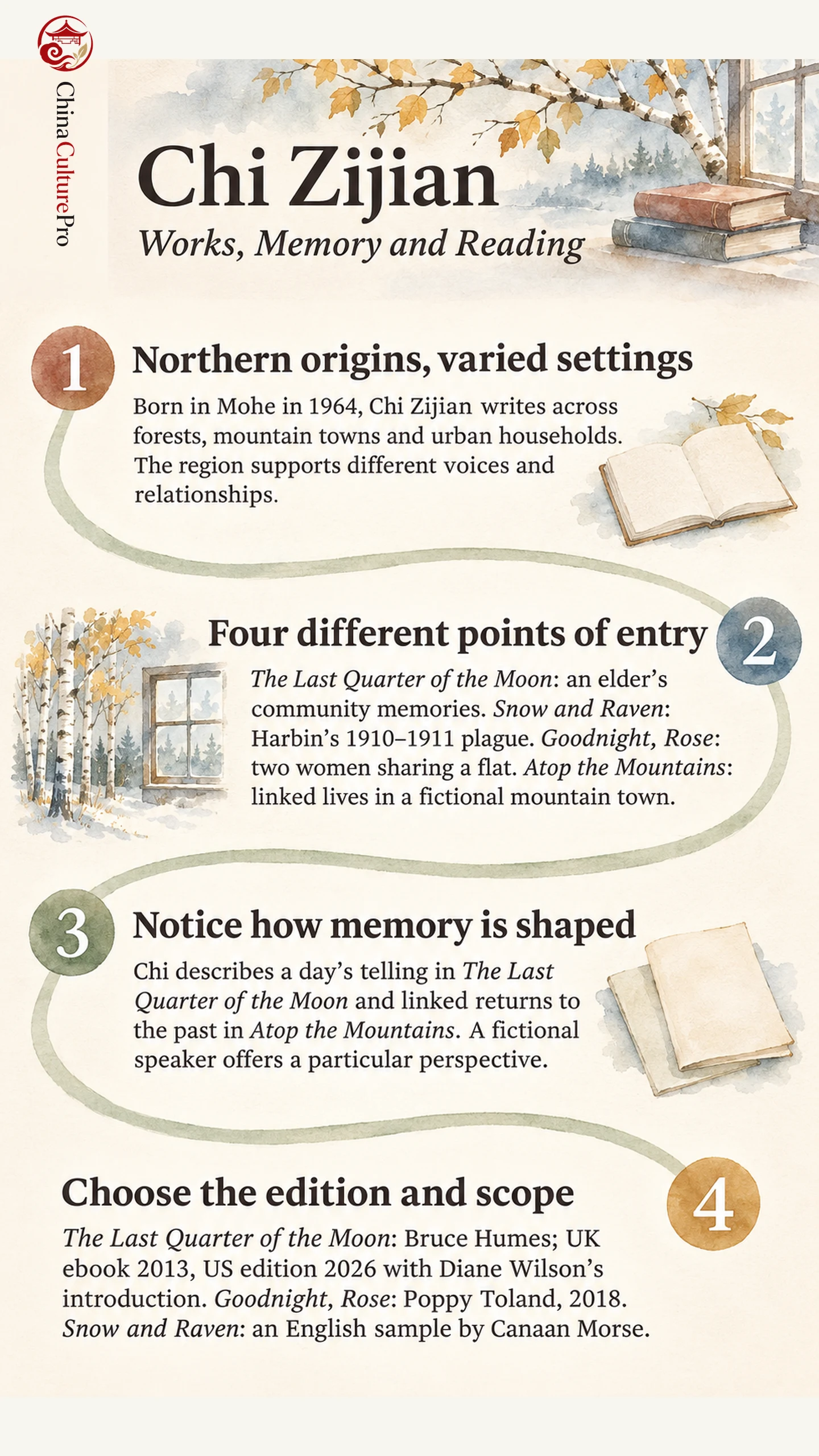
Snow and northern scenery are recognizable parts of Chi Zijian’s literary world, but they are only a beginning. Four works offer different ways into her writing: an elder’s recollections, a city facing plague, an unlikely household and a mountain town whose residents carry intertwined pasts.
Northern Origins and a Wider Literary Range
Mohe, where Chi was born, lies in China’s far north. Her writing belongs within modern and contemporary Chinese literature, with a body of work that extends beyond the one novel many English readers first encounter. Her bibliography includes long fiction as well as shorter forms. [1][9]
The northern setting changes its role from book to book. A forest community’s relationship with animals and seasonal life raises different questions from those of women sharing a Harbin flat. Treating the region as a single scenic backdrop would miss those differences in social scale and perspective. [2][4]
The broader Chinese literature guide provides a route from this author-focused selection to other periods and kinds of writing.
Four Works and Their Different Points of Entry
- The Last Quarter of the Moon: This novel (额尔古纳河右岸, É’ěrgǔnà Hé Yòu’àn) follows an elderly woman looking back across her life. She belongs to the Evenki people (鄂温克族, Èwēnkè Zú), and her memories connect family relationships, reindeer, forest life and upheavals in the twentieth century. A useful reading question is how an individual lifetime becomes a way to tell a community’s changing history. The Evenki culture guide offers a separate introduction to cultural context. [2]
- Snow and Raven: This work (白雪乌鸦, Báixuě Wūyā) centres on residents of Harbin’s Fujiadian district during the plague of 1910–1911. Its Chinese edition appeared in 2010. The focus moves across a community whose daily relationships are transformed by epidemic death. Read for what pressure brings out in people’s obligations, loyalties and attempts to continue living. [6]
- Goodnight, Rose: This shorter work (晚安玫瑰, Wǎn’ān Méigui) brings an eighty-year-old woman from the Jewish diaspora and a much younger woman together in a Harbin flat. Their differences in age, temperament and relation to the past make shared space a source of discovery. It offers an urban entry into Chi’s fiction through the gradual emergence of another person’s history. [4]
- Atop the Mountains: The 2015 novel (群山之巅, Qúnshān zhī Diān) takes place in the fictional mountain town of Longzhan (龙盏镇, Lóngzhǎn Zhèn). A butcher, a court officer and a funeral-home beautician belong to its network of lives. The author describes a structure in which present events lead back into characters’ histories. Follow those connections to see how a town emerges through overlapping personal stories. [8]
Memory, Ordinary Lives and the Shape of a Story
In a 2015 interview, Chi distinguished the structures of two novels. The forest elder’s recollections unfold through a single day’s telling, moving from morning through noon to dusk, while Atop the Mountains uses returns to the past to connect its characters. She also explained that real-life models become fictional people through the character and inner life a writer gives them. These are her accounts of specific creative choices, rather than a rule that every book uses one method. [8]
A small example appears in Canaan Morse’s English sample of Snow and Raven. It opens with a household under pressure to produce an heir, presenting the family reasoning that leads to a man taking a mistress. Ask whose expectations make that decision seem necessary within the narration, and whose position it leaves vulnerable. Those questions help distinguish household expectations from the interests of individual characters. [7]
The elder’s voice in The Last Quarter of the Moon is likewise a constructed narrative voice. Reading it as fiction allows attention to memory and perspective without treating one speaker as an exhaustive account of China’s ethnic and cultural diversity. [3]
English Editions and Choosing a Starting Point
Bruce Humes translated The Last Quarter of the Moon. An English ebook appeared in 2013 and a UK paperback in 2014. The US edition published by Milkweed Editions on January 13, 2026, also credits Humes and includes an introduction by Diane Wilson. The 2026 date identifies that edition, rather than the novel’s first appearance in English. [2][3]
Goodnight, Rose is available in Poppy Toland’s English translation, published in Penguin Specials in 2018. Its English ebook was published on October 22 that year. Choose it for the concentrated encounter between two women; choose The Last Quarter of the Moon for a longer family and community narrative. [4][5]
For a brief sample of another work, an English extract from Snow and Raven is available in a translation by Canaan Morse. The page is explicitly a sample. Keep that scope in mind when comparing it with a complete published book. [7]
These starting points let you select a story by its situation and reading scope. The English title of a work, by itself, does not identify a translator or a complete edition.
FAQs About Chi Zijian
Which work won the Mao Dun Literature Prize?
The novel known in English as The Last Quarter of the Moon won the seventh Mao Dun Literature Prize in 2008. Its Chinese title refers to the right bank of the Argun River. [9]
Is The Last Quarter of the Moon a memoir?
It is a novel. Its first-person elder is a fictional narrator, so her account should be read as a literary perspective rather than Chi Zijian’s own life story. [3]
Who translated Goodnight, Rose into English?
Poppy Toland translated the English edition published in Penguin Specials in 2018. Checking that credit helps distinguish the translation from other editions or discussions of the work. [5]
Sources
[1] Milkweed Editions. Chi Zijian: Author Biography
[2] Penguin Books UK. The Last Quarter of the Moon: Description, Translator and Editions
[3] Milkweed Editions. The Last Quarter of the Moon: 2026 Edition
[4] Penguin Books Australia. Goodnight, Rose: Description and 2018 Ebook Details
[5] University of Leeds, Centre for New Chinese Writing. Goodnight, Rose: Translator and Edition Credits
[6] Paper Republic. Snow and Raven: Work and Publication Record
[7] Canaan Morse, translation hosted by Paper Republic. Snow and Raven: English Translation Sample
[8] Sun Da, interview with Chi Zijian, published by China Writers. Chi Zijian: Language Is a Writer’s Soul
[9] China Publishing Group. Chi Zijian: Biography and the 2008 Mao Dun Award