

Quick Answer: Who Are China’s Evenki Communities?
The Evenki people(鄂温克族,Èwēnkèzú), also written Ewenki, are an officially recognized ethnic group in China. Communities live mainly in Inner Mongolia, with others in Heilongjiang. Their cultural life includes regional speech varieties, pastoral and forest histories, clothing skills, oral stories and gatherings. Multilingual contact is an important part of that setting.[1]
Reindeer herding belongs to one part of this wider picture. It should not define every Evenki household. A grassland herding community, a farming settlement and a forest community have different relationships with work, materials and neighboring peoples.

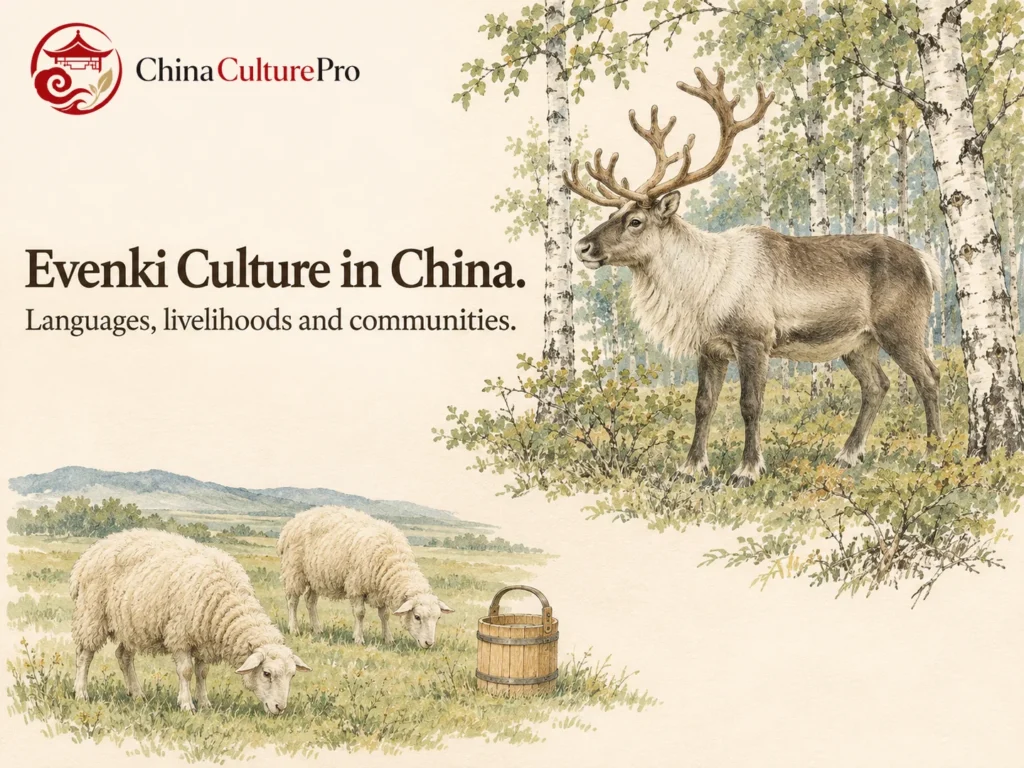
A reindeer moving through birch woodland is a familiar image of Evenki culture. A dairy vessel on the grassland tells another story. To understand Evenki communities in China, consider those different settings together, then look at how language, clothing and oral knowledge connect people within them.
Pastoral, Forest and Agricultural Settings
Regional histories include grassland husbandry, agriculture and forest livelihoods. Aoluguya(敖鲁古雅,Áolǔgǔyǎ), associated with Genhe, is one forest community. These settings represent different community histories, not a sequence every family followed.[2]
| Setting in community history | Examples of livelihood and place |
|---|---|
| Grassland pastoral | Cattle, sheep and horse husbandry in areas including Evenki Autonomous Banner and Chen Barag. |
| Forest and reindeer | Reindeer-assisted movement and forest livelihoods associated with Aoluguya. |
| Agricultural or mixed | Farming in settings such as Nehe, with different combinations of work in other communities. |
A 2020 study of Solon Evenki pastoral communities examined livestock farming and the role of community organization as economic arrangements changed. It gives the grassland setting a social dimension beyond the animals themselves. Cooperation, household relationships and access to resources form part of how herding works.[3]
That dimension belongs within the wider study of pastoral cultures in China. Identifying an animal is only the beginning. Understanding the community requires attention to the people organizing its care and the work around it.
Aoluguya Reindeer Life and Historical Change
In the forest history of the Reindeer Evenki, reindeer carried tents and equipment during movement between places. Seasonal shelters used pole frameworks, with bark or animal-hide coverings. The relationship between people, animals and forest materials helped make mobile life possible.[4]
A major change came with relocation to a new settlement near Genhe in 2003. Reindeer continued to matter as a livelihood and a symbol of local identity, while families’ relationships with settlement and forest life changed. This is a history of a specific community, rather than a description of all Evenki people in China.[4]
Ethnographic accounts also describe shamanic practices among these forest communities. Such descriptions belong to their historical and social setting. They cannot establish the personal beliefs of every Evenki individual or be treated as a rule for communities elsewhere.[4]
Continuity and change belong in the same account. A reindeer can remain important to family memory and identity even when housing, education or work has changed. An image of forest life cannot explain those changes on its own.
Languages and Multilingual Communities
The Evenki language(鄂温克语,Èwēnkèyǔ)belongs to the Tungusic family. Chinese overview accounts commonly distinguish Hailar, Chen Barag and Aoluguya varieties. A language-resource summary published in 2024 records these labels and language-protection survey sites, while drawing on earlier investigations.[1][5]
Specialist linguistic classification can use different boundaries. In a 2022 research volume, the discussion distinguishes Solon from Evenki proper more narrowly than the broad Chinese grouping. Readers may therefore find Solon treated separately in one study and included within Evenki in another. The classification and the variety being described need to be checked together.[6]
The relationship with Oroqen communities illustrates the distinction between an ethnic category and linguistic relationships. Separate official identities do not require their speech varieties to be unrelated. Equally, a linguistic relationship does not make the communities identical.[6]
Daily language use also involves contact with Mongolian and Chinese. Mongolian language and writing have been important in pastoral settings, while Chinese has been prominent in agricultural and forest-adjacent communities. These connections with Mongolian cultural life belong within a multilingual region, not a single language pattern shared by every household.[1]
Clothing, Food and Household Skills
Material life reflects different working environments. Historical forest clothing used animal hides, while pastoral clothing also drew on sheep skins. Recorded pastoral food traditions include meat, dairy products and milk tea; agricultural settings included a greater role for grain and vegetable foods. These are regional descriptions, not a fixed menu for all households.[2]
A specific clothing tradition is documented in Chen Barag. The national entry describes Tungus Evenki garments whose construction varies for men, unmarried women and married women. Pleats, shoulder shaping and the use of a waistcoat contribute to those distinctions. The project entered the fourth national heritage list in 2014, under X-155.[7]
The skills include cutting, sewing, embroidery, braid work and leather processing. Knowing the appearance of a garment is different from knowing how to make it. Family teaching passes on decisions about construction and finishing as well as visible design.[7]
Within minority dress traditions, this local example is more useful than one supposedly universal Evenki costume. A garment can be understood through the community, wearer and occasion for which it was made.
Stories, Gatherings and Cultural Transmission
Oral traditions include myths, legends, proverbs, jokes and stories about heroes and relationships with the natural world. The national Evenki Folk Tales(鄂温克族民间故事,Èwēnkèzú Mínjiān Gùshì)project entered the fifth national intangible cultural heritage list in 2021, under I-163. Its account distinguishes narrative interests among different communities, from forest stories to pastoral and historical subjects.[8]
These forms belong alongside other Chinese folk tales while retaining their own tellers and language. A recorded story and a new dramatic adaptation offer different encounters with it. Neither can replace the full setting of a live telling.
Sebin(瑟宾节,Sèbīnjié)provides a contemporary gathering context. On June 18, 2026, teachers and students from Hulunbuir University took part in festival documentation, recording songs, photographing activities and organizing interview material. The programme included ceremony, wrestling and dance.[9]
The activity linked song recordings with interviews and direct observation. Those records offer different kinds of detail about the celebration, while remaining tied to that particular event.
FAQs About Evenki Culture in China
Are all Evenki people in China reindeer herders?
No. Reindeer life is associated with a particular forest community. Other Evenki histories include livestock pastoralism, agriculture and mixed livelihoods.
Are Evenki and Oroqen the same ethnic group?
They are distinct official ethnic groups in China, with related Tungusic linguistic traditions and regional connections.
Do all Evenki communities use the same language variety?
No. Regional varieties, different classification conventions and multilingual household practices all need to be considered.
Sources
[1] National Ethnic Affairs Commission. Evenki Community Overview
[2] National Ethnic Affairs Commission. Evenki Regional Livelihoods and Household Traditions
[3] Nasunmenghe and K. Yagi. The Pastoral Economy of the Solon Evenki, 2020
[4] Åshild Kolås. Writing the Reindeer Ewenki, Book Introduction
[5] Minzu University Language-Resource Centre. Evenki Language Use and Protection, 2024
[6] Andreas Hölzl and Thomas E. Payne, editors. Tungusic Languages: Past and Present, 2022
[7] China Intangible Cultural Heritage. Evenki Clothing, Chen Barag
[8] China Intangible Cultural Heritage. Evenki Folk Tales
[9] Hulunbuir University. Sebin Festival Documentation Activity, June 2026