

Quick Answer: What Is Chinese Minority Dress?
Chinese minority dress(少数民族服饰,shǎoshù mínzú fúshì)covers the clothing and adornment traditions of China’s ethnic minority communities. It is a broad category within traditional Chinese clothing, encompassing different cuts, materials and regional styles rather than a single national outfit.[1]
- Garments: Robes, jackets, skirts, trousers and headwear take different forms across communities.
- Craft: Weaving, dyeing, embroidery and attached ornaments contribute different parts of an ensemble.
- Context: A festival outfit, a work garment and a contemporary adaptation need to be understood in relation to their particular use.
An ethnic label is a starting point; locality, date and occasion make the description more precise.
A pleated skirt, an embroidered jacket and a silver ornament reveal different kinds of workmanship. Their construction helps explain a regional ensemble; a decorative motif alone cannot identify its wearer. This guide connects documented garments with their materials, social settings and continuing changes.
Local Dress and the Occasion
Consider a Miao(苗族,Miáozú)festival jacket from Taijiang(台江,Táijiāng), Guizhou, dated to the 1980s. Its black velvet ground carries embroidery and attached silver plates, bosses and tassels. The museum identifies it as special-occasion clothing; its description does not establish what everyone in Taijiang wore on a working day.[2]
The same collection includes a 1960s outfit from Rongjiang(榕江,Róngjiāng)with a glossy jacket and a batik pleated skirt, as well as a Guizhou garment identified with the Gejia(革家,Géjiā)community and decorated with wax-resist patterns. These examples make regional and technical differences visible inside a broad museum category.[2]
Miao silver jewelry also deserves attention as metalwork in its own right. An ornament attached to a jacket and a separate collar may belong to one ensemble, but they are different objects. When reading a display, distinguish the individual garment from the accessories arranged beside it.
Regional Examples Beyond One Outfit per Group
The following examples offer a small selection of documented forms. They are not a catalogue of every community’s clothing, and a garment associated with one subgroup should not become a uniform assigned to everyone in a larger category.
| Documented example | Construction or material to notice | What the example helps distinguish |
|---|---|---|
| Taijiang festival jacket | Embroidery and attached silver on a dark textile ground. | A particular ceremonial ensemble within wider regional Miao dress traditions.[2] |
| Baiku Yao(白裤瑶,Báikù Yáo)men’s trousers, Guizhou–Guangxi border region | White handspun cloth, with cross-stitched decoration at the leg hems. | A subgroup’s distinctive clothing, rather than one style for all Yao communities.[3] |
| Hezhen(赫哲族,Hèzhézú)fish-skin jacket and trousers | Prepared fish skin forms the garment material; the jacket has a diagonal opening. | Skin-working and tailoring traditions, rather than treating all regional dress as woven fabric.[4] |
| Li(黎族,Lízú)textiles in Hainan(海南,Hǎinán) | Spun, dyed, woven and sometimes embroidered cloth used for skirts, headcloths and other garments. | A connected textile-making tradition with differences among language groups.[5] |
The contrast is useful because it separates material, technique and social attribution. White trousers and fish-skin tailoring invite different questions about making and use.
Cloth Making and Decoration
Look first at how the surface was made. A woven pattern is built through the arrangement of threads; embroidery adds stitches to an existing ground; appliqué attaches pieces of cloth. Dye-resist work changes where colour enters the fabric. These processes can coexist in one garment, so a richly patterned jacket should not automatically be called embroidered.[1][3]
Chinese batik uses wax to protect selected areas during dyeing. Chinese embroidery instead directs attention to stitches, threads and the cloth they decorate. Silverwork adds another material and another set of craft skills.[1]
The Li textile tradition demonstrates a longer production chain: preparing fibres, spinning yarn, dyeing, weaving and embroidery. Its recognized practices include warp-resist dyeing and double-sided embroidery. The skills, and the knowledge needed to transmit them, are the heritage being safeguarded. The UNESCO element moved from the Urgent Safeguarding List, where it was inscribed in 2009, to the Representative List in 2024.[5]
Dress, Identity and Change
Traditional clothing continues to absorb new materials. A museum discussion accompanying a south-central Guizhou costume describes synthetic yarn, plastic beads and trainers alongside older textile practices. Such combinations show adaptation; a modern material alone cannot tell you whether an outfit matters to its wearer.[6]
In research published in 2014, fieldwork in Upper Jidao(季刀上寨,Jìdāo Shàngzhài), Guizhou, distinguished full festival ensembles from less elaborate locally recognized clothing. Younger women often used synthetic materials and machine embroidery, while older festival outfits contained more handwoven cloth and hand-embroidered trim. The account found appreciation for handwork without a simple hierarchy in which all older clothes were valued above newer ones.[7]
Tourism and photography also shaped what became visible. During a 2007 media visit, a woman changed into clothing she considered more representative; a male village leader remained in jeans and a leather jacket. The contrast shows why a photograph of ceremonial clothing cannot establish what every person normally wears.[7]
Reading Clothing with Context
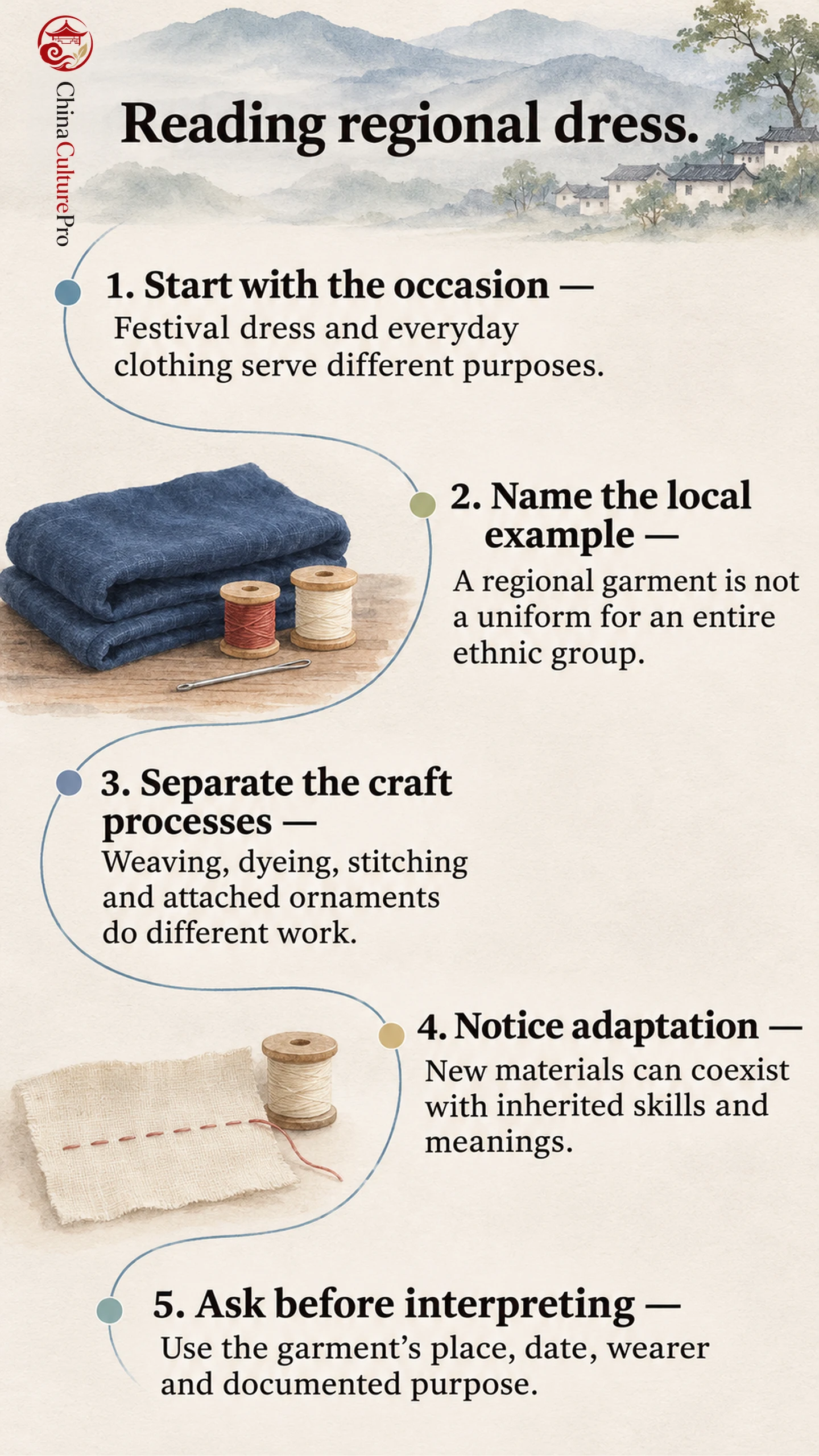
A useful clothing description connects an object to evidence. Begin with these questions when reading a catalogue, speaking with a maker or viewing a display:
- Place and date: Which locality and period does the label identify?
- Object and technique: Is the decoration woven, stitched, dyed or attached? Are accessories being described separately?
- Use and wearer: Was this everyday clothing, festival dress or a garment linked to a particular role?
- Meaning and source: Who explains a motif, and does that explanation concern this garment or a much broader tradition?
Treat these as questions rather than a visual identity test. A catalogue’s regional attribution is more informative than guessing from colour alone. For participation or photography, respectful cultural appreciation begins by asking the wearer or host about appropriate handling and use.
FAQs About Chinese Minority Dress
Is there one traditional outfit for each ethnic group?
No. Regional and community styles can differ within the same broad category, and people also dress differently for different occasions.
Do people wear festival clothing every day?
Not necessarily. Elaborate museum ensembles often represent special occasions; they do not establish a community’s everyday wardrobe.
Does every pattern have one fixed meaning?
No. Use an explanation tied to a specific garment and community rather than assigning a universal meaning from appearance alone.
Can visitors wear regional traditional clothing?
Ask the host or maker about the particular garment and setting. Participation in a hosted activity does not imply permission for every ceremonial item or use.
Sources
[1] Shanghai Museum. Chinese Minority Nationalities’ Art Gallery
[2] Museum of Ethnic Cultures, Minzu University of China. Traditional Dress of Southern Ethnic Groups
[3] Museum of Ethnic Costumes, Beijing Institute of Fashion Technology. Attire and Adornment: Southern Ethnic Groups
[4] Museum of Ethnic Costumes, Beijing Institute of Fashion Technology. Attire and Adornment: Northern Ethnic Groups
[5] China Intangible Cultural Heritage. Traditional Li Textile Techniques
[6] British Museum. Miao Woman’s Costume, As1998,01.1
[7] Jenny Chio. “Take a Picture with Us,” A Landscape of Travel