

Quick Answer: What Were Chinese Publishing Houses?
Chinese publishing houses were workshops, booksellers and other institutions that organized the issue of books. A commercial bookshop or print workshop, often called a shufang (書坊, shūfāng), could commission an edition and sell the copies. Government offices, collectors and academies could also sponsor editions.[1][2][3]
- Issuing a book: The sponsor or publisher arranged the edition and its circulation.[1][3]
- Making the copies: Scribes, carvers and printers performed different parts of the work on a woodblock edition.[4]
- Recognizing an edition: An imprint can identify a publishing house even when the book’s author lived centuries before it.[6][7]
A workshop’s name, the people who made the copies and the author’s name answer different questions about the same book.
A late Ming novel could carry a Nanjing publishing house’s name. A work written in the Tang could survive in an edition associated with a Ming collector. Knowing how to separate the text from its edition makes both records easier to read.[6][7]
Who Paid for and Issued the Books?
Four institutional settings help explain who arranged printing in the late Ming. The labels indicate sponsorship and circulation. A carver or workshop might contribute to more than one type of edition.[2][3]
| Publishing setting | Typical sponsor | What the setting helps explain |
|---|---|---|
| Official press | Government office | How institutions issued and distributed texts under official authority |
| Commercial shop | Book dealer or print business | Why the choice of titles had to serve paying readers |
| Private press | Collector or scholar | How an individual’s scholarly interests shaped an edition |
| Academy press | Academy | Why a teaching institution might issue books for its scholarly community |
The surviving list of titles may give only a partial picture of a publisher’s business. A publisher with a small output could operate commercially, and the kinds of works it printed might resemble those issued by a private collector.[3][5] The institutional setting of shuyuan academies explains why an educational center could also be a source of printed books.
How a Workshop Produced a Woodblock Edition
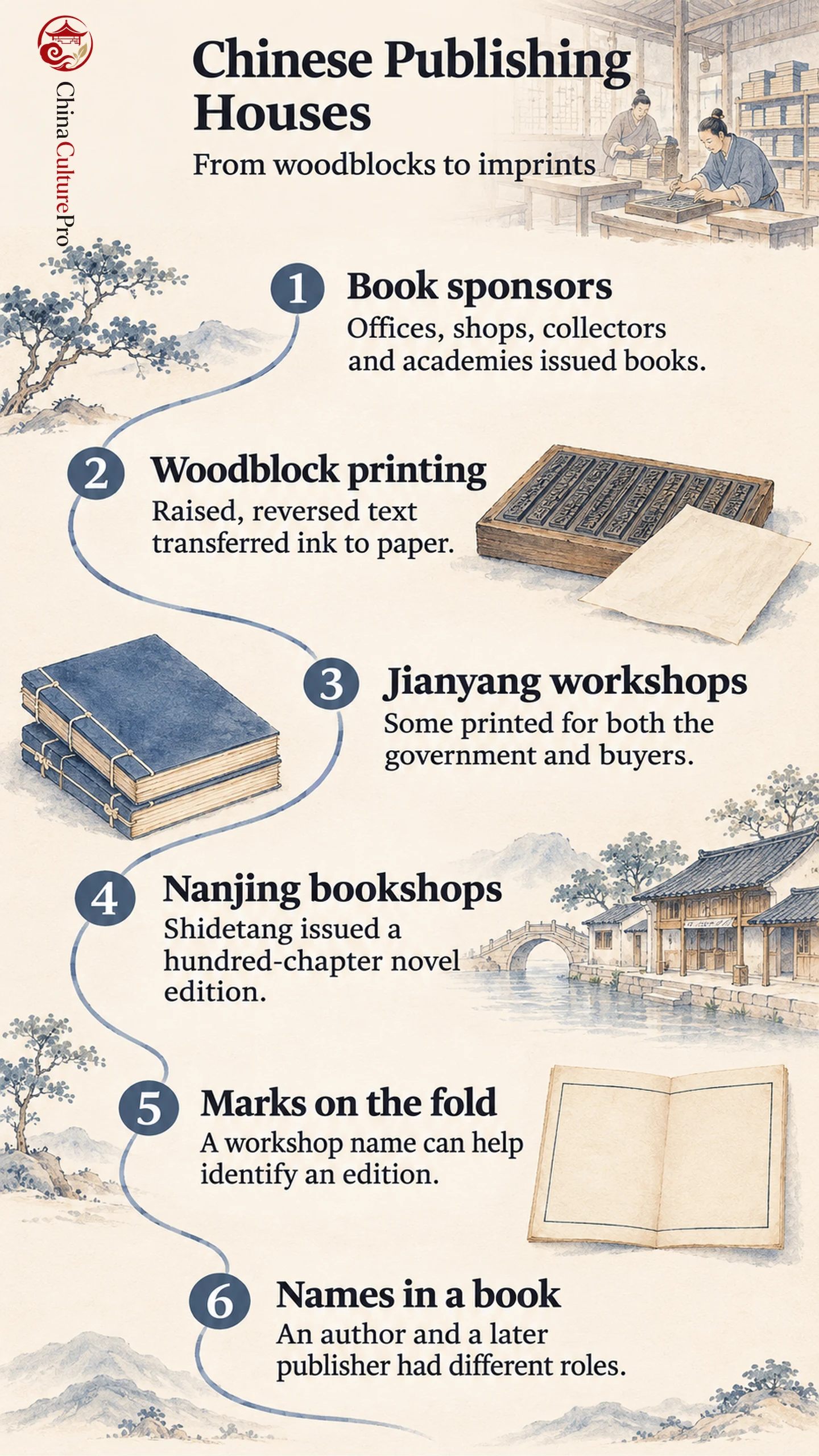
For a typical monochrome woodblock edition, a scribe prepared the writing on paper and the design was transferred face down to a block. Carvers cut away the surrounding wood, leaving the reversed text raised. The printer inked that surface, laid a sheet over it and transferred the impression. The carved surface could be inked again to make further copies.[4]
This division of labor mattered to a publisher. Commissioning a text involved decisions about what version to reproduce, how to lay it out and how to obtain skilled labor. Selling a book drew on a different set of decisions about the expected audience and distribution. A catalogue’s imprint can identify who issued a copy while leaving individual carvers and printers unnamed.[1][4][7]
Jianyang and the Bookshops of Ming Nanjing
Commercial publishers in Jianyang (建陽, Jiànyáng), in Fujian, were active in the Chinese book trade from the eleventh through the seventeenth centuries. Their publications reached readers looking for primers, dictionaries, medical texts, histories and fiction. This variety helps explain why the trade cannot be reconstructed from famous novels alone.[1]
Some Jianyang printers also had duties under Ming government arrangements. Early Ming book households (書戶, shūhù) were assigned to reprint and distribute official publications. Some later Ming owners of commercial workshops were members of these registered households. The same place and labor network could support official production and retail publishing.[2] For the wider administrative setting, see household registration in Chinese history.
In Ming Nanjing, Sanshan Street (三山街, Sānshān Jiē), or Three Mountains Street, was a center of the book trade. One documented Nanjing house was Shidetang (世德堂, Shìdétáng). Its surviving illustrated edition of *Journey to the West* has a preface dated to 1592 and contains a hundred chapters arranged in twenty textual divisions. The edition documents the form the story took in this printing. Stories about the journey had circulated in earlier forms.[5][6] The bookshops fit within the broader commercial life of Ming Nanjing.
How to Read a Publisher’s Mark
A surviving edition of *Record of Famous Paintings Through the Ages* identifies the Tang author Zhang Yanyuan and the Ming reviser Mao Jin. The catalogue records Jiguge (汲古閣, Jígǔgé) at the foot of the banxin (版心, bǎnxīn), the part of the printed sheet visible along the fold. The three names separate the writing, revision and imprint evidence for this copy.[7]
For an unfamiliar book, compare the named roles before interpreting dates. A book can preserve an older work under the name of its original author and carry the workshop mark of a later printing. A mark along the fold may help identify the workshop even when the catalogue gives no precise date. Those details help distinguish individual editions within the larger late imperial printing markets.[5][7]
FAQs About Chinese Publishing Houses
Was a Shufang a Bookshop or a Printing Workshop?
In the Jianyang book trade the word refers to commercial bookshops or print workshops. It can describe a business that arranged production and sold books. The role of an individual shop depends on the surviving evidence.[1][2]
Were All Woodblock Editions Commercial?
Woodblock was a printing technique. Official presses, scholars and academies could also issue books. The sponsor and route of circulation establish whether a particular edition was commercial.[2][3][4]
Does an Imprint Date the Text Itself?
A dated imprint or preface is evidence for the edition. Compare it with the author’s lifetime, earlier editions and any older material incorporated in the work.[6][7]
Sources
[1] Lucille Chia. Printing for Profit: The Commercial Publishers of Jianyang, Fujian
[2] Li Zigui. Jianyang Shuhu and Print Workshops in the Ming Dynasty
[3] Shuhui Yang. Stories Old and New: A Ming Dynasty Collection, Introduction
[4] The Metropolitan Museum of Art. The Printed Image in China, 8th–21st Century
[5] Lucille Chia. Of Three Mountains Street: The Commercial Publishers of Ming Nanjing
[6] Nicholas Koss. The Chapter Titles in Xiyou ji and Honglou meng
[7] CiNii Books. 歷代名畫記, catalogue record BB19262546