

Quick Answer: What Was the Treaty of Nerchinsk?
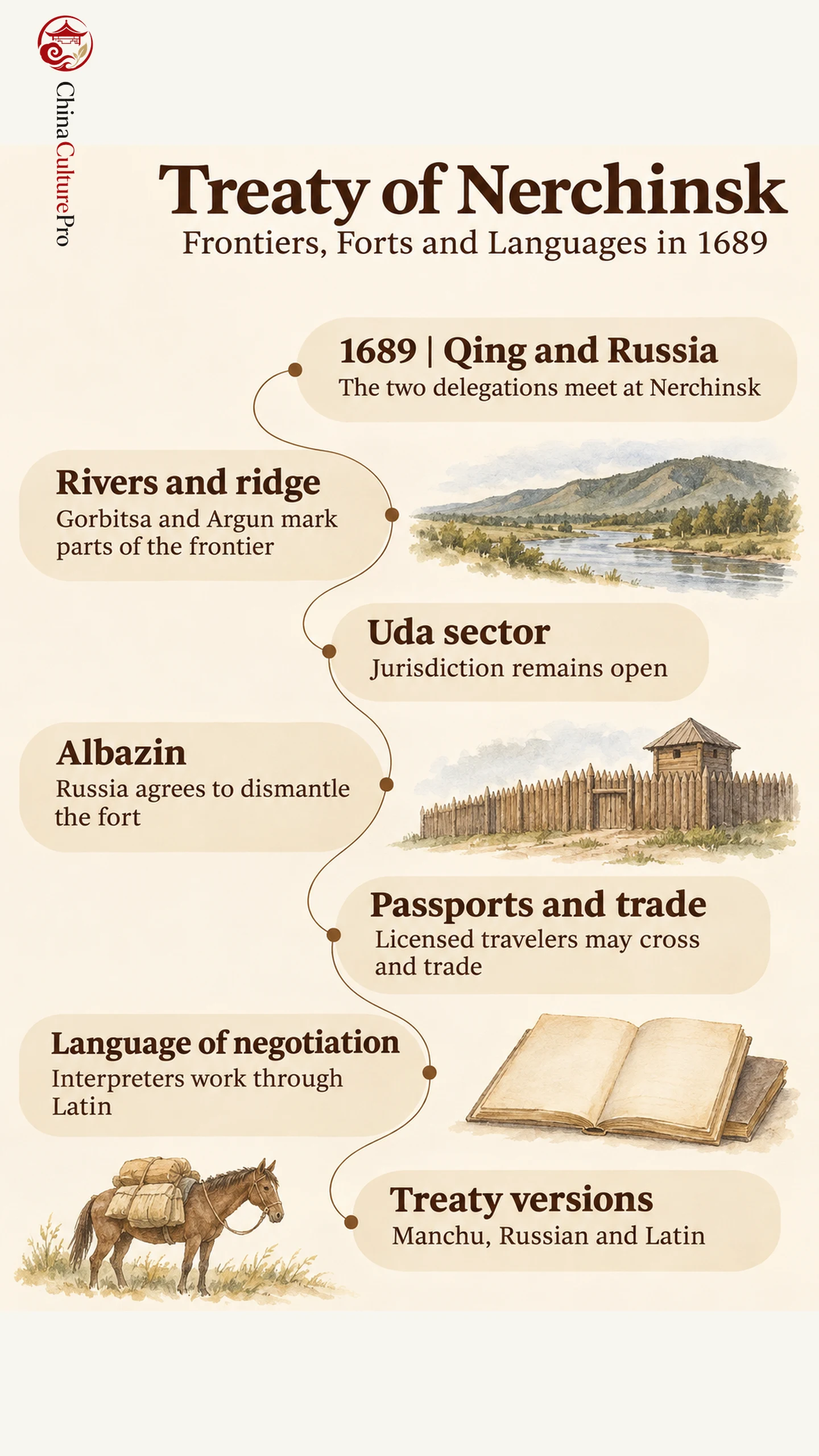
The Treaty of Nerchinsk (尼布楚条约, Níbùchǔ Tiáoyuē) was the 1689 agreement between the Qing empire and Russia that ended fighting over the Russian fort at Albazin (雅克萨, Yǎkèsà). It set out parts of the frontier, required Russia to dismantle the fort and permitted cross-border travel and trade with passports. [1][2][3][4][5]
- Boundary: The treaty described river and mountain sections and left one area open.
- Withdrawal: The Russians agreed to leave Albazin and take their property with them.
- Language: Interpreters used Latin in the talks between the two delegations. [2][4][5][6]
The treaty ended the immediate conflict without settling every question along the frontier. [4][5][7]
The negotiators had to agree on what to do with a fort, how to name a frontier and what to do when people crossed it. They also had to find a language both sides could work through.
Why the Qing and Russia Negotiated at Nerchinsk
In the mid-seventeenth century Russian parties moved east through Siberia and established settlements in the Amur (黑龙江, Hēilóngjiāng) basin. Albazin became a fortified Russian settlement at a site previously held by local Daur people. The Qing dynasty treated the settlement as an intrusion into a region it sought to control. Qing forces besieged Albazin in 1685. Russian settlers reoccupied the site, and Qing forces besieged it again from 1686. [1][2][3]
The two governments sent delegations to meet at Nerchinsk. The Kangxi emperor’s delegation was headed by Songgotu (索额图, Suǒ’étú). Fyodor Golovin led the Russian delegation. The delegations had to settle what would happen to the fort and its inhabitants. They also needed rules for the movement of people and goods after troops left. [1][2][4][6]
What the Treaty Settled and Left Open
The treaty names the Gorbitsa, near the Shilka, and a ridge stretching eastward from its source. This was a description of a divide between river basins. The streams flowing on either side helped the negotiators define territory beyond the settlements they could name. Waters flowing south toward the Amur lay on the Qing side. The Argun formed another part of the frontier. The treaty required Russian settlements on the southern side of the Argun to be moved. [4][5][7]
The parties left the area between the ridge and the Uda River unresolved. The text envisaged settling the question later by correspondence or another mission. The Albazin clause gave the delegations a decision they could carry out immediately. The fort was to be dismantled, and its inhabitants could withdraw with their property. [4][5]
The treaty also dealt with people crossing the frontier. It allowed people who had already settled on the other side to remain but provided for the return of future fugitives. People with valid passports could cross for private business and trade. The date of a person’s crossing mattered for extradition, while passports provided a recognized basis for travel and trade. [4][5]
Why the Delegations Used Latin
Qing and Russian officials had corresponded through Mongolian before the talks. At Nerchinsk they used Latin as a language of negotiation. The Jesuits Tomás Pereira and Jean-François Gerbillon interpreted for the Qing. Andrei Bielobocki interpreted on the Russian side. Ning Chia’s study uses correspondence and negotiating records to distinguish written communication before the meeting from the language the interpreters used at the table. [2][6]
The agreement circulated in Manchu, Russian and Latin versions. A Chinese rendering of the Manchu text gives readers another way into the treaty. It represents a separate stage of transmission from the Manchu, Russian and Latin copies. Names vary even among modern editions. The English text uses Gorbitza and Oud, while other accounts use Gorbitsa and Uda. [2][4][5][6][7]
What Changed After Nerchinsk
Nerchinsk settled an immediate military conflict and created rules for a section of the Qing–Russian frontier. It made room for licensed trade alongside restrictions on movement. Later treaties altered the arrangement. The agreements at Aigun in 1858 and Beijing in 1860 changed the frontier in the Amur and Ussuri regions. [1][2][4][7][8]
The Treaty of Kiakhta in 1727 extended the agreed boundary westward and identified trading places. One was Kiakhta near the northern frontier of Mongolia. The 1689 text recognized travel and trade with passports, whereas the later arrangement provided designated places where merchants could meet. [4][9]
The treaty is evidence for the places and rules the two courts agreed on in 1689. It tells us less about how people in borderland communities understood the changes. The Uda clause is a reminder that a map of the agreement must leave some territory unassigned. [3][4][5][6][7]
FAQs About the Treaty of Nerchinsk
Where was the Treaty of Nerchinsk negotiated?
The delegations met at Nerchinsk, now in Russia’s Transbaikal region. Some English editions of the treaty use the name Nipchu. [1][2][4]
What happened to Albazin under the treaty?
The treaty required Russia to dismantle the fort and withdraw its residents and property to Russian territory. [4][5]
Is the 1689 frontier the same as the modern boundary?
No. Later treaties changed the frontier. The 1689 text itself also left a sector near the Uda River to future negotiation. [4][5][7][8]
Sources
[1] Palace Museum, Beijing. The Qing–Russian Treaty of Nerchinsk
[2] Boris Yeltsin Presidential Library. The Conclusion of the Treaty of Nerchinsk
[3] Harvard University, Russia in Global Perspective. The Treaty of Nerchinsk
[4] The World and Japan Database. Treaty of Nerchinsk, English translation
[5] Treaty of Nerchinsk, Chinese translation from Manchu. Treaty of Nerchinsk: Manchu Text in Chinese Translation
[6] Ning Chia. Language Translation and the Treaty of Nerchinsk
[7] Maria Adele Carrai and coauthors. Territory, Treaty Relations and Mapping in Late Imperial East Asia
[8] Chatham House. Russia and China: The Border Question
[9] Joseph Fletcher. Sino-Russian Relations, 1800–62