

Quick Answer: What Was the Yellow Turban Rebellion?
The Yellow Turban Rebellion (黄巾起义, Huángjīn Qǐyì) was a major uprising against the Eastern Han (东汉, Dōng Hàn) in 184 CE. Zhang Jue (张角, Zhāng Jué) and his brothers mobilized followers through a religious network. Han forces defeated the main armies that year. Later groups continued to use the Yellow Turban name. [1][2][3][5][7]
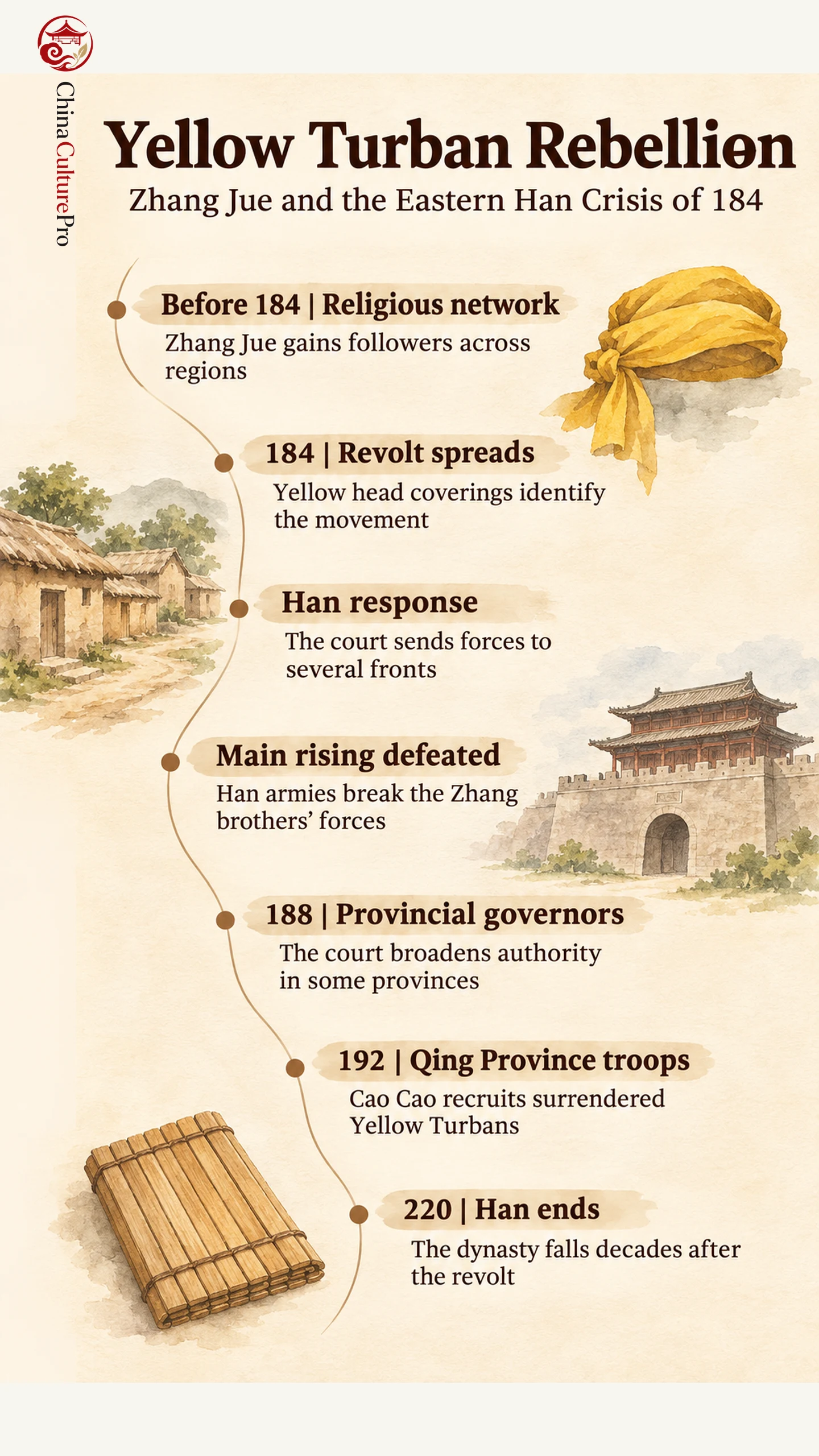
- Movement: Followers wore yellow head coverings and proclaimed a new age.
- Campaign: The court sent several armies and suppressed the main rising.
- Aftermath: Regional armed groups remained important after the defeat. [1][2][3][5][6][7]
The defeat of Zhang Jue’s movement and the fall of the dynasty were separated by decades. [5][6]
The court’s histories describe followers seeking cures before they describe an uprising. To understand how the Yellow Turbans spread, it helps to start with the people and networks Zhang Jue had already organized.
How Zhang Jue Built a Following
Zhang Jue, whose name is also rendered Zhang Jiao, came from Julu, in what is now Hebei. The Book of Later Han describes a teacher whose followers confessed faults and sought healing with water and talismans. Disciples carried his teaching to several regions. The chronicle reports that followers traveled to join him, evidence that the network extended well beyond his home district. Historians commonly associate the movement with the Way of Great Peace. The label reflects the religious ideas attributed to the followers in later records. [1][3][4]
The precise relationship between Zhang Jue’s followers and the surviving Scripture of Great Peace is harder to establish. Grégoire Espesset notes that the link to a Great Peace text appears in a history compiled more than two centuries after the revolt. The account is evidence for later descriptions of the group, but it does not establish that Zhang Jue wrote or used the received scripture in its current form. [1][4]
Why the Revolt Spread in 184
The movement operated in an empire experiencing disease, unrest and political conflict. By the time officials uncovered plans for the revolt, it already had organized groups in several provinces. According to the dynastic history, the organizers brought the revolt forward after their plans were exposed. Yellow head coverings identified its participants. The slogan reported by the histories announced that the old heaven had died and a yellow heaven would take its place. [1][2][3][5]
The court histories preserve useful details about where reports arrived and how officials reacted. They also speak from the government’s side and use hostile language for the insurgents. The places named in the annals show where the court encountered resistance. The reported totals are harder to verify and should not be read as a census of the movement. [1][2][3]
How the Han Defeated the Main Forces
The Han court reinforced approaches to its capital at Luoyang and sent commanders to different fronts. The emperor also lifted political bans on some people punished in earlier court struggles, a step the annals connect with fears that former opponents could support the revolt. Lu Zhi was assigned against Zhang Jue’s forces, while Huangfu Song (皇甫嵩, Huángfǔ Sōng) and Zhu Jun fought groups closer to the capital and farther south. The fighting developed differently on each front. Zhu Jun’s forces suffered a setback against one rebel group before he and Huangfu Song defeated it at Changshe. [1][2][3]
Zhang Jue died of illness according to the Book of Later Han. Huangfu Song defeated his brother Zhang Liang at Guangzong and later defeated Zhang Bao at Xiaquyang. Zhu Jun fought the southern rebels. By the end of the main campaign, the Zhang brothers were dead and the army that had gathered around them was defeated. Huangfu Song’s biography records that he secured a year of land-tax relief in Ji Province to help people facing hunger. Defeating the rebel armies still left officials with the task of governing affected districts. [1][2][3][5]
What Survived and Why the Rebellion Mattered
In the years that followed, the court faced further rebellions and instability. It appointed governors with broader authority over some provinces in 188. After Emperor Ling died in 189, a separate struggle among the court’s senior figures allowed the general Dong Zhuo to take power at Luoyang. The governors and commanders able to raise troops gained importance in these years. The rebellion helped create demand for local military power, while later court struggles and other wars changed who controlled it. [5][6]
In 192, Yellow Turbans from Qing Province surrendered to Cao Cao (曹操, Cáo Cāo), who recruited some of them into his army. The Records of the Three Kingdoms calls those recruits the Qing Province troops. The episode shows that people fighting under the Yellow Turban name in a later campaign could become part of a rising regional commander’s forces. [5][6][7]
FAQs About the Yellow Turban Rebellion
Why were they called the Yellow Turbans?
The dynastic histories say the insurgents wore yellow head coverings. The color also appears in the slogan that announced a new heaven. [1][2][3]
Did Zhang Jue write the Scripture of Great Peace?
The surviving evidence does not establish that he wrote it. Later sources associate the movement with Great Peace teachings, while the text has a separate history of transmission. [1][4]
Did the uprising end the Han dynasty?
No. The court defeated the main uprising in 184. The Eastern Han survived until 220, through several later rebellions, court crises and wars among regional commanders. [5][6]
Sources
[1] Fan Ye and other compilers. Book of Later Han, chapter 71: Huangfu Song and Zhu Jun
[2] Fan Ye and other compilers. Book of Later Han, chapter 8: Annals of Emperor Ling
[3] Rafe de Crespigny, trans. and annot.. To Establish Peace, chapter 58: Zhongping 1, 184
[4] Grégoire Espesset. Review of The Scripture on Great Peace
[5] Rafe de Crespigny. Fire Over Luoyang: A History of the Later Han Dynasty, 23–220 CE
[6] Rafe de Crespigny. Chronology of Later Han
[7] Chen Shou and Pei Songzhi. Records of the Three Kingdoms, chapter 1: Annals of Cao Cao