


Quick Answer: What Was Wang Mang’s Xin Dynasty?
The Xin dynasty (新朝, Xīn Cháo) ruled from 9 to 23 CE between the Western and Eastern Han. Its founder, Wang Mang (王莽, Wáng Mǎng), rose to power as a Han regent and then took the imperial title. He issued new land rules and redesigned the currency. The regime fell when rebels entered Chang’an in 23 CE. [1][2][3][4][6][7]
- Land: The court restricted sales and called for redistribution in specified cases.
- Coins: The court introduced and withdrew several denominations.
- Collapse: Rival forces defeated the regime and competed over restoring the Han. [2][3][4][6][7]
The surviving orders describe what the government wanted to change. Coin finds establish what was made, and neither source alone shows how well the policy worked everywhere. [2][3][4][5]
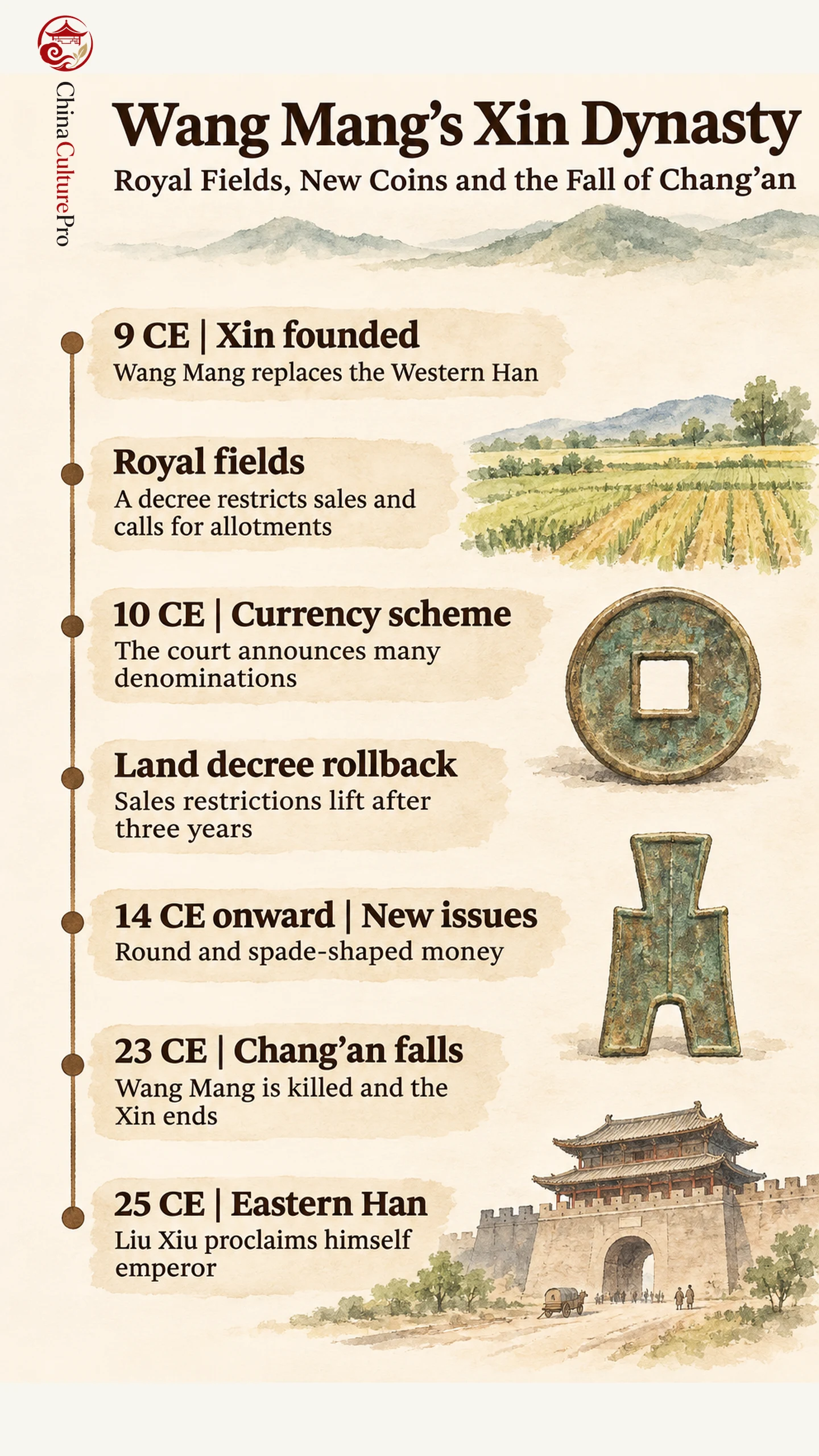
A land decree and a bronze coin give different views of the Xin. One tells us what the emperor ordered. The other shows a new denomination that was actually cast.
How a Han Regent Became Emperor
Wang Mang was a nephew of the Han empress dowager Wang Zhengjun. He held high office and became regent after Emperor Ping died, while a child from the Han imperial family was designated as heir. Wang then took the throne himself and named his dynasty Xin, meaning New. The change broke the imperial line of the Han dynasty while leaving the new emperor to govern with many of the offices and officials already in place. [1][2][3]
Wang presented his measures as a return to principles attributed to earlier sage rulers. His land decree, for example, invoked a model of fields distributed in regular allotments. Wang used the authority of the past to justify changes he was ordering in the present. The Book of Han preserves that argument even though its compilers judged his accession as usurpation. [1][2][6]
What the Royal Fields Decree Tried to Change
Wang’s decree renamed land royal fields (王田, Wángtián) and called enslaved people private dependents. It forbade sales of both. In specified cases it ordered households with excess land to transfer some to relatives or neighbors, and it provided for allotments to landless households. Wang justified the change by contrasting earlier ideals with the concentration of land and abuse he described in his own time. [2][3]
The decree specified which households had to give up excess land and named relatives and neighbors as possible recipients. It also prohibited transactions that officials could punish under the new rules. They do not show that officials redistributed land across the empire. The economic treatise of the Book of Han records that Wang lifted the sales restrictions three years later. The reversal shows how short-lived the prohibition was. It does not show how much land, if any, had been transferred before then. [2][3]
What the Coins Reveal About Reform
Wang began changing the currency in 7 CE while he was still regent. After taking the throne he withdrew the Han wuzhu coin and introduced new denominations. The scheme announced in 10 CE distinguished 28 grades across several materials, including bronze, metal ingots, shells and turtle carapaces. In 14 CE the court introduced new round and spade-shaped denominations and moved toward a simpler system. The National Museum of China records that one earlier large-denomination coin remained in use under the new rules until it was withdrawn in 20 CE. [2][3][4]
A bronze huoquan (货泉, Huòquán) in the Ashmolean Museum is dated to 14–23 CE. It is a cast round coin with a square hole and the denomination written on its face. The museum records it at 2.94 grams. Its weight and inscription establish the form of that particular issue. The Book of Han separately reports continued use of old coins in some transactions despite the new rules. [4][5]
Why the Xin Fell and What Followed
Flooding and changes in the course of the Yellow River added to economic distress. Food shortages and displacement made it harder for the Xin to maintain control. The economic treatise also describes the cost of supplying troops on the frontier and the collection of extraordinary levies. Forces known as the Red Eyebrows (赤眉, Chìméi) rose in the east as those pressures mounted. In the south, a different rebellion in Nanyang joined with other groups seeking to restore a Han ruler. [1][3][6][7][8]
Those forces backed Liu Xuan, the Gengshi Emperor (更始帝, Gēngshǐ Dì), in 23 CE. The defeat at Kunyang weakened the Xin army. In the autumn, opponents of Wang entered Chang’an. Wang was killed and the Xin ended. The Red Eyebrows took the city in 25 CE, after the Xin had already fallen. Liu Xiu proclaimed himself emperor that same year and is known as Guangwu, founder of the Eastern Han. [1][6][7]
FAQs About Wang Mang’s Xin Dynasty
What did the name Xin mean?
Xin means New. It was the name Wang Mang gave his dynasty when he replaced the Western Han. [1][2]
Did Wang Mang abolish slavery?
The decree changed the label for enslaved people and prohibited their sale for a time. It did not grant them freedom, and Wang later lifted the sales ban. [2][3]
Did the Red Eyebrows kill Wang Mang?
The regime fell and Wang died when opponents took Chang’an in 23 CE. The Red Eyebrows captured the city in 25 CE, after the Xin had already ended. [6][7]
Sources
[1] Hans Bielenstein. Wang Mang, the Restoration of the Han Dynasty, and Later Han
[2] Ban Gu and other compilers. Book of Han, chapter 99, middle section: Wang Mang
[3] Ban Gu and other compilers. Book of Han, chapter 24: Food and Money
[4] National Museum of China. Wang Mang’s Coins
[5] Ashmolean Museum, Heberden Coin Room. Chinese Cash Coin HCR62201
[6] Ban Gu and other compilers. Book of Han, chapter 99, final section: Wang Mang
[7] Rafe de Crespigny. Chronology of Later Han
[8] Stephen Owen, ed. and trans.. An Anthology of Chinese Literature: Beginnings to 1911