

Quick Answer: What Was the Southern Song Retreat?
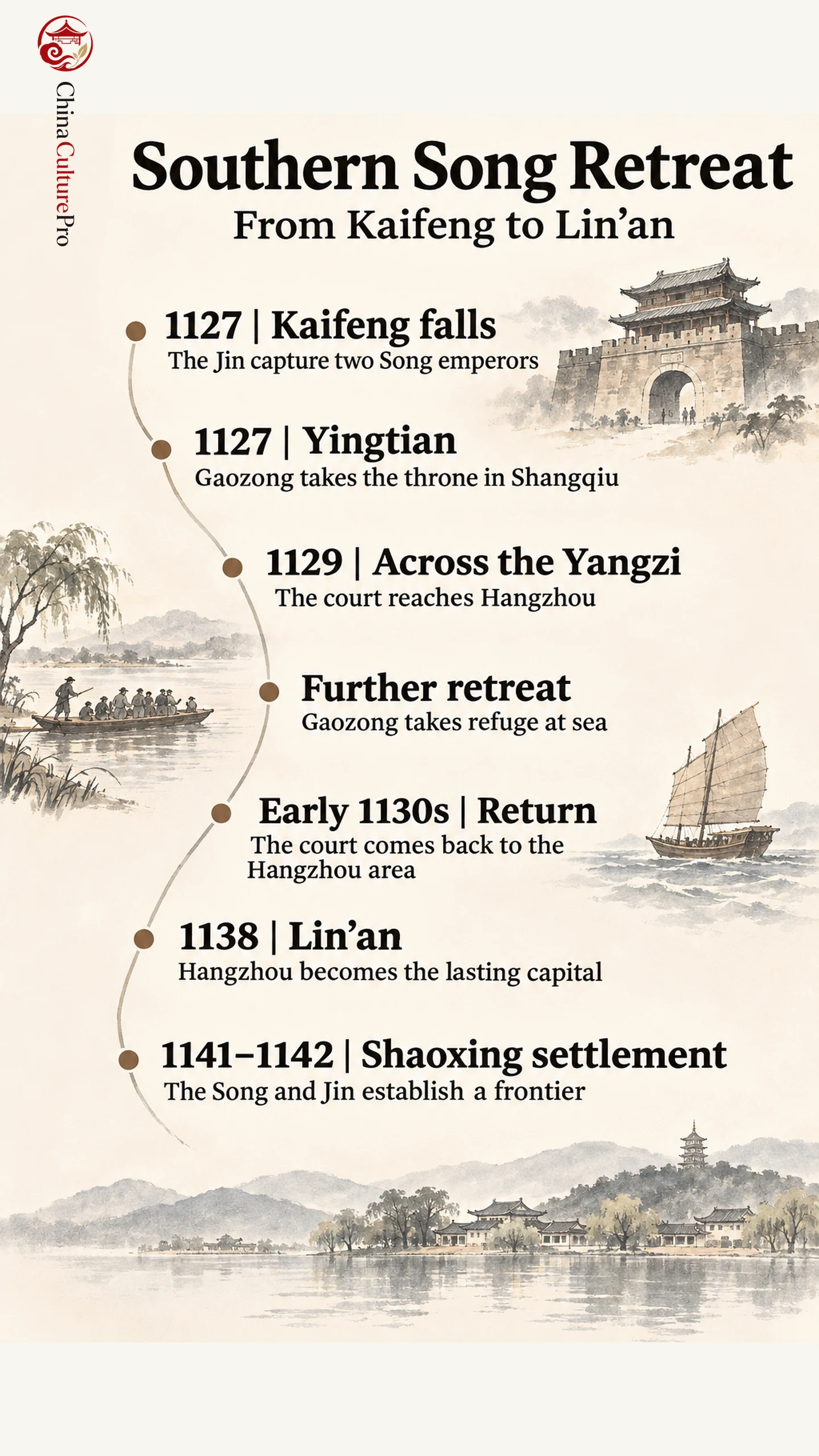
The Southern Song (南宋, Nán Sòng) retreat was the Song court’s move south after Jurchen forces took Kaifeng in 1127. Emperor Gaozong (宋高宗, Sòng Gāozōng) took the throne at Yingtian, in present-day Shangqiu. His court moved repeatedly before making Lin’an (临安, Lín’ān), today’s Hangzhou, its lasting seat of government. [1][2][3][4][5][6]
- 1127: The Northern Song capital fell and the court re-formed under Gaozong.
- 1129: The court reached Hangzhou but was still on the move.
- 1138: Lin’an became the lasting capital. [1][2][3][4][5]
The dates refer to different stages. The dynasty was restored years before its government settled in one city. [1][4][5]
Gaozong had to keep a court and an army in operation while moving them out of reach of the forces that had taken Kaifeng. The city that eventually became his capital was one stop in that process.
How the Song Court Re-Formed After Kaifeng Fell
In the Jingkang Incident (靖康之变, Jìngkāng Zhī Biàn), armies of the Jurchen Jin dynasty took Kaifeng, the Northern Song capital. They removed the reigning Qinzong and his father Huizong, a former emperor, and took members of the imperial family into captivity. Capturing the emperors left officials and armies outside Kaifeng without a reigning Song monarch they could reach. [1][2][4]
The prince Zhao Gou had been assigned a military command outside the city, so he escaped the capture of the court. He took the throne at Yingtian in 1127 and is known to history as Gaozong. Yingtian was also called Nanjing in Song records, a designation meaning Southern Capital. The site is in present-day Shangqiu in Henan, not the modern city of Nanjing in Jiangsu. Gaozong’s enthronement continued the Song dynasty while its armies and officials sought a defensible base. [1][2][4]
Where Gaozong’s Court Went Between 1127 and 1138
The court moved to Yangzhou, north of the Yangzi. When Jin troops threatened it in 1129, Gaozong crossed the river and traveled through cities including Zhenjiang and Changzhou toward Hangzhou. Hangzhou was elevated to Lin’an prefecture that year. The court faced problems within its own ranks as well. A military coup at Hangzhou briefly forced Gaozong from the throne in 1129 before his supporters restored him. Gaozong moved again as the Jin pursued him. [2][3][4][5]
The flight continued along the southeast coast. At one stage Gaozong put to sea, making clear how little security a stop at Hangzhou had provided in 1129. The court returned to the Hangzhou area in the early 1130s, but this did not settle all questions of where it would stay. Ye Han dates a decision to relocate to Lin’an to late 1131. The West Lake heritage nomination dates the city’s establishment as capital to 1138. The early date marks a renewed commitment to Lin’an. The later date marks its establishment as the enduring seat of government. [1][3][4][5]
Why Lin’an Became the Seat of Government
Hangzhou had waterways, commercial networks and an established urban economy before the court arrived. Its position south of the Yangzi put it farther from the early Jin advances. The city’s position on the Grand Canal connected it with other markets. Hangzhou had already been a regional capital under the Wuyue kingdom and a prosperous city during the Northern Song. The southern court could draw on the lower Yangzi economy. Existing trade and transport routes made it easier to supply officials, soldiers and the people who followed them. [4][5][6]
Documents often called Lin’an the seat of the traveling court, a term that reflected its origins as a place of refuge. It became the center of administration even though that older terminology survived. Businesses moved from the old capital and joined local traders. Markets expanded with the increased flow of people and supplies, and West Lake became a public setting for commerce and leisure alongside its role in garden and religious life. Xiaolin Duan’s study describes how commerce spread beyond the walls and water management became important for the growing city. [4][5][6]
What the Retreat Changed and How We Know
The Shaoxing settlement (绍兴和议, Shàoxīng Héyì) in 1141–1142 established a frontier between the Song and Jin. It followed the Huai River in the east and reached the Dasan Pass in the west. The Song agreed to make annual payments to the Jin in silver and silk. The settlement gave a diplomatic framework to the division created by the conquest. The Jin retained Kaifeng and the north, while the Song government continued to rule from Lin’an. [1][7]
The court’s move also changed Hangzhou over a much longer period. The West Lake nomination traces new gardens, buildings and named views developed in the Southern Song. These changes are easier to see in a study of the city than in an imperial annal, which tracks where Gaozong and his officials went and what they ordered. [3][4][5][6]
FAQs About the Southern Song Retreat
Was Gaozong crowned in modern Nanjing?
No. The Nanjing named in accounts of his enthronement was the Song Southern Capital at Yingtian, present-day Shangqiu. [2][4]
Did Hangzhou become the capital in 1127?
No. The court reached Hangzhou in 1129, returned in the early 1130s and established its long-term capital there in 1138. [3][4][5]
Is the Southern Song retreat the same as the Jingkang Incident?
The Jingkang Incident was the fall of the Northern Song capital and capture of its emperors. The retreat covers the restoration and repeated moves of the court that followed. [1][2][3][4]
Sources
[1] Tao Jing-shen. The Move to the South and the Reign of Kao-tsung, 1127–1162
[2] Toqto’a and other Yuan court compilers. History of the Song, volume 24: Annals of Gaozong, Part 1
[3] Toqto’a and other Yuan court compilers. History of the Song, volume 25: Annals of Gaozong, Part 2
[5] People’s Republic of China, nomination filed with UNESCO. West Lake Cultural Landscape of Hangzhou: World Heritage Nomination
[6] Xiaolin Duan. Lin’an: Nature, Commerce, and Transition
[7] Chih-Jung Huang. Territory, Sovereignty, and Empire/State