

Quick Answer: What Was the Xuanwu Gate Incident?
The Xuanwu Gate Incident (玄武门之变, Xuánwǔmén Zhī Biàn) was a palace coup in 626. Li Shimin (李世民, Lǐ Shìmín) and his supporters killed Crown Prince Li Jiancheng (李建成, Lǐ Jiànchéng) and their younger brother Li Yuanji (李元吉, Lǐ Yuánjí) at the palace in Chang’an. Emperor Gaozu (唐高祖, Táng Gāozǔ) named Li Shimin crown prince. Li Shimin later took the throne as Taizong (唐太宗, Táng Tàizōng). [1][2][3][4][5]
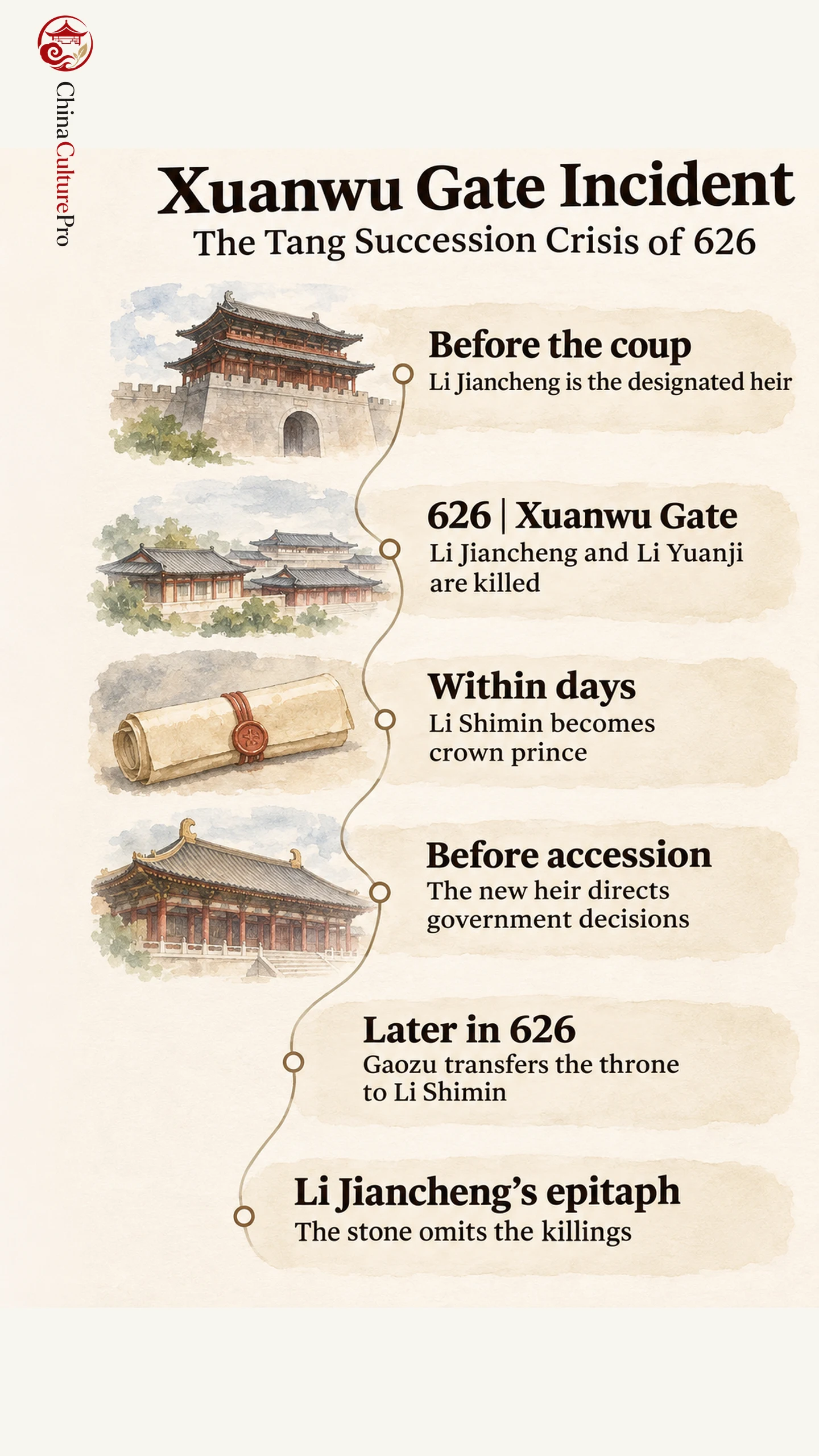
- Before: Li Jiancheng was the designated heir.
- After the coup: Li Shimin became crown prince and took charge of government decisions.
- Later in 626: Gaozu passed the throne to him. [1][2][3][6]
The court transferred decision-making power before it transferred the throne. [2][3][6]
The crown prince had the claim that mattered most in a formal succession. His younger brother had the military standing and political network to challenge it. At the palace gate in 626, that rivalry became a struggle over who could direct the Tang court.
Why the Tang Princes Competed for Power
When Li Yuan founded the Tang dynasty in 618 as Emperor Gaozu, he named his eldest son Li Jiancheng crown prince. Li Shimin, the Prince of Qin, won important victories during the wars that established the dynasty. He commanded troops in his own right and had a household staff with careers tied to his position. Li Yuanji, the Prince of Qi, aligned with the crown prince. [1][2][3][4]
The succession dispute took place while Gaozu was still on the throne. The crown prince’s title gave him a formal claim to inherit, while Li Shimin’s influence came partly from his role in the conquest. The succession therefore concerned more than the three brothers. The victory of one household would affect which commanders and officials served the next ruler. [2][3][4]
What Happened at the Xuanwu Gate
On the fourth day of the sixth lunar month of 626, Li Shimin and his men confronted his brothers at the Xuanwu Gate, the northern entrance to the imperial palace compound. Li Jiancheng and Li Yuanji were killed. The detailed account in Sima Guang’s Comprehensive Mirror for Aid in Government attributes the death of Li Jiancheng to Li Shimin and that of Li Yuanji to Li Shimin’s follower Yuchi Jingde. [2][3][5][7]
The histories give accounts of accusations and threats preceding the killings. Those accounts are evidence of how writers explained the coup, but they cannot independently establish every private plan attributed to the princes. For example, Jun Li examines whether the north gate guard itself played a decisive part. The certainty that the killings occurred does not settle which officers prepared the way for them. [3][5][7]
How Li Shimin Took Control of the Government
Gaozu appointed Li Shimin crown prince within days. The Comprehensive Mirror records a further instruction that government and military matters be decided by the new heir. Li Shimin thus gained control over much of the government before he held the title of emperor. Gaozu was still emperor during that interval. He transferred the throne in the eighth lunar month of 626, about two months after the killings. Gaozu then held the title of retired emperor, while Li Shimin reigned as Taizong. [1][2][3][6]
The new leadership combined punishment with accommodation. The dead princes’ sons were killed, while the court announced a broad amnesty for other followers. Some of Li Shimin’s own advisers, including Fang Xuanling and Du Ruhui, took posts in his new household and later in the central government. Li Shimin also gave a position to Wei Zheng, who had previously advised Li Jiancheng. The appointments kept some existing expertise while moving authority toward the new heir. Ang Zou identifies one example of Li Shimin’s new authority. Before his accession, he suspended a decree of Gaozu’s that would have reduced the number of Buddhist and Daoist institutions and monastics. [2][3][6]
What the Annals and Li Jiancheng’s Epitaph Reveal
The Old Book of Tang presents the coup within the annals of the new emperor. Sima Guang, writing centuries later, criticized the killing even as he recognized the tension between the eldest son’s formal position and Li Shimin’s part in founding the dynasty. Sima Guang’s discussion asks what precedent the killings set for later Tang successions. That is a later historian’s judgment rather than a record of what the participants said on the day. [2][3][4]
Li Jiancheng’s epitaph provides a different source. Lü Bo’s study notes that part of the inscription showing his posthumous title was altered. The epitaph leaves out the violent episode that brought the crown prince’s life to an end. Lü compares the stone with transmitted texts to reconstruct how the court handled the dead prince’s title. The epitaph shows how he was commemorated. It does not establish how the brothers planned their confrontation. [2][3][7]
FAQs About the Xuanwu Gate Incident
Where was the Xuanwu Gate?
It was a northern entrance to the imperial palace compound at Chang’an, the Tang capital, near present-day Xi’an. [2][3][5]
Did Li Shimin become emperor on the day of the coup?
No. Gaozu first named him crown prince and delegated authority. Li Shimin took the throne later in 626. [2][3][6]
Why is Li Jiancheng’s epitaph important?
Its altered inscription and omissions are material evidence for how Li Jiancheng was commemorated. The epitaph records a different aspect of the event from the annals and later histories. [2][3][7]
Sources
[1] Palace Museum, Beijing. Li Shimin
[2] Liu Xu and other compilers. Old Book of Tang, chapter 2: Annals of Taizong
[3] Sima Guang and collaborators. Comprehensive Mirror for Aid in Government, volume 191
[4] Howard J. Wechsler. Taizong, Reign 626–649: The Consolidator
[5] Jun Li. The North Gate Guard and the Xuanwu Gate Coup of 626
[6] Ang Zou. The Life of Daoxuan: According to Others and in His Own Words
[7] Lü Bo. The Epitaph of Li Jiancheng and the Xuanwu Gate Incident