
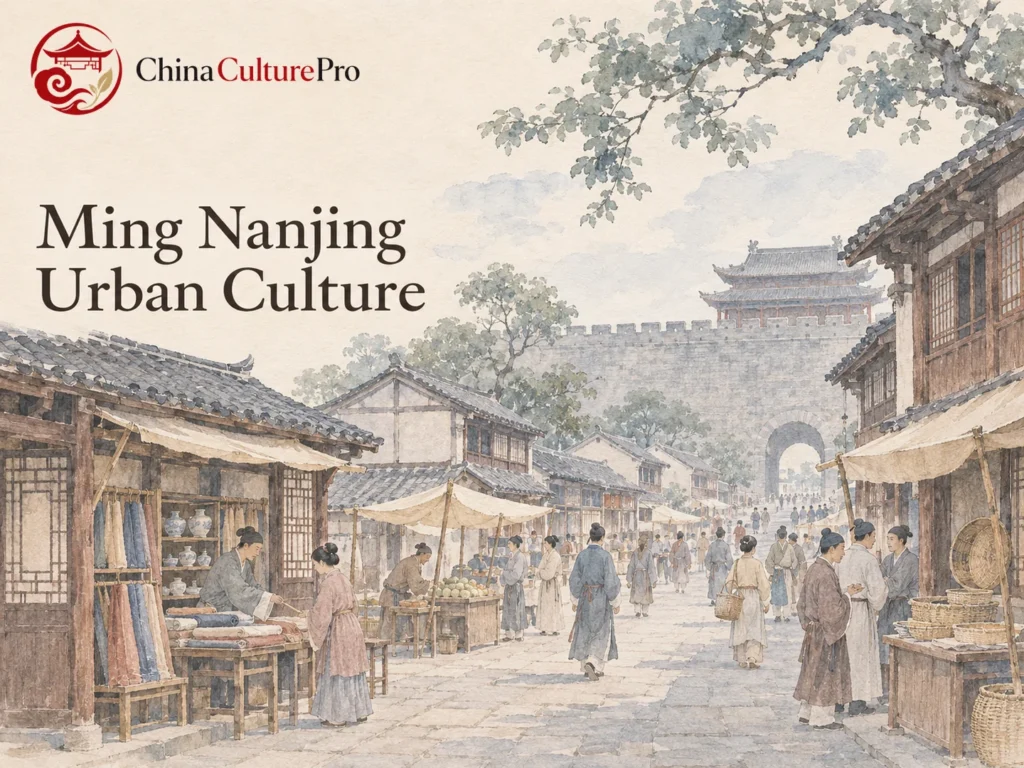

Quick Answer: What Was Ming Nanjing Like?
Nanjing (南京, Nánjīng) was the first principal capital of the Ming dynasty. After the court moved to Beijing in 1421, it retained institutions of a southern capital. Later Ming evidence shows a city of markets, publishing businesses, performances and cultural networks as well as government buildings.[1][2][4][6]
- Capital building: Ming wall bricks preserve marks connected to construction and supply.[3]
- Commerce: A surviving handscroll depicts crowded streets, shop signs and entertainment.[4]
- Culture: Publishing and the arts gave people different ways to experience and represent the city.[1][5][6]
Early capital building and the later commercial revival belong to different phases. A late Ming painting tells us about a city that had already lived through the move of the court.[1][2][4]
An inscription on a city wall brick can name a supplier in another prefecture. A later handscroll gives store signs and a stage their own place in the city. The two sources describe different phases and different kinds of work.[3][4]
From the First Ming Capital to the Southern Capital
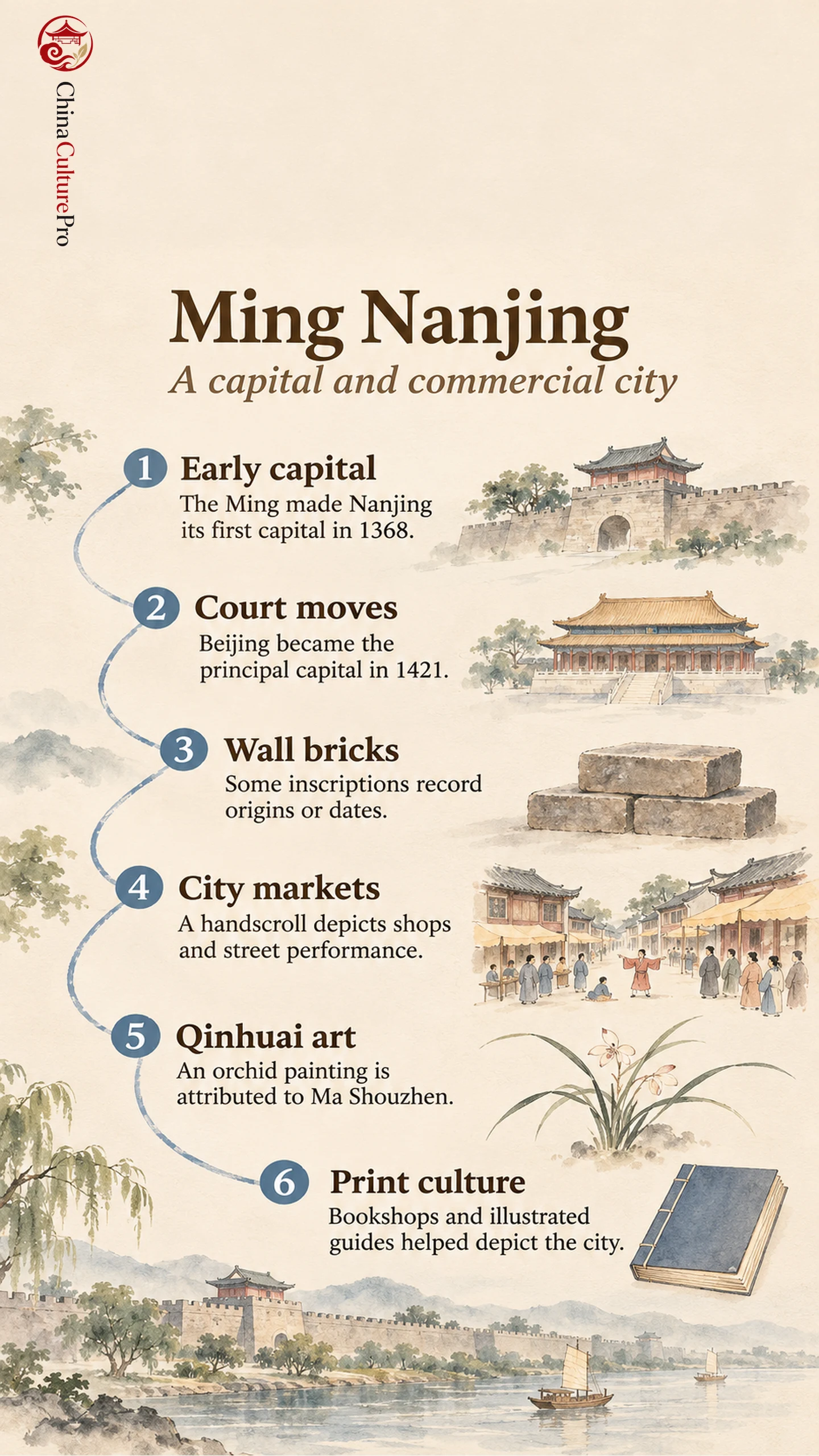
The Ming founder established his capital at Nanjing in 1368. The first decades brought major changes to its built environment. In 1421, the Yongle emperor moved the principal capital to Beijing. The change reduced Nanjing’s political role and disrupted the local economy. The city later revived as a commercial center within the Lower Yangzi region.[1][2]
Nanjing retained official functions, including educational and examination institutions. Its Guozijian was part of the Ming system of institutions in two capitals. Official activity remained part of city life, alongside enterprises and cultural institutions outside the court.[1][2][7]
What the City Wall Bricks Record
Some wall bricks carry dates and inscriptions naming where they were made or who was involved in making them. The material can therefore connect a wall in Nanjing to the many places and people that supplied it. Nanjing’s municipal heritage account describes dated bricks from the Hongwu reign and bricks identified with Yuanzhou Prefecture in what is now Jiangxi.[3]
The inscription matters because the finished wall conceals most of the process that produced it. A mark on an individual brick can preserve the identity of a place or person behind a large building project. It gives a different kind of record from a view of the completed city.[3]
Shops, Performance and the Qinhuai
The National Museum of China preserves the handscroll <em>Thriving Southern Capital</em> (南都繁會圖, Nándū Fánhuì Tú). It shows busy commercial streets, traders, signs and a stage. Some signs advertise leather goods from the northwest or seafood associated with Fujian and Guangdong. A stage gathers spectators in the middle of the painted street. The painter put buying, selling and performance within the same urban scene.[2][4]
The Qinhuai (秦淮, Qínhuái) pleasure district was another setting for the arts. The Metropolitan Museum of Art holds a 1572 painting of an orchid and rock attributed to Ma Shouzhen (馬守真, Mǎ Shǒuzhēn), an artist associated with the district. The attribution connects this painting to one figure in a neighborhood where artists and patrons met. It is a different kind of evidence from the commercial crowd in the handscroll.[2][5]
How Printed Books Represented the City
The bookshops of Three Mountains Street (三山街, Sānshān Jiē) were part of Ming Nanjing’s commercial life. Some of the Chinese publishing houses that worked there made books for audiences far beyond the city. Their role fits the larger pattern of late imperial printing markets.[6]
Books could also shape how people pictured Nanjing. Si-yen Fei studies the illustrated guide <em>Illustrated Odes on Nanjing</em> (金陵圖詠, Jīnlíng Túyǒng), which selected sites in and around the city and brought together images and writing about them. Fei reads it as a guide to experiences associated with those places. It shows how a book could direct attention to a city’s landscapes and cultural associations.[1]
FAQs About Ming Nanjing
When did the Ming court move to Beijing?
Beijing became the principal capital in 1421 under the Yongle emperor. Nanjing retained some government and educational functions after the move.[1][2]
Why do some Nanjing wall bricks have writing?
Marks could identify their origin, date or people associated with production. Individual bricks can document parts of the wall’s supply network.[3]
Is the handscroll a literal map of the city?
It represents selected scenes of commerce and performance. Its details can support historical interpretation, while the painted selection and arrangement reflect the artist’s choices.[2][4]
Sources
[1] Si-yen Fei, Urban History. Ways of Looking: The Creation and Social Use of Urban Guidebooks
[2] Monica Merlin, University of Oxford. The Late Ming Courtesan Ma Shouzhen: Visual Culture, Gender and Self-Fashioning in the Nanjing Pleasure Quarter
[3] Nanjing Municipal Bureau of Culture and Tourism. Inscriptions on Nanjing’s Ming city wall bricks
[4] National Museum of China. Thriving Southern Capital handscroll
[5] The Metropolitan Museum of Art. Orchid and Rock, attributed to Ma Shouzhen
[6] Lucille Chia. Of Three Mountains Street: The Commercial Publishers of Ming Nanjing
[7] Architectural Institute of Japan. The Research on the Nanjing Guozijian in Ming Dynasty