


Quick Answer: How Did Late Imperial Printing Markets Work?
Late imperial Chinese printing markets connected workshops to paying readers through commercial booksellers. A business had to choose which titles to publish, pay for production and get copies to buyers. During the Ming and Qing, those tasks linked large cities with small printing centers and bookshops in other regions.[1][2][3]
- Production: Once a publisher had paid to carve blocks, the same blocks could be used to print more copies when needed.[1][3]
- Distribution: Traveling booksellers and branch shops helped reach customers beyond the place of printing.[2]
- Demand: Educational texts, reference books and practical manuals could support a market alongside fiction and other works.[1][2][4]
The market reached different readers in different ways. A printed title’s survival does not tell us how many copies it sold or who read them.[1][2]
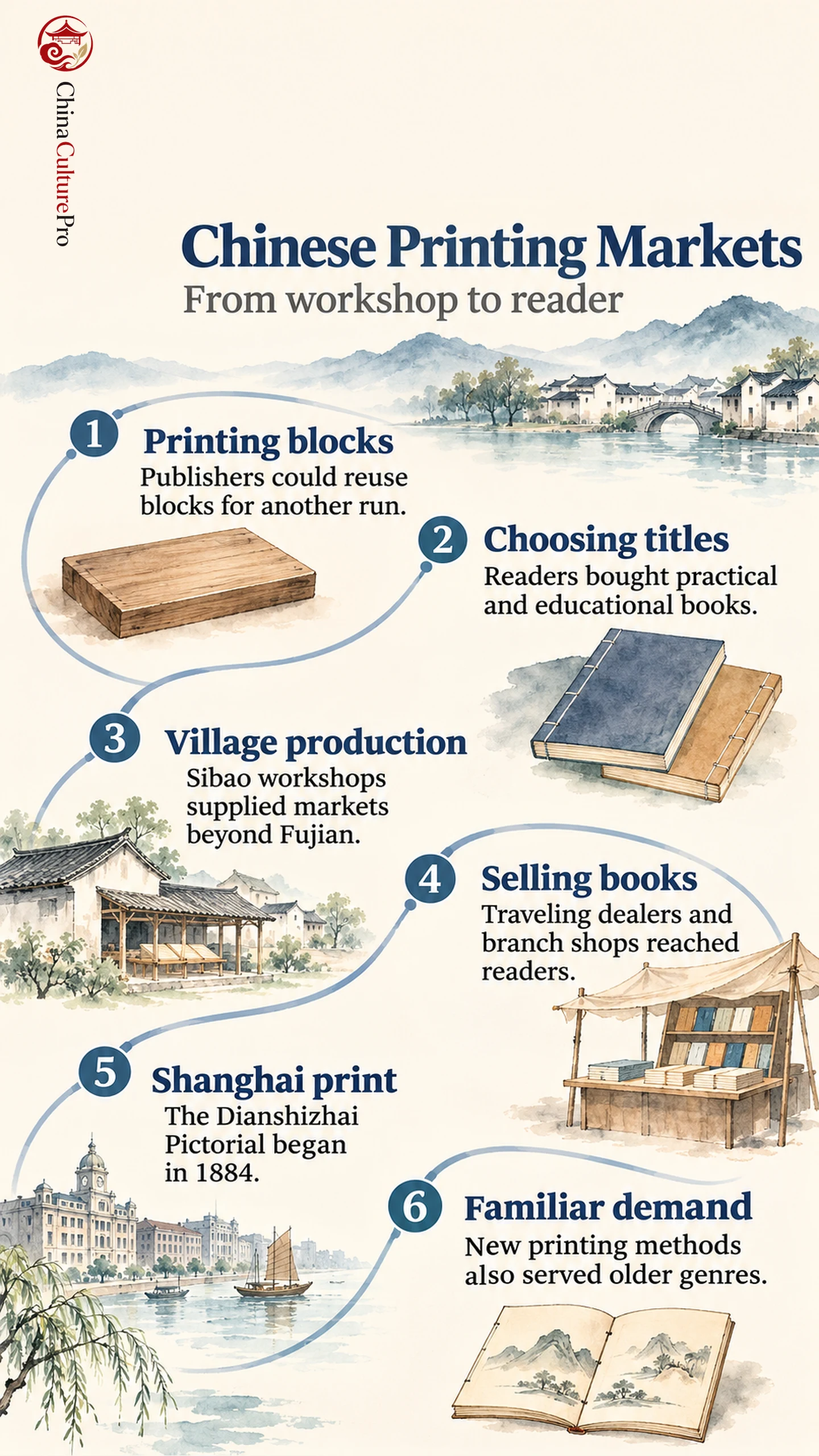
A medical handbook printed in a Fujian village could reach a reader through a traveling bookseller or a branch shop. The workshop could use the same blocks for another run if the book found buyers.[2][3]
Why a Publisher Kept the Woodblocks
Producing a woodblock edition required paying for a prepared text and carved blocks. After that initial work, the blocks remained a resource for future impressions. A workshop could print some copies, watch demand and return to the same blocks to make more. This gave printers a way to manage uncertainty about how many readers would buy an edition.[1][3]
Reusing blocks spread the cost of preparing an edition over several runs. A printer still needed paper, labor and a place to store the blocks. A bookseller needed buyers and a way to keep stock moving. The article on Chinese publishing houses describes the different kinds of sponsors that could arrange an edition. A commercial publisher also had to decide how much stock to carry and whether a new run was worth paying for.[1][3][5]
What Buyers Wanted to Read
Commercial printers in Jianyang (建陽, Jiànyáng), Fujian, published for readers with different needs over several centuries. Their output shows the variety within a single publishing center. One reader might look for a reference work or an educational text, while another wanted fiction.[1]
Sibao (四堡, Sìbǎo), in western Fujian, supplied books that were useful in schools and households. Cynthia Brokaw’s study identifies educational titles, household guides and medical handbooks among the inexpensive books moving through its network. These ordinary titles help explain how the market extended beyond collectors and owners of deluxe editions.[2][5]
How Sibao Books Reached Other Regions
Sibao’s publishing industry drew on local labor and materials. Sales, however, extended well beyond its home villages. Traveling booksellers carried stock, while branches managed by people from Sibao offered a more permanent outlet. Traveling sellers took books to readers along a route. Branch shops kept stock available in a settled location. The combination let production remain concentrated while sales spread across much of southern China.[2][5]
A production center and a sales center could therefore be different places. A reader might purchase a book in one of the Chinese market towns on a seller’s route, even though its blocks and the workshop that printed it were far away. Distribution was what made the original investment in blocks useful beyond the village.[2][3]
What Changed in Late Qing Shanghai
Shanghai developed newspapers, illustrated publications and new publishing businesses. The <em>Dianshizhai Pictorial</em> (點石齋畫報, Diǎnshízhāi Huàbào) began in 1884 as an illustrated supplement to a Shanghai newspaper. It appeared as a separate booklet, adapting stories from the newspaper to another format.[6] Yet demand for older categories continued. Studies of the Shanghai market note that dictionaries, classical works and examination aids sold well in reprint.[4]
Lithography could provide a different way to reproduce books while serving readers who still wanted familiar titles. A printer could therefore serve readers seeking familiar books while another publication catered to readers of illustrated news. The new production method and the new genre were separate developments.[4]
FAQs About Late Imperial Printing Markets
Were commercial books printed only in major cities?
Smaller centers supplied wide markets. Sibao workshops used traveling sellers and branch shops to get books to readers elsewhere.[2][5]
Why did publishers continue using woodblocks?
The blocks could be stored and used for another run. After the up-front work, a publisher could print more copies as demand developed.[3]
Did lithography make older kinds of books disappear?
Late Qing printers continued to sell reprints of dictionaries, classics and examination aids. New technology could serve established demand.[4]
Sources
[1] Lucille Chia, Harvard-Yenching Institute. Printing for Profit: The Commercial Publishers of Jianyang, Fujian
[2] Cynthia J. Brokaw, Harvard University Asia Center. Commerce in Culture: The Sibao Book Trade in the Qing and Republican Periods
[3] Cynthia J. Brokaw, Hong Kong University Press. Empire of Texts: Book Production, Book Distribution, and Book Culture in Late Imperial China
[4] Journal of Chinese History. From Suzhou to Shanghai: A Tale of Two Systems
[5] The American Historical Review. Review of Commerce in Culture
[6] MIT Visualizing Cultures. The Dianshizhai Illustrated Supplement: Introduction and first issues