


Quick Answer: What Was Imperial Household Registration?
Household registration (戶籍, hùjí) was a way for Chinese governments to record who belonged to a household and classify it for administration. Surviving records and rules differ by dynasty. Depending on the period, registers could track family members, property, legal status or liability for taxes and public service.[1][2]
- Records: Early slips name members of particular households and distinguish categories such as adults and children.[2][3]
- Obligations: Officials used registration to organize duties, from labor and military service to taxes assessed on property.[1]
- Change: The relationship between household membership, land ownership and taxation shifted across dynasties.[1]
A register reflects what officials intended to count. Its categories and totals need to be read in light of the administrative purpose and the quality of local reporting.[1]
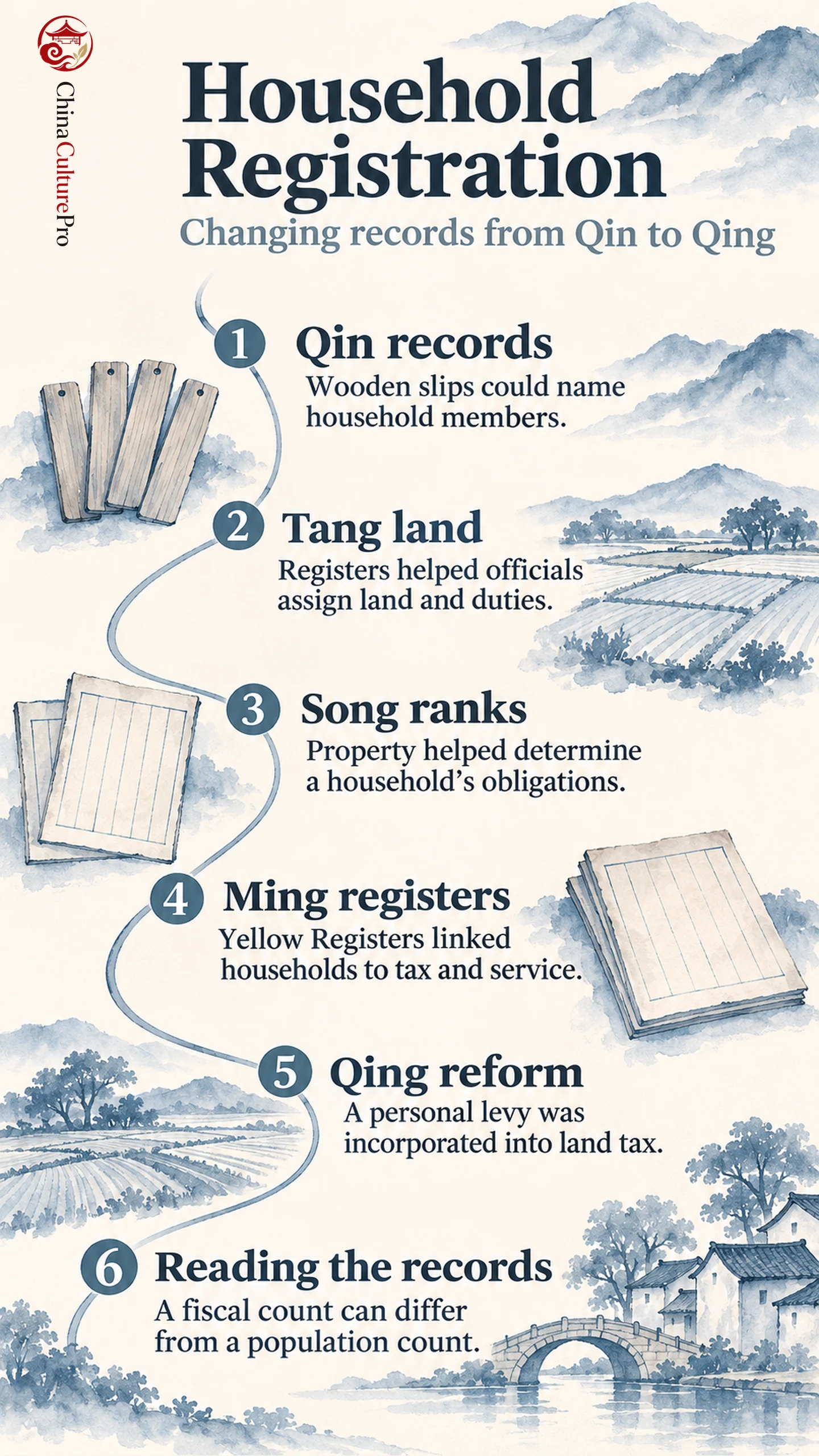
A Qin clerk could scrape a name off a wooden household slip. A Ming official working on a later register might instead check the taxable duties assigned to a village group. The records tell us both who appeared on the page and what the office wanted to know.[1][2]
What a Qin Household Register Could Record
Wooden records from Liye (里耶, Lǐyē) in present-day Hunan preserve paperwork from Qin Qianling County. A household entry could begin with the householder and then name a spouse, children, other relatives and enslaved members. Some entries distinguish minors from adults. These were categories used by an office whose files also covered taxes, population and other county business.[2][3]
The household gave early states a practical unit for assigning labor and military duties. Even a short entry can tell a historian whose names the office recorded and how it classified them. Changes to a slip can also preserve a trace of updating. In one example, an erasure has been interpreted as the removal of a wife’s name, possibly after her death.[1][2]
Tang Land Allocations and Song Household Ranks
The Tang equal-field system linked registered people to possible land allocations and fiscal obligations. An office had to know who qualified before it could calculate a share. Actual holdings in surviving registers could differ from those laid down in the rules. Linking people and land on paper helped make the claims visible, even where a full share was unavailable.[1]
The Song also distinguished host households (主戶, zhǔhù), which held property, and guest households (客戶, kèhù), which lacked the property used for that classification. The Song ranked rural property holders in five classes, and those ranks could affect service duties. Urban classifications used a different scale. A rank described a household’s position in a fiscal system. It was distinct from the record of which people belonged to that household.[1]
Ming Yellow Registers and the Lijia
The Ming compiled Yellow Registers (黃冊, huángcè) on a ten-year cycle. The Ming collected statutes specify that the ten-year survey was used to determine taxes and service. The register connected those obligations to information about households and property. The lijia system (里甲, lǐjiǎ), introduced under Hongwu in 1381, organized rural households into groups with rotating leadership and collective administrative obligations.[1][4][5]
A surviving register offers a view of the unit officials charged with a duty. It needs to be read with care when used to estimate population. Some Ming totals for men liable for service stayed nearly constant over long periods. A figure copied or preserved for assessment could survive changes in the population behind it. In practice, a county’s written obligations could outlast changes in the household on the ground, a distinction relevant to the work of Chinese magistrates.[1]
How Qing Tax Reform Changed What Officials Counted
The Qing stopped compiling the Ming-style Yellow Registers in the seventeenth century and used other surveys. One object of those surveys was the ding (丁, dīng), a taxable adult male or an accounting unit for the levy associated with such men. In 1712 the court fixed quotas for that levy using earlier returns. Eighteenth-century changes then incorporated it into the land tax, helping put the fiscal emphasis on landholdings and land-tax silver.[1][6]
Officials still had reasons to collect information about where people lived and how households were grouped. The fiscal reform changed the purpose of some records and reduced the need for older counts of men liable for labor-service payments. A later local list may therefore answer a different administrative question from a Ming Yellow Register.[1]
FAQs About Imperial Household Registration
Can an imperial household register give the total population?
It can provide evidence about people recorded by a particular office. The categories, people omitted and purpose of the count matter when estimating a wider population.[1][2]
Did household registration include property?
Some systems recorded property or used it to rank households. The Song household grades and Ming Yellow Registers are examples. The details varied over time.[1]
Did Qing officials stop registering households?
Officials continued collecting information for local administration. Qing fiscal changes altered which categories they needed to assess taxation, especially after the personal levy was combined with land tax.[1]
Sources
[1] Richard von Glahn, in Registration and Recognition. Full chapter on imperial household registration
[2] Brill. Early household registers and the Liye finds
[3] Hunan Provincial Cultural Heritage Bureau. Liye Qin slips and the Qianling county archive
[4] The Palace Museum. Yellow Registers
[5] Collected Statutes of the Ming Dynasty, translated by Leif Littrup. Chapter 20: Population and the Yellow Registers
[6] Helen Dunstan, Journal of Chinese History. Fiscal Irrationality and Dynastic Succession in Eighteenth-Century China