

Quick Answer: What Were Shuyuan Academies?
A shuyuan (書院, shūyuàn) could bring books, teachers and students together in one institution. In imperial China these academies could combine teaching with a library and ceremonial life. They took different forms across periods. Scholars, local supporters and officials all played a part in founding or running particular institutions.[1][2][4]
- Books: Collections gave teachers and students material to read and discuss.[1][2]
- Teaching: Some academies hosted lectures, private study and exchanges between scholars.[1][2]
- Ritual: Honoring sages or teachers could form part of institutional life.[1]
Academies could complement government schools, and some received official support. Their degree of independence varied.[1][4]
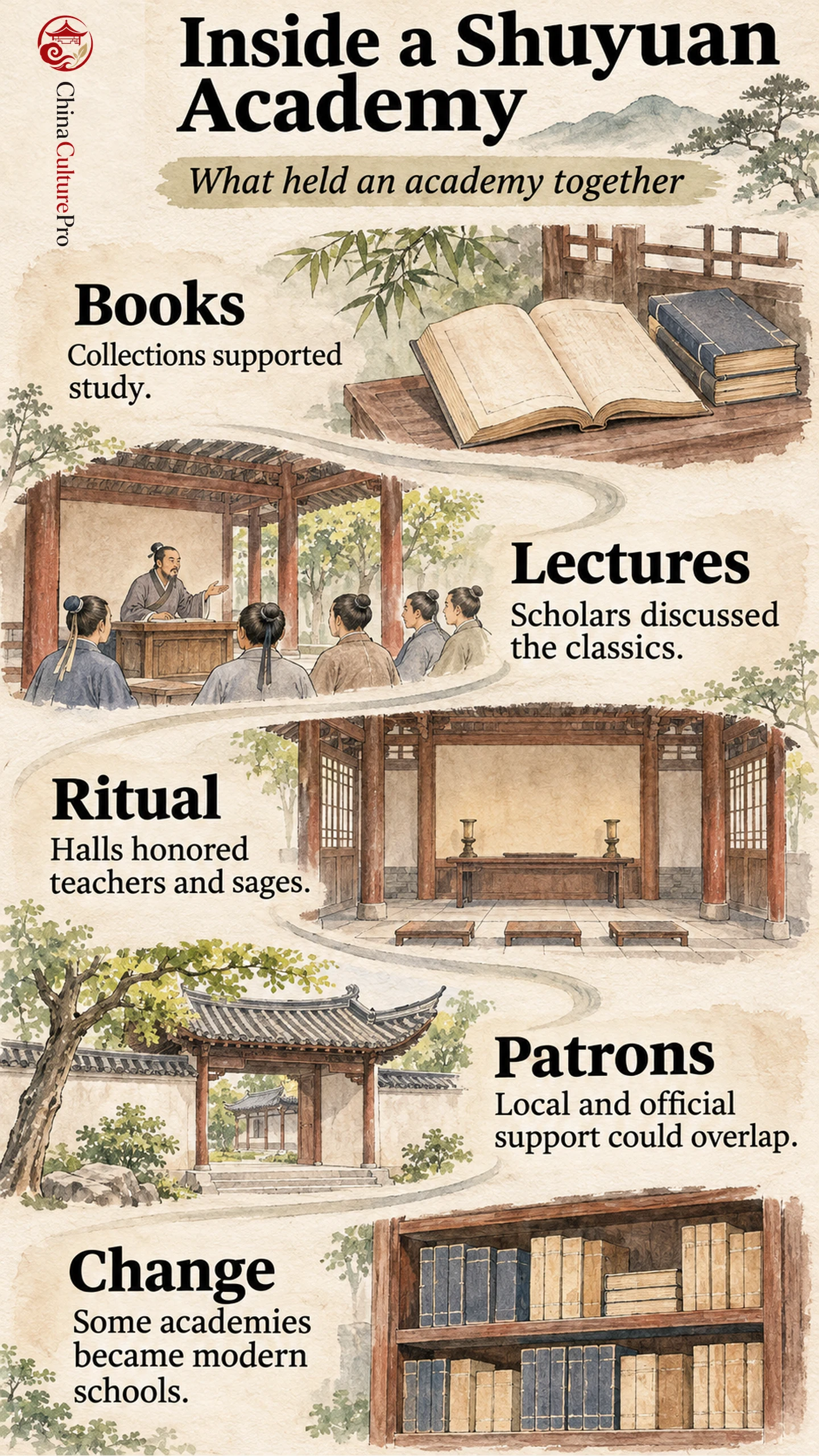
An academy could be a place to listen to a visiting scholar, consult a book or honor earlier teachers. The buildings at a surviving site may preserve a lecture hall or a library, but the people and resources that made them useful changed over time.[1][2][3]
Books, Lectures and Ritual
The Songyang Academy material in the UNESCO nomination for the Dengfeng monuments describes book collection, teaching and worship as functions of the institution. Collections brought books together where students could consult them. Teaching could involve explanation of the classics and discussion, as well as study that students undertook on their own.[1][2]
Some academies encouraged academic exchanges. Yuelu Academy (嶽麓書院, Yuèlù Shūyuàn), formally established in 976, became associated with the Southern Song scholars Zhang Shi and Zhu Xi. Their discussions illustrate the connection between an academy and a wider community of scholars. A particular academy could also honor earlier teachers through worship. The mix of study, debate and ritual made these institutions part of intellectual and local life.[1][2][3]
The Four Great Academies are a way to compare celebrated sites. The word shuyuan describes the broader kind of institution to which those sites belonged.[1][3]
Who Supported the Academies
The word private can obscure how an academy was actually supported. Scholars might lead its teaching while officials or other local patrons helped provide resources. The Qing court also acted directly. In 1733 the Yongzheng emperor ordered the establishment of academies in provincial capitals.[1][4]
The 1733 order gave the court a clearer role in provincial academies. At Luoyuan Academy (濼源書院, Luòyuán Shūyuàn) in Jinan, the policy still relied on people in the province to put it into practice. Official funding and local management could operate together. This example shows why the founder, the source of funds and the people running an academy are separate questions.[4]
How Shuyuan Related to State Schools and Exams
The Guozijian was a central state institution, while the shuyuan label applied to many institutions with differing origins and sponsors. Both existed in a world where the classics mattered to education and government. Study at a shuyuan could help prepare a student for the civil examinations, depending on its curriculum. Passing an examination remained a separate route to a credential.[1][2][4]
What Changed in the Late Qing
Hunan University dates Yuelu’s conversion into the Hunan Institute of Higher Learning to 1903. The change belonged to the late Qing transformation of educational institutions. Yuelu shows how a site and its name could outlast a change in the kind of school it housed. Other academies had their own trajectories, and a surviving complex can carry evidence from several different periods.[3]
FAQs About Shuyuan Academies
Were shuyuan always privately run?
Patronage and administration varied. The Qing order of 1733 supported academies in provincial capitals, and local participants helped operate them.[4]
Did every academy teach in the same way?
Institutions differed. The documented activities include everyday teaching, self-study, scholarly exchanges and events that could admit a wider audience.[1][2]
Is a shuyuan the same as the Guozijian?
Shuyuan names a category of academy with many local examples. Guozijian refers to a central institution of the imperial state.[1][4]
Sources
[1] UNESCO World Heritage Centre. Nomination dossier for the Historic Monuments of Dengfeng
[2] Andy Kirkpatrick and Zhichang Xu. Shuyuan and Chinese Writing Pedagogy
[3] Hunan University. Yuelu Academy
[4] University of Cambridge Repository. A Provincial Legacy of Autocracy: Shandong’s Luoyuan Academy in and beyond the Yongzheng Reign