
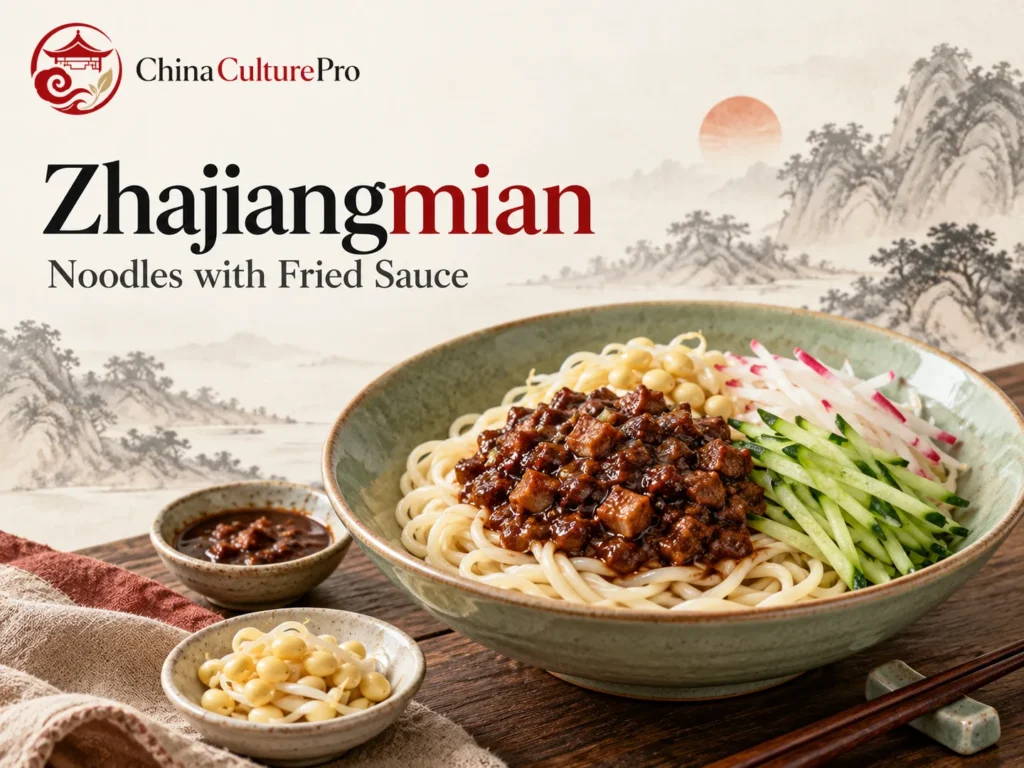

Quick Answer: What Is Zhajiangmian?
Zhajiangmian (炸酱面, zhájiàngmiàn) is a Chinese noodle dish strongly associated with Beijing, built around wheat noodles and a savory cooked paste sauce.
- Noodles: Firm, chewy wheat strands carry the concentrated sauce; thickness and shape vary.
- Fried sauce: Fermented pastes are cooked in oil, commonly with diced or minced pork, to make a rich topping.
- Vegetable toppings: Caima (菜码, càimǎ) provide fresh or cooked vegetables and beans that contrast with the sauce.
Among Chinese noodles, this is generally a boiled-and-tossed dish: the name’s “fried” describes the sauce, not a requirement to fry the strands.

A Beijing bowl may pair dark pork sauce with crisp vegetable shreds. A Taiwanese household version might add mushrooms and tofu; a Hong Kong café plate may feature pork strips in a red, tangy sauce. The same name covers different combinations of noodles, sauce and toppings.
Why Is It Called Fried Sauce Noodles?
The sauce is called zhajiang (炸酱, zhájiàng), literally “fried sauce.” Fermented paste and aromatics are cooked in oil, often together with meat, creating a concentrated topping. The noodles are normally boiled separately, then dressed with the sauce and vegetables.[1]
That differs from chow mein (炒面, chǎomiàn), whose preparation centers on frying the noodles themselves. A bowl of zhajiangmian does not need a crisp noodle base or a final stir-fry of the strands. Its dark color and glossy coating come mainly from the sauce, not from browning the noodles in a wok.
The Three Parts of a Bowl of Zhajiangmian
Wheat Noodles and Their Texture
Wheat noodles give the dish a firm, springy base. Hand-rolled noodles (手擀面, shǒugǎnmiàn) are a familiar Beijing choice, but machine-cut and dried wheat noodles also appear. Rolled-and-cut strands can be flat; they are not necessarily round. Thicker noodles offer a substantial bite against the sauce, while thinner choices produce a lighter mouthful.[1]
There is no universal width, and handmade noodles are not a condition for using the dish’s name. Egg and alkaline noodles occur in some preparations, especially Hong Kong examples; the noodle recipe and finished sauce remain separate questions.
Fermented Pastes and the Meat Sauce
Yellow soybean paste, huangjiang (黄酱, huángjiàng), contributes a concentrated fermented savoriness. Sweet flour sauce, tianmianjiang (甜面酱, tiánmiànjiàng), traditionally uses fermented wheat flour and brings sweetness as well as savory depth. Beijing household recipes may combine pastes or favor one; a sweet-flour-sauce-only version is also documented.[2]
The English label “sweet bean sauce” can be misleading. Commercial formulations differ, and some include both soybeans and wheat, so neither “all bean” nor “soy-free” is a safe assumption.[3] These pastes also differ from Sichuan chili bean paste, doubanjiang (豆瓣酱, dòubànjiàng), which can change the dish’s heat and flavor.
Diced pork supplies distinct bites, while minced pork spreads more evenly through the sauce. Neither cut is compulsory across every household. Saltiness, sweetness, richness and the amount of meat vary independently; a dark sauce does not establish one fixed flavor balance.
Vegetable Toppings: What Caima Means
Caima are an important part of the eating experience, not simply decoration. Cucumber and radish shreds bring crispness; bean sprouts, soybeans and other vegetables may be cooked before serving. The selection changes with the season and the cook, rather than following a mandatory list.[4]
Their lighter flavors and contrasting textures break up the concentrated sauce between bites. Some bowls arrive already assembled; others include small dishes of toppings to mix in. The Beijing expression “seven plates and eight bowls” describes abundance, not a requirement to count out fifteen separate accompaniments.[4]
Regional Variations of Zhajiangmian
Regional names offer clues, but household choices still matter. These are representative preparations, not rules governing every bowl from each place. A useful comparison looks at the paste, the size of the meat pieces and the relationship between sauce and vegetables, rather than simply judging how dark the sauce appears.
| Example | Sauce and meat | Noodles and accompaniments | Flavor and boundary |
|---|---|---|---|
| Beijing-style | Yellow soybean paste, sweet flour sauce or a blend, commonly with pork pieces. | Firm wheat noodles and seasonal caima; some vegetables are raw, others cooked. | Savory, fermented and rich. Paste choice, sweetness and meat cut vary between families.[2][4] |
| Taiwanese home-style examples | Minced pork may share the sauce with shiitake mushrooms and firm pressed tofu pieces. | Wheat noodles with finely divided sauce ingredients; fresh cucumber can add contrast. | A textured, mushroom-rich sauce is one pattern. Tofu, mushrooms and chili are not compulsory in every Taiwanese bowl.[5] |
| Hong Kong café examples | Pork strips can accompany ketchup, vinegar, chili sauce and fermented bean seasoning. | Cha chaan teng (茶餐厅, chácāntīng), or Hong Kong cafés, may use thin egg or alkaline noodles, with cooked greens in some examples. | Often redder, tangy, sweet and spicy. The sauce and garnish vary; it need not reproduce Beijing’s caima arrangement.[6] |
Zhajiangmian vs Jajangmyeon
Korean jajangmyeon shares Chinese culinary roots with zhajiangmian, but developed within Korean-Chinese cooking. Common versions feature a glossy, very dark, savory-sweet sauce with pork and vegetables such as onion. It is a related dish with its own preparations, not simply another name for a Beijing bowl.[7]
Its characteristic paste is chunjang. Although often labeled “black bean paste” in English, that name does not establish that it is made only from black soybeans: commercial ingredients can include wheat flour, soybeans and caramel coloring.[8] Compare the actual sauce and ingredients rather than assuming that every Korean version is sweeter than every Chinese one, or that dark color alone identifies the paste.
Eating Zhajiangmian and Checking Ingredients
Mix the sauce through the noodles and fold in the vegetable toppings. When sauce is supplied separately, add it to suit the bowl rather than assuming the entire serving must go in at once. Warm noodles and noodles cooled by rinsing are both familiar Beijing presentations; the dish is not required to be cold.[4]
Before ordering, check the whole bowl:
- Meat and fat: Ask whether the sauce contains pork, meat stock, lard or other animal ingredients, even when the vegetables are prominent.
- Noodles and pastes: Wheat and soy are common. Egg can occur in noodle dough, and sauce formulations may include additional ingredients such as sesame.[3]
- Vegetarian preparation: Confirm that the sauce and cooking fat are suitable, rather than asking only for the visible meat to be removed.
The same ingredient-by-ingredient approach helps when choosing Chinese vegetarian food.
FAQs About Zhajiangmian
Are the noodles themselves fried?
Usually, no. The noodles are boiled and mixed with the cooked sauce. “Fried sauce” refers to how the topping is prepared; it does not mean that the finished bowl must contain fried or crunchy noodle strands.
Is zhajiangmian spicy?
Beijing-style versions commonly emphasize savory fermented flavor rather than chili heat. Some Taiwanese or Hong Kong preparations add chili. Ask about the particular sauce instead of assuming either that all versions are mild or that all are spicy.
How is zhajiangmian different from dan dan noodles?
Zhajiangmian centers on cooked fermented paste sauce. Sichuan dan dan noodles (担担面, dàndànmiàn) commonly emphasize chili oil and Sichuan pepper alongside savory toppings. Their sauces vary, so “thick versus thin” is not a reliable universal distinction.
Is zhajiangmian served hot or cold?
Both are possible. Noodles can be served warm or cooled by rinsing before mixing. Cool noodles do not necessarily mean that the sauce and every topping are also cold.
Can zhajiangmian be vegetarian?
Yes. Mushrooms and tofu can replace meat, but confirm the paste, stock and cooking fat too. A vegetable garnish or the removal of pork pieces alone does not establish that the entire dish is vegetarian or vegan.
Sources
[1] Wei Guo. Zha Jiang Mian (Fried Sauce Noodles, 炸酱面)
[2] Maggie Zhu. Zha Jiang Mian (Old Beijing Fried Sauce Noodle, 炸酱面)
[3] Lee Kum Kee. 甜面酱
[4] Beijing Tourism. 吃京味美食,品舌尖上的老北京
[5] Tiffy Cooks. Taiwanese “Fried Sauce” Noodle Zha Jiang Mian 炸醬麵
[6] TVB. 炸醬食譜|茶餐廳風味 港式炸醬麵|流行都市
[7] Korea Tourism Organization. Jjajangmyeon: A Korean-Chinese Favorite for All Ages
[8] Singsong Foods. Singsong Chunjang (Black Bean Paste) 200g