


Quick Answer: What Are Dan Dan Noodles?
Dan Dan Noodles (担担面, dàndànmiàn) are a Sichuan noodle dish, not a separate type of noodle dough. Three features help identify the bowl:
- Noodles and toppings: Wheat noodles commonly carry minced pork and ya cai (芽菜, yácài), a preserved mustard vegetable.
- Flavor: Red chili oil (红油, hóngyóu) adds fragrant heat; Sichuan pepper (花椒, huājiāo) brings a tingling, numbing sensation alongside savory toppings.[1][2]
- Serving style: Sichuan versions often have just enough liquid for tossing, while some adaptations use a full bowl of broth.
The name covers a family of preparations. Neither the amount of soup nor the presence of a nutty sauce establishes one universal recipe.
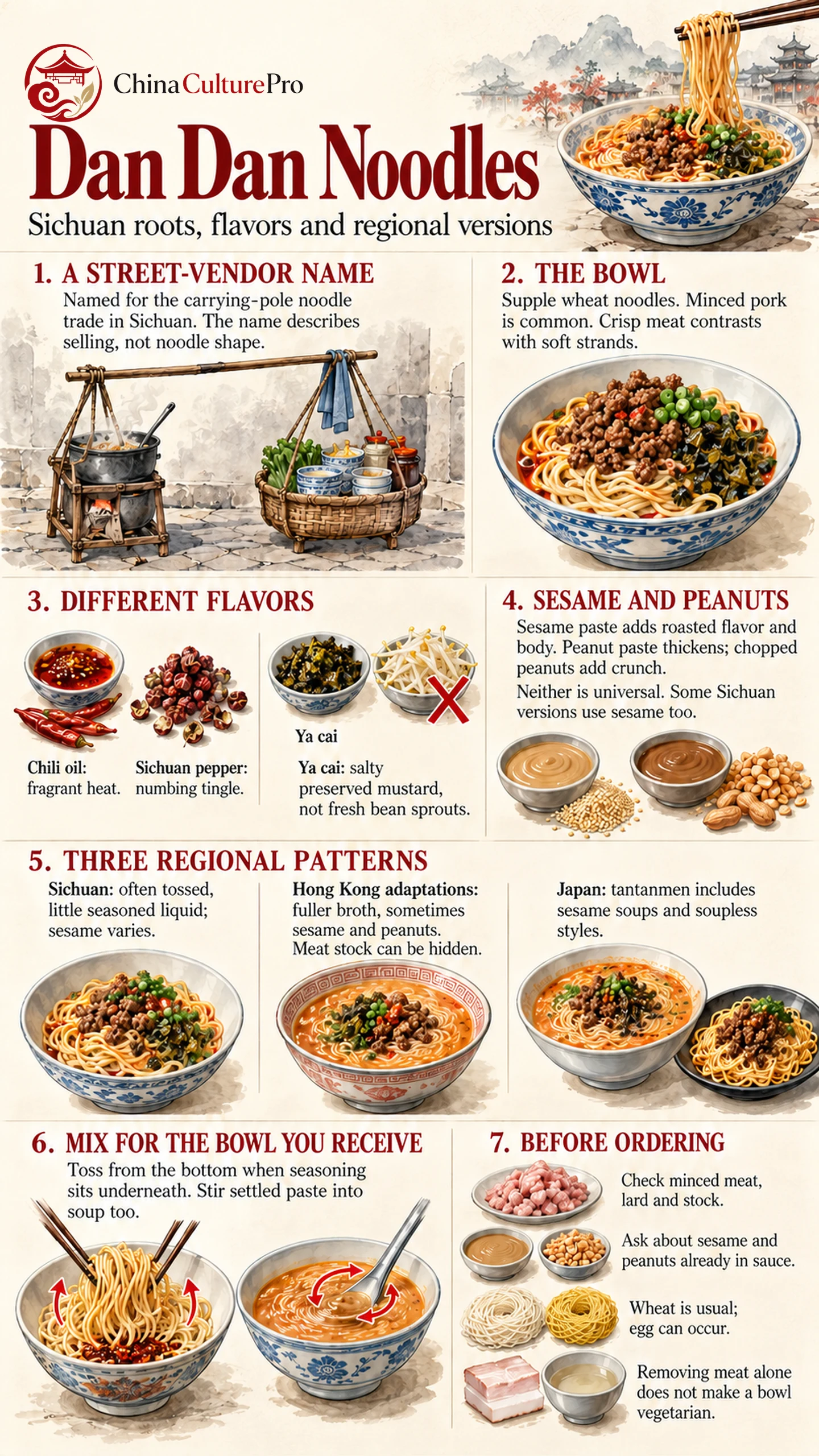
A bowl of dan dan noodles might arrive with red oil and crisp minced meat, or with a generous, nutty broth. Within the wider world of Chinese noodles, understanding this dish means separating its Sichuan street-food background, flavor components and changing serving styles.
Why Are They Called Dan Dan Noodles?
The name recalls the carrying pole used by noodle vendors. A portable setup placed a stove and cooking pot at one end, with noodles, seasonings and serving equipment at the other. Vendors could prepare bowls as they moved through the streets, giving the dish a name tied to its method of sale.[1]
That connection to Chinese street food explains the name more securely than assigning the dish to one inventor. Accounts of a particular founder and an exact starting year circulate as origin stories; they should not be treated as a single established historical record. The enduring context is Sichuan’s noodle-vending tradition and the dish’s association with Chengdu.
Today, it belongs within Sichuan cuisine, served in noodle shops and restaurants. Its name preserves the vending background without specifying noodle thickness, a fixed topping or how much broth should be in the bowl.
What Gives Dan Dan Noodles Their Flavor?
Wheat Noodles and Savory Meat Toppings
Fine wheat noodles provide a supple, slightly chewy base that takes up the seasonings. There is no single required diameter, and eggs are not essential to every version. A packet labeled “dan dan noodles” may describe its intended dish rather than a unique noodle ingredient.
The common minced-meat topping, or saozi (臊子, sàozi), adds savory richness and a contrast of crisp, browned pieces against soft noodles. Pork is familiar, but it is better understood as a common choice than a rule applying to every restaurant. Greens and scallions may add freshness without replacing the seasoned topping’s role.[2]
Chili Oil, Sichuan Pepper and Preserved Vegetables
Chinese chili oil contributes aroma, oiliness and chili heat. Sichuan peppercorns produce a different sensation: a fragrant tingle or numbness. Together, they create mala (麻辣, málà), the pairing of numbing and spicy flavors. One can be more prominent than the other; a red-looking bowl does not reveal the exact balance.
Ya cai supplies concentrated saltiness and preserved-vegetable flavor. Yibin ya cai is made from mustard vegetables, not the fresh bean sprouts sometimes suggested by an English translation.[3] It belongs among Chinese preserved vegetables. Its small, chopped pieces mingle with the meat and noodles, rather than behaving like a fresh vegetable garnish.
The Role of Sesame Paste and Peanuts
Sesame paste (芝麻酱, zhīmajiàng) adds roasted flavor and body. Peanut paste can also thicken a sauce or soup, while chopped peanuts contribute crunch. Those are different effects, so a sprinkle of nuts and a paste mixed into broth should not be described interchangeably.
Some Sichuan preparations use sesame paste, while others emphasize red oil and preserved vegetables without it.[2] A richer, nutty sauce is therefore a clue to the preparation, not proof that the bowl must come from outside Sichuan.
Regional Variations of Dan Dan Noodles
These are useful menu patterns, not fixed specifications for every kitchen. Compare the liquid and seasoning emphasis together; the same city can offer more than one approach.
| Version | Serving style | Flavor emphasis | What not to assume |
|---|---|---|---|
| Sichuan, especially Chengdu | Often tossed with a small amount of seasoned liquid rather than submerged in soup | Savory meat, preserved vegetables, red oil and pepper; sesame use varies | “Dry” does not mean no liquid. Neither extreme heat nor the absence of sesame is guaranteed. |
| Hong Kong soup adaptations | A fuller bowl of broth | Some versions emphasize sesame and peanuts, with chicken-and-pork broth and a gentler chili presence | A pale, nutty soup is not necessarily vegetarian, and its spice level still varies.[4] |
| Japanese tantanmen | Commonly a ramen-style soup, but soupless preparations also exist | Sesame-rich broth is one familiar approach, with minced meat and chili oil; seasoning varies | Tantanmen does not always mean a large bowl of soup. Hiroshima also serves soupless tantanmen.[5][6] |
Restaurant and packaged versions elsewhere can combine these features. A soup may still be intensely spicy, while a tossed bowl may contain a rich paste. The regional label offers context, but the preparation determines the ingredients and eating experience.
How Dan Dan Noodles Are Served and What to Check
For a tossed version, seasonings may sit underneath the noodles, with meat and preserved vegetables on top. Lift from the bottom and mix so the sauce reaches the strands instead of leaving the first mouthful plain and the last heavily seasoned. A soup version is eaten with its broth, but any settled paste or concentrated seasoning may still need stirring through.
Before ordering, check the components that appearance cannot settle:
- Meat and cooking fat: Ask about minced pork, lard and animal stock. Removing the meat topping alone does not make the dish vegetarian.
- Sesame and peanuts: They may already be blended into the sauce or broth, even when there are no visible seeds or chopped nuts.[7]
- Noodles and sauces: Wheat is the usual noodle base, and some versions contain egg. Confirm the complete preparation if seeking Chinese vegetarian food.
If you want less chili or less pepper, ask about each separately. Adjustments depend on whether the kitchen has already mixed the seasoning.
FAQs About Dan Dan Noodles
What kind of noodles are used in dan dan noodles?
Usually fine wheat noodles with a supple, resilient bite. Thickness and shape vary, and egg is not compulsory. “Dan dan” identifies the finished dish rather than one standardized noodle product, so the noodle label alone does not define the whole bowl.
Are dan dan noodles always spicy?
Chili heat is common, but its strength varies. Sichuan pepper adds a separate numbing sensation. A kitchen may adjust one or both, although a sauce prepared in advance can limit how much a particular serving can be changed.
Are dan dan noodles a soup?
They can be. Many Sichuan versions are tossed with limited liquid, while Hong Kong adaptations and Japanese tantanmen include soup versions. Japanese soupless preparations also exist. A little stock used to loosen seasoning does not automatically turn it into a bowl of noodle soup.
Do dan dan noodles always contain sesame or peanuts?
Neither sesame nor peanuts appear in every version. However, both can appear in toppings, sauces or broths, including some Sichuan preparations. The absence of visible peanuts does not establish that a dish contains no peanut ingredients.
Are dan dan noodles vegetarian?
Common versions contain minced meat, and some also use lard or animal stock. Vegetarian versions need a suitable topping, cooking fat, sauce and broth. For a vegan bowl, check whether the noodles contain egg as well.
Sources
[1] China Weather, Sichuan. 担担面
[2] Ministry of Commerce Digital Museum. 提督担担面
[3] China–EU Geographical Indications Agreement. 地理标志保护与合作协定
[4] MICHELIN Guide. Tracing The Origin: Hong Kong’s Dan Dan Noodles
[5] Namiko Hirasawa Chen. Black Sesame Tantanmen (Dan Dan Noodles)
[6] Hiroshima Tourism Association. Hiroshima Noodle Culture Tasting Tour
[7] Lee Kum Kee. Noodles in Dan Dan Soup