


Quick Answer: What Is Henan Huimian?
Henan huimian (烩面, huìmiàn) is a regional noodle-soup dish combining broad, hand-stretched wheat noodles with broth and accompaniments.
- Noodles: Flat wheat ribbons, stretched from prepared pieces of dough, give the bowl its recognizable shape and chewy bite.
- Broth and toppings: Lamb broth is a familiar base; beef and other versions also exist, with meat, vegetables and additional ingredients.
- Regional identity: Zhengzhou is especially associated with the dish, alongside distinctive local forms elsewhere in Henan.
English menus may use “braised noodles” or “stewed noodles.” Here those names identify a soup-based preparation, rather than a dry, sauce-coated plate.[1]
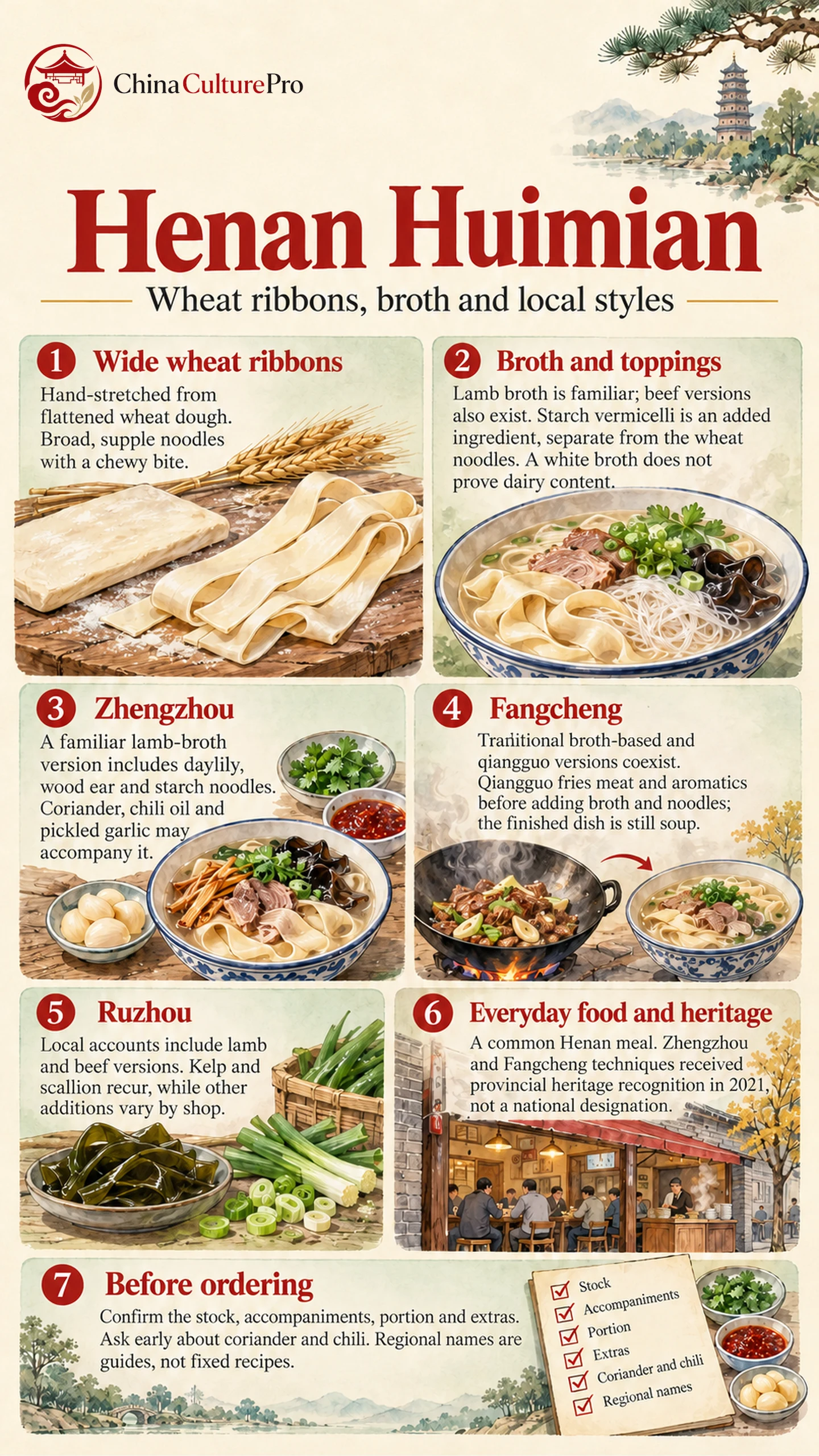
Wide wheat ribbons, meat and vegetables share a deep bowl of steaming broth. A menu may call it “braised noodles,” although the meal in front of you is clearly soup. This guide explains that distinction and its place among Chinese noodles.
Wide Wheat Ribbons: How the Noodles Are Formed
The main noodles are made from wheat flour. Their broad, flat shape comes from stretching flattened dough pieces, rather than cutting rice sheets into strips.
A typical prepared piece is a small rectangle of rested dough. Stretching lengthens and thins it; separating it along its length produces the ribbons that go into the cooking pot. Rectangular dough pieces stretched and torn into wide strips are documented in Ruzhou.[2] The visible result is a supple ribbon whose edges and thickness may show small handmade variations.
That shape matters when eating. A broad strip offers more of the noodle’s surface and body in each bite than a fine strand. You notice the soft surface against the soup as well as the firmer chew within it. Width and thickness vary between kitchens, so a specific measurement is not a reliable definition of the dish.
Hand-pulling describes a family of forming techniques with several possible shapes. It does not mean every noodle must be thin and round. Knife-shaving, by contrast, removes pieces directly from a larger block of dough. These distinctions help explain the appearance without turning the dish into a single compulsory shaping pattern.
Broth, Meat and Mixed Toppings
The broth gives huimian its savory setting. A familiar Zhengzhou version uses lamb and lamb bones for a pale, rich soup, with meat and accompanying ingredients in the bowl.[3] Beef versions are also documented in Ruzhou.[2] The meat named on a menu is a useful starting point, but it may not identify every ingredient used in the stock.
A milky appearance can result from tiny fat droplets dispersed through water, stabilized by components such as soluble proteins. Light scattering makes the soup look opaque.[4] This appearance alone cannot tell you whether milk was added, whether a recipe is dairy-free, or whether one broth is nutritionally superior to another.
Accompaniments may include daylily buds, wood ear mushrooms, kelp, tofu strips and starch noodles. They add contrasting textures, but no single collection is compulsory. Glass noodles or other starch vermicelli are separate ingredients from the broad wheat ribbons, even when both appear in one bowl.
Sanxian (三鲜, sānxiān), often translated as “three delicacies,” is another menu modifier. A reported huimian example combines sea cucumber, squid and mushrooms; it does not establish a fixed trio for every shop.[5] It also does not mean “three kinds of seafood.”
Lamb, beef and sanxian describe ingredient choices. Zhengzhou, Fangcheng and Ruzhou describe places and local traditions. A menu can combine these naming systems, so the region’s name need not tell you exactly which meat or toppings to expect.
Zhengzhou, Fangcheng and Ruzhou: Local Styles
Local descriptions show both shared foundations and different emphases. These examples help you read a bowl and its menu; they are reference points rather than three rigid recipes.
| Place | Recognizable emphasis | Broth or accompaniments | What can vary |
|---|---|---|---|
| Zhengzhou | A well-known example brings broad noodles and several accompaniments together in lamb broth | The city’s published example includes a white lamb broth, daylily buds, wood ear and starch noodles, with coriander, chili oil and sweet pickled garlic alongside | Ingredients and included side dishes vary by shop; this is a representative combination.[3] |
| Fangcheng | Both a traditional broth-based form and qiangguo (炝锅, qiàngguō), a pan-seared aromatic preparation, are documented | In the qiangguo version, meat and aromatics such as scallion and ginger are fried before broth and noodles are brought together; greens can accompany the bowl | Not every Fangcheng bowl uses qiangguo. Packaged convenience versions also exist and need their own preparation directions.[6] |
| Ruzhou | Local accounts describe lamb and beef versions, with attention to the broth and broad noodles | Kelp and scallion are recurring accompaniments; the local record also includes wood ear among possible ingredients | A relatively simple-looking bowl does not establish a rule excluding mushrooms, greens or other additions at every Ruzhou shop.[2] |
Qiangguo adds a distinct aromatic character, but the finished meal remains a noodle soup. The brief frying stage does not turn it into a dry stir-fried noodle dish.
Huimian in Henan Food Culture
Huimian is an everyday meal as well as a recognizable regional specialty. A bowl gathers a wheat staple, soup, meat and vegetables into one serving, making it suitable for a straightforward lunch or dinner. Its place in Henan cuisine is tied to ordinary eating as much as to formal descriptions of regional food.
For people returning home, a familiar noodle shop can also provide a taste associated with family and place. Accounts of Henan food describe huimian among the dishes that returning residents seek out.[5] This connection helps explain why local styles matter even when their ingredients overlap: the remembered bowl may be a particular broth, texture or condiment combination.
The craft also has a documented place in modern heritage protection. In 2021, Zhengzhou and Fangcheng huimian-making techniques were included in Henan’s provincial intangible-cultural-heritage listings.[5] These listings recognize the techniques at the provincial level. It records protection of a living food craft without establishing a single inventor or proving that today’s dish has remained unchanged since antiquity.
Ordering a Bowl of Huimian
Three checks are useful before the bowl is prepared:
- Version: Confirm the meat, stock and main accompaniments. A lamb, beef or sanxian label describes a direction, not a complete ingredient list. If the grain matters, our rice-versus-wheat noodle comparison explains the distinction; huimian’s main ribbons are wheat-based.
- Portion and extras: Ask about bowl size, included meat and additional toppings. Large and small servings, refills and extra charges depend on the shop.
- Seasoning: State preferences early: “不要香菜” means no coriander, “辣椒另放” asks for chili separately, and “少辣” means less spicy. Availability depends on how the kitchen prepares its stock and garnishes.
Condiments let diners adjust some bowls to taste, but there is no required sequence of tasting soup and adding chili oil. Ask what can be changed before assuming every component is adjustable.
FAQs About Henan Huimian
Is huimian the same as lamian?
No. Lamian (拉面, lāmiàn) refers to hand-pulled noodles or their forming technique; huimian names a complete regional soup dish. Lanzhou beef noodles are another dish using hand-pulled noodles, with a range of shapes rather than exclusively fine round strands.
Is huimian always spicy?
No. Chili oil can be a separate addition, allowing some bowls to be adjusted. Other kitchens season the broth or accompaniments beforehand. Ask about both the soup and added chili; requesting no chili oil does not guarantee an entirely unspiced bowl.
Is Henan huimian always halal?
No. Lamb or beef in the dish’s name does not establish that every ingredient and kitchen practice meets halal requirements. Check the restaurant’s practices directly. Our Chinese Muslim food guide explains the wider dining context.
Can huimian be vegetarian?
A specifically prepared version can be, but removing visible meat from a usual meat-broth bowl is insufficient. Confirm the stock, fats, sauces and accompaniments together. The Chinese vegetarian food guide explains why vegetable toppings alone do not establish a vegetarian meal.
Sources
[1] China Culture. Henan’s Stewed Noodles
[2] Ruzhou Municipal Government. Huimian: Local Gazetteer and Food Accounts
[3] Zhengzhou Municipal Government. Huimian: Broth and Accompaniments
[4] Chinese Academy of Sciences, Shenyang Branch. The Science of Milky-White Soup
[5] The Beijing News. Henan Food and Provincial Heritage, 2025
[6] Fangcheng, published on Zhengguan News. Fangcheng Huimian: Local Forms and Food Culture