
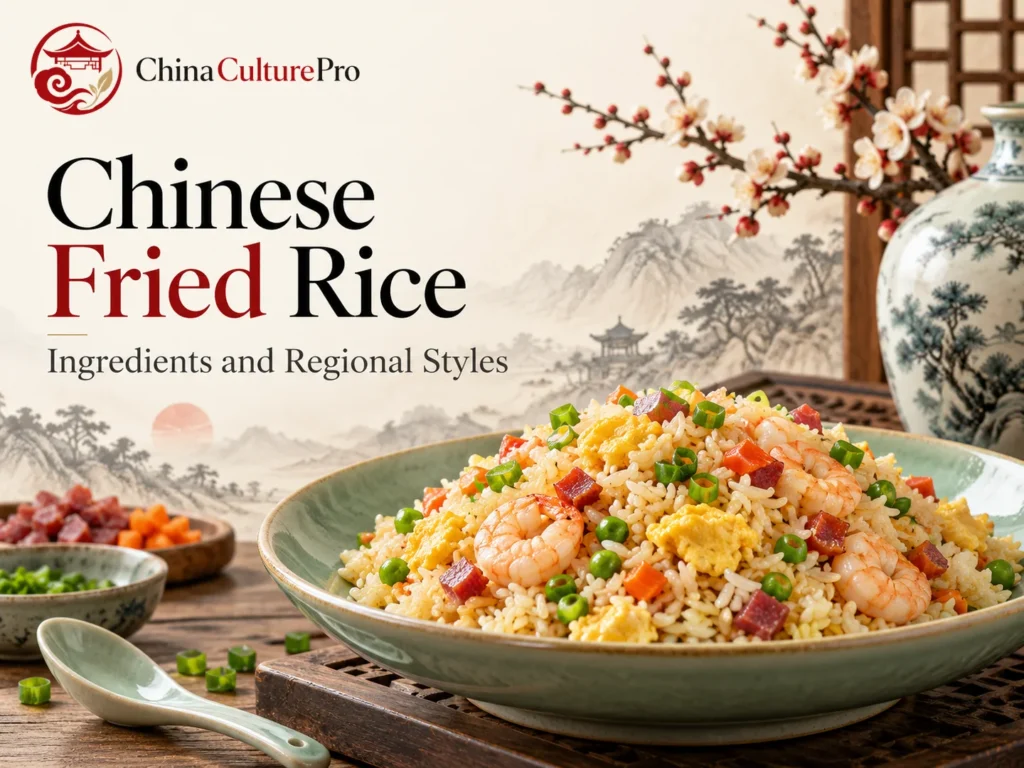

Quick Answer: What Is Chinese Fried Rice?
Chinese fried rice (炒饭, chǎofàn) is cooked rice stir-fried with seasonings and a changing combination of other ingredients.
- Rice: The ordinary versions covered here begin with fully cooked rice, rather than raw grains fried until ready to eat.
- Preparation: The rice is worked through a hot pan so the grains, flavorings and accompaniments combine.
- Styles: Choices range from simple egg fried rice (蛋炒饭, dànchǎofàn) to regional mixtures and restaurant versions finished with gravy.
Day-old rice, eggs and soy sauce are common choices, not universal requirements. A topping on plain steamed rice does not, by itself, make fried rice.

Some plates arrive pale and fragrant, others dark with soy seasoning, and others under a glossy gravy. The familiar takeaway image of rice, egg and soy sauce captures only part of the picture. These differences make fried rice a useful introduction to the variety of Chinese food.
What Rice Is Used for Chinese Fried Rice?
Long-grain white rice, including jasmine rice, is a common choice because it can retain distinct grains after cooking.[1] Medium- and short-grain varieties can also work, often giving a more cohesive chew.[5] The rice variety and how it was cooked both affect the texture; a package labeled jasmine does not guarantee loose grains if the cooked rice is very wet.[2]
The aim for a relatively dry style is rice that is fully cooked but firm enough to handle. Moisture, surface stickiness and compacted clumps matter more than the number of hours since cooking. Fresh rice can work when its moisture is controlled and the grains are loosened appropriately. Refrigerated leftovers are convenient, and cooling can help them firm up, but waiting overnight is not part of the definition.[1]
Food safety is a separate issue. For rice being saved, divide it into smaller portions or spread it in a clean shallow container so it cools promptly, then refrigerate it. Hong Kong food-safety guidance specifies cold storage at or below 4°C. Do not leave rice at room temperature overnight to make it drier: surviving Bacillus cereus spores can grow and produce heat-stable toxins, and frying again cannot reliably undo unsafe storage.[3]
Eggs, Vegetables and Seasonings
Fried rice is built from ingredients with different jobs. A simple egg version can be a meal without reproducing a restaurant’s long list of additions.
| Ingredient group | What it contributes | Common variations |
|---|---|---|
| Eggs | Egg aroma, soft pieces or a fine coating around rice | Common, but not required in every style |
| Vegetables and aromatics | Color, crunch, freshness and fragrant notes | Peas, carrots, greens, scallions or ginger; cutting follows the ingredient |
| Meat and seafood | Meaty flavor or concentrated savory notes | Chicken, roast pork, shrimp, cured meat, salted fish or dried scallops |
| Seasonings and fats | Saltiness, aroma, color and lubrication | Salt, soy sauce, white pepper and cooking oil; some versions use lard, oyster sauce or chili paste |
Small pieces often mix conveniently with rice, but not everything must be diced: shredded lettuce and chopped scallions are familiar exceptions. Proteins, vegetables and seasonings change with the intended dish.[4]
Salt alone can provide the savory base.[2] Soy sauce may add flavor and color, while a substantial thickened sauce belongs to particular gravy-topped versions. A pale plate can be deliberately lightly seasoned; a darker plate is not automatically more authentic or more flavorful. Nor does an ingredient such as oyster sauce belong in every recipe.[4]
How Stir-Frying Shapes the Texture
Frying changes the rice through contact with the hot pan, oil and moving ingredients. In a relatively dry preparation, excess moisture and an overcrowded pan can prevent the intended frying effect. Ingredients may instead steam in accumulated liquid. Separating large clumps before or during cooking helps expose more grains evenly; forceful stirring alone cannot turn very soft, wet rice into firm grains.[4]
Egg can form visible soft pieces or be distributed more closely around the grains. The two approaches give different appearances and textures; neither requires a fixed number of tosses. Egg fragments and a finer coating are both deliberate possibilities, not reliable signs of a kitchen doing it wrong.[1]
Wok hei (镬气, huòqì in Mandarin) refers to the fleeting toasted, seared aroma associated with hot-wok cooking. It is not a synonym for burnt rice. A wok can help create that effect, but flame tossing is not essential to the category.[5] Broad frying pans are another practical choice.[2] The broader distinctions between stir-frying, steaming and other techniques belong in our Chinese cooking methods guide.
Regional Fried Rice Styles to Recognize
These four examples show different ingredient traditions and serving structures. They are useful menu reference points, not an exhaustive map of Chinese regions or mutually exclusive recipes.
Yangzhou Fried Rice: A Mixed-Ingredient Tradition
Yangzhou fried rice (扬州炒饭, Yángzhōu chǎofàn) is associated with Yangzhou in Jiangsu and the Huaiyang cooking tradition. Its appeal lies in a mixed arrangement of colors, flavors and textures rather than one dominant topping. Egg, shrimp, cured ham and vegetables are familiar components; richer traditional formulations may also contain chicken, bamboo shoots, sea cucumber or dried scallops.[2]
The ingredients are generally cut small enough to distribute through the rice, but there is no reason to expect every restaurant to supply every luxury ingredient. Overseas menus may spell the name Young Chow or Yeung Chow and use roast pork or other substitutions. Those adaptations should be read as actual ingredient choices, not assumed to match a single local formulation.[6]
Light seasoning is characteristic of many versions. Some versions use salt without soy sauce.[2] Others include a little light soy.[6] A pale color alone neither identifies the dish nor proves that a restaurant has followed a particular recipe.
Cantonese Salted Fish and Chicken Fried Rice
Salted fish and chicken fried rice (咸鱼鸡粒炒饭, xiányú jīlì chǎofàn) is a recognizable Cantonese combination. The preserved fish contributes a concentrated salty aroma, while chicken supplies the main meat component. Egg, ginger, scallions and shredded lettuce often complete the mixture.[7]
Some cooks choose mei xiang salted fish (梅香咸鱼, méixiāng xiányú), a softer, fermented product with a pronounced aroma. Firmer salted-and-dried fish is another possibility, so one fish product should not be treated as compulsory. Its strong seasoning effect means it need not occupy the same volume as the chicken.[7]
The familiar finish is relatively dry, with preserved-fish flavor spread through the rice. A dish described simply as chicken fried rice will not necessarily have this distinctive character; both parts of the name matter when ordering.
Hong Kong-Style Fujian Fried Rice with Gravy
Fujian fried rice (福建炒饭, Fújiàn chǎofàn), often called Hokkien fried rice in English, is familiar on Cantonese and Hong Kong restaurant menus. In this context, it describes a recognizable gravy-topped preparation. Its name should not be used to infer one proven birthplace or the everyday rice habits of the whole of Fujian Province.[11]
The structure is important: the base is already fried rice, commonly with egg. A separately prepared mixture of chicken, shrimp, mushrooms and vegetables is finished with a thickened sauce and poured over it. Some versions include scallops or other seafood; the exact combination varies.[8]
The result is intentionally moist, with gravy carried into each spoonful. That is different from dry-fried rice that has accidentally become soggy. It is also distinct from an ordinary topping on plain steamed rice, because the base itself has undergone frying.
Guiyang Guailu Fried Rice: A Spicy Mixed Bowl
Guailu fried rice (怪噜饭, guàilū fàn) is a Guiyang specialty in Guizhou. The local name suits its flexible mixture of ingredients. Cured pork or sausage, cooked beans, greens and fish-mint root are recorded combinations, with many variations among stalls and restaurants.[9]
Ciba chili paste (糍粑辣椒, cíbā làjiāo) supplies a characteristic chili flavor. Pickled vegetables, such as sour long beans, can add acidity separately: the chili paste should not automatically be described as the source of every sour note. The result may combine smoky cured-meat aroma, spicy seasoning and crisp pickled pieces.[9]
This is a regional mixed-rice tradition, not a fixed checklist that every shop must reproduce. Ask about the actual ingredients and heat level rather than assuming that a long list of possible additions appears in every bowl.
Serving and Ordering Chinese Fried Rice
Fried rice can be the main part of a meal for one, a shared dish alongside vegetables and meat, or a starch served during a larger meal.[6] Portion size alone does not decide its role. Home cooking and banquet settings create different expectations, and restaurant portions vary.
Three checks make ordering easier:
- Finish and flavor: Choose a relatively dry mixture, a gravy-topped version or a chili-seasoned style. Confirm spiciness separately; soy color does not tell you the heat level.
- Ingredients and portion: Ask which meat, seafood and vegetables are included, and whether the serving is intended for one person or for sharing. A regional name is a starting point, not a complete ingredient label.
- Dietary requirements: Check eggs, cooking fat, stock, sauces and marinades. Removing meat does not automatically remove lard, oyster sauce or seafood seasoning. Eggs may suit some vegetarian diets but do not suit a vegan order.
Use our Chinese food names and Chinese vegetarian food guides for those checks. Overseas adaptations also vary; the wider Chinese and Chinese-American food comparison explores that context without judging dishes by color or a single authenticity rule.
FAQs About Chinese Fried Rice
Do you need day-old rice for fried rice?
No. Properly handled fresh rice can work when its moisture and texture suit frying. Refrigerated leftovers are convenient and may separate more readily, but a night in storage is not a required ingredient. Rice left at room temperature overnight is not a safe shortcut.[1][3]
Does Chinese fried rice always contain soy sauce?
No. Some versions use salt and other light seasonings, while others use soy sauce for flavor and color. Even Yangzhou-style preparations vary. A darker plate is not automatically more traditional, and a pale one does not necessarily lack seasoning.[6]
Does all Chinese fried rice contain egg?
No. Egg is common, but it is not part of the definition of every fried-rice dish. Egg-free and vegan versions can be made. If avoiding eggs, ask explicitly rather than assuming that a vegetable label means the kitchen omits them.
Is fried rice a main dish or a side dish?
Either. It can form a simple meal or accompany other dishes at a shared table. Ask about portions and how the dish is served; there is no universal rule that food in China is always a main while overseas fried rice is always a side.
Is Chinese fried rice gluten-free?
Not automatically. Plain rice is naturally gluten-free, but soy sauce made with wheat, marinades and other seasonings can change the finished dish. Confirm the ingredients and kitchen handling, including possible cross-contact, instead of relying on the word rice.[10]
Sources
[1] Made With Lau. Fried Rice
[2] Wei Guo. Yangzhou Fried Rice (扬州炒饭)
[3] Centre for Food Safety, Hong Kong. Bacillus cereus in Fried Rice
[4] The Woks of Life. How to Make Fried Rice: An Easy Formula
[5] J. Kenji López-Alt. Easy Fried Rice
[6] Made With Lau. Yangzhou Fried Rice
[7] Made With Lau. Salted Fish and Chicken Fried Rice
[8] Lee Kum Kee. Fujian (Hokkien) Fried Rice
[9] Guizhou Radio and Television. 好吃贵州丨风格多变、搭配丰富的怪噜饭
[10] U.S. Food and Drug Administration. Questions and Answers on the Gluten-Free Food Labeling Final Rule
[11] Made With Lau. Hokkien Fried Rice