


Quick Answer: What Grains Are Used in China Besides Rice?
China’s grain foods include cooked kernels, porridges and flour-based dishes. This guide focuses on four grain identities within three groups.
- Corn: Corn (玉米, yùmǐ), also called maize, is eaten fresh or processed into grits and meal.
- Millets: Foxtail millet (小米, xiǎomǐ) is familiar in porridge; dahuangmi (大黄米, dàhuángmǐ) is glutinous broomcorn millet used for sticky foods.
- Sorghum: Sorghum (高粱, gāoliang) supplies flour for regional foods and grain for Chinese spirits.
These are selected examples, not China’s complete grain inventory. “Millet” covers several crops, and their names do not guarantee one texture or recipe.
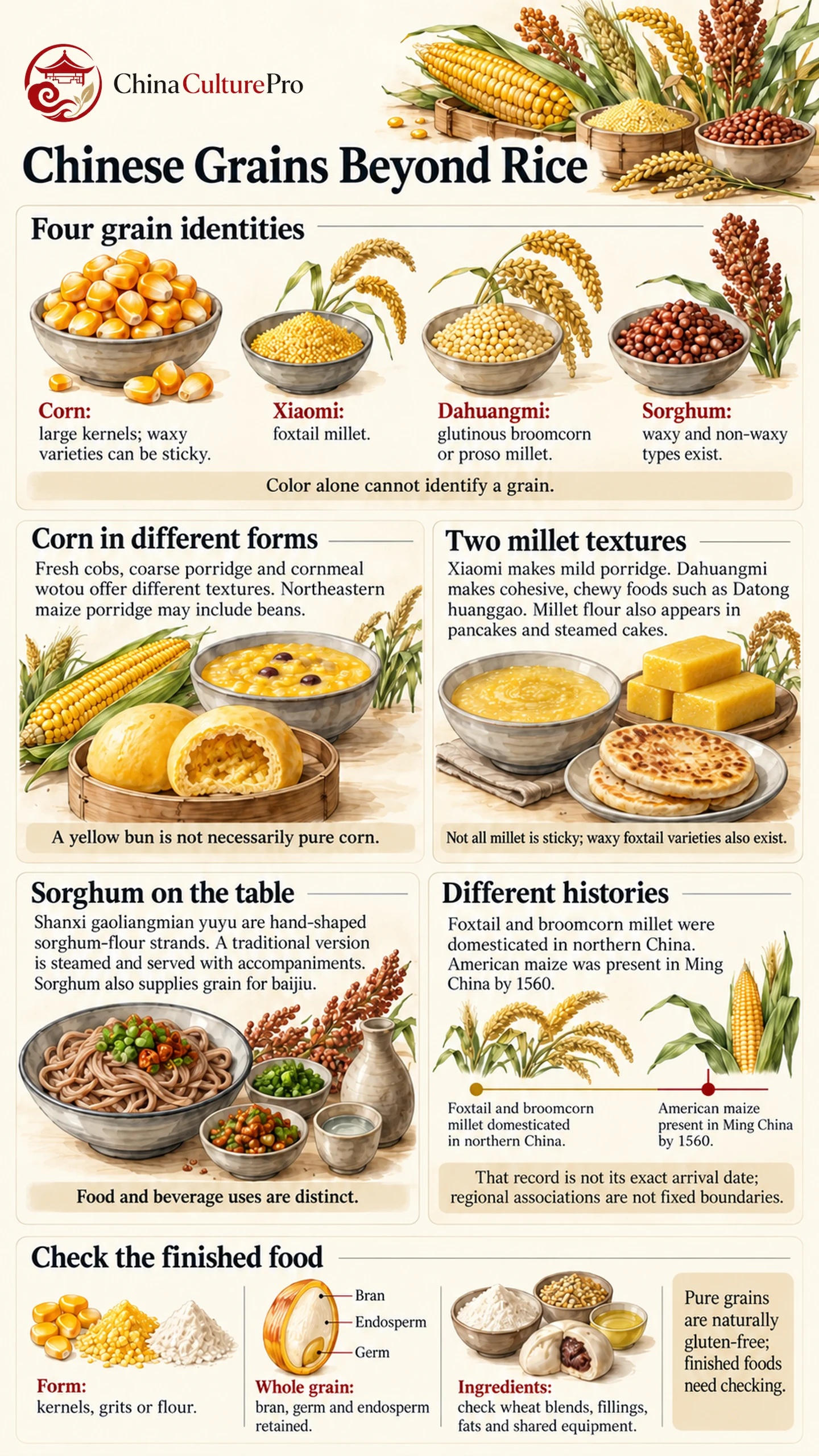
Yellow porridge, hollow steamed buns and dark, hand-shaped noodles show how varied China’s grain foods can be. Alongside familiar rice dishes, these everyday staples have distinct ingredients and textures. The useful starting point is to separate the grain, its flour and the finished food.
Corn, Millet and Sorghum: Chinese Names and Identities
English “millet” is broader than the familiar bag of yellow xiaomi. Foxtail millet and broomcorn millet are different crops; broomcorn millet is also called proso millet. Dahuangmi identifies its glutinous food form, rather than every variety of proso millet. The following names help distinguish grain ingredients before considering finished dishes.[1]
| Chinese name | English identity | Crop or processed grain | Recognition clues |
|---|---|---|---|
| 玉米 yùmǐ | Corn / maize | Zea mays | Large kernels, often yellow or white; waxy varieties can be sticky. |
| 小米 xiǎomǐ | Foxtail millet | Hulled grain of su (粟, sù), Setaria italica | Very small, often yellow grains; commonly used as porridge grain. |
| 大黄米 dàhuángmǐ | Glutinous broomcorn / proso millet | Hulled grain of shu (黍, shǔ), Panicum miliaceum | Usually larger and rounder than xiaomi; opaque kernels that cook sticky. |
| 高粱 gāoliang | Sorghum | Sorghum bicolor | Small rounded kernels in varied colors, including red-brown and white; waxy and non-waxy types exist. |
Color alone is an unreliable identification test. A white kernel need not be rice, and a yellow grain need not be foxtail millet. Chinese names and ingredient labels are more useful than photographs when distinguishing similar-looking grain products. Likewise, “glutinous” describes sticky starch behavior, not the presence of wheat gluten.[1][2][5]
How These Grains Are Eaten in Regional Chinese Cuisine
Corn: From Fresh Cobs to Cornmeal Foods
A fresh cob and a bag of cornmeal are different forms of the same crop. Fresh sweet corn has juicy kernels, while waxy corn has a denser, sticky bite. Both are sold cooked on the cob. Dried maize can instead become coarse grits for porridge or finer meal for steamed and griddled foods.[2]
Wotou (窝头, wōtóu) are a recognizable northern example: compact steamed buns with a hollow underside. Cornmeal versions have a grainy crumb and a more substantial bite than a fluffy white wheat bun. Their texture changes with the grind and any added flours; a yellow bun is not necessarily pure corn. Northern food traditions also include cornmeal cakes browned against a cooking surface.[4]
In northeastern China, coarse maize porridge is often paired with beans, leaving visible kernels or broken pieces in the bowl. It has a different mouthfeel from a smooth cornmeal porridge: the pieces give the spoonful more texture, while finer meal disperses into a thicker base. These are everyday grain preparations rather than one nationally fixed breakfast recipe.[2] A cornmeal cake cooked against a pan can develop a browned surface; a steamed wotou instead has a set crumb without that griddled crust. The product form helps explain the eating experience.
Millet: Xiaomi Porridge and Sticky Yellow-Millet Cakes
Xiaomi porridge is a familiar northern breakfast, with tiny grains suspended in a yellowish liquid. It may be thin enough to sip or thick enough to eat by the spoonful. In Datong’s Yunzhou area, both thinner porridge and much thicker millet preparations belong to local food traditions. The cooked grains soften and give a mild cereal flavor; that creamy consistency is different from the cohesive texture of a sticky cake.[3]
The broader congee and porridge category includes different grains. A bowl made from xiaomi is not rice porridge simply because its Chinese name contains mi. The grain remains foxtail millet, whether served on its own or in a mixed-grain preparation.
Xiaomi also appears as flour. In Shanxi, local food reporting includes millet-flour pancakes and steamed millet cakes, showing that porridge is only one use. Grinding changes the form without turning it into another cereal.[14]
Dahuangmi offers a contrasting texture. Its cooked grains cling together, and its flour can form chewy cakes. In Datong, huanggao (黄糕, huánggāo) is a local yellow-millet food, served as a steamed cake or shaped into filled, fried pieces. Sweet bean fillings and savory fillings both occur; this is not exclusively a dessert.[6]
An ordinary porridge millet and a glutinous cake millet are therefore not automatic substitutes. Still, the distinction should not become “all foxtail millet is nonsticky”: waxy foxtail cultivars also exist. Check the actual grain variety when a particular texture matters.[1]
Sorghum: Flour Foods and a Role in Baijiu
In Shanxi food traditions, sorghum flour becomes more than porridge. Gaoliangmian yuyu (高粱面鱼鱼, gāoliangmiàn yúyu) consists of hand-shaped, tapered strands whose name evokes little fish. A traditional version is steamed and served with soup or other accompaniments. Its compact bite differs from the stretchy texture of a wheat noodle. The name identifies the sorghum-flour food, not a fish ingredient or a guarantee that no other flour was added.[4]
Sorghum also plays a major role in baijiu (白酒, báijiǔ), China’s distilled grain spirits. That use should not erase its place on the food table. Nor are all sorghum grains inherently nonsticky: waxy varieties have a different starch composition from non-waxy ones.[5][7]
Serving makes another difference: the strands can arrive with soup or a vegetable accompaniment, rather than as plain flour dumplings. Regional accounts describe these foods within both household meals and local restaurant repertoires.[4] Their grain content and their toppings remain separate questions, so a vegetable accompaniment alone does not establish what is in the dough or broth.
Old Staples, Later Arrivals and Regional Food Traditions
Foxtail millet and broomcorn millet were domesticated in northern China and were important crops in prehistoric farming. Their long association with the Yellow River region helps explain the prominence of millet foods in northern culinary traditions. Archaeological grain remains establish crop use, however, not the age of a particular modern breakfast or cake.[8]
Maize has a different history. It originated in the Americas and was present in China by the Ming dynasty. A clear description in the 1560 Pingliang prefectural gazetteer documents its presence by the mid-sixteenth century; that record is not an exact date for its first arrival. Its later spread made an introduced crop part of established regional food traditions.[9]
These northern associations are useful context, rather than a strict boundary around people’s diets. Grain cultivation, local recipes and modern food choices are different things; northern and southern Chinese food cannot be reduced to one grain per region.
The historical phrase Five Grains (五谷, wǔgǔ) also needs context. Lists differ across texts, so it should not be read as a single, timeless five-item shopping list.[10]
Reading Grain Labels and Checking Ingredients
Three separate checks help turn a grain name into useful ingredient information:
- Form and milling: Kernels, grits and flour describe physical forms. Whole grain means that bran, germ and endosperm remain in their original proportions; whole-grain flour is possible. Removing an inedible outer hull is different from polishing away the bran, so intact-looking grains are not automatically whole grain.[11]
- Blended ingredients: Cornmeal buns, millet cakes and sorghum-flour foods may include wheat flour, beans, eggs or other ingredients. A dish named after one grain does not promise a single-grain formula. Fillings, fats and sauces also matter when checking vegetarian food.
- Gluten and preparation: Pure corn, millet and sorghum are naturally gluten-free. Finished products may contain wheat or encounter it through shared milling and preparation equipment. Check the complete label and the maker’s gluten-free information; in a restaurant, ask about both ingredients and shared equipment.[12][13]
“Whole grain,” “gluten-free” and “plant-based” answer different questions. None can reliably be inferred just from a grain’s color, the dish name or a floury appearance.
FAQs About Traditional Chinese Grains
Is xiaomi a type of rice?
No. Xiaomi is foxtail millet, a different crop from rice. In Chinese food names, mi can refer to a processed grain; it does not always mean that the ingredient comes from the rice plant.
Are all types of millet sticky?
No. Millet includes different crops and varieties. Dahuangmi is a glutinous broomcorn-millet product, while familiar porridge millet is usually less sticky. Waxy foxtail millet also exists, so the English word alone cannot predict the cooked texture.
Are these grains always whole grains?
No. The answer depends on what remains after processing. An intact-looking kernel may be polished, while flour can retain the whole grain. Check the ingredient description rather than assuming a coarse texture or traditional name proves whole-grain content.
Are corn, millet and sorghum foods gluten-free?
The pure grains are naturally gluten-free, but foods made from them may contain wheat or have cross-contact during production. A corn bun or millet cake needs its own ingredient check; the grain’s identity does not certify the finished product.
Sources
[1] Ministry of Agriculture and Rural Affairs. Millet terminology: NY/T 893—2021 submission draft
[2] Xinjiang Department of Finance. Corn varieties and food uses
[3] Yunzhou District Government. Xiaomi porridge
[4] Shanxi News Network. Everyday food customs in Shanxi
[5] FAO. Sorghum and millets: carbohydrate and starch
[6] Yunzhou District Government. Huanggao
[7] Ministry of Commerce. Basic facts about baijiu
[8] He et al. Holocene millet agricultural patterns in northern China
[9] Institute for the History of Natural Sciences. Agriculture in the Ming and Qing periods
[10] Junru Liu. Chinese Food: grain traditions
[11] Whole Grains Council. What is a whole grain?
[12] Whole Grains Council. Gluten-free whole grains
[13] FDA. Gluten-free food labeling questions and answers
[14] People’s Daily. Qinzhou millet and local foods