

Quick Answer: What Is the Difference Between Northern and Southern Chinese Food?
The broadest difference is the prominence of wheat-based foods in many northern traditions and rice-based foods in many southern ones. Flavor depends more closely on the particular regional cuisine.[1]
| Comparison | Northern tendencies | Southern tendencies |
|---|---|---|
| Staple emphasis | Wheat-based foods are prominent. | Rice and rice-based foods are prominent. |
| Common forms | Noodles, steamed buns and flatbreads. | Cooked rice, rice noodles and rice cakes. |
| Flavor | Savory seasoning is important in many traditions. | Styles range from mild and fresh to sweet-savory or chili-hot. |
These are tendencies, not dietary rules. Northern rice-eating communities and southern wheat foods are established parts of local food culture, not contradictions to be explained away.[1][3]
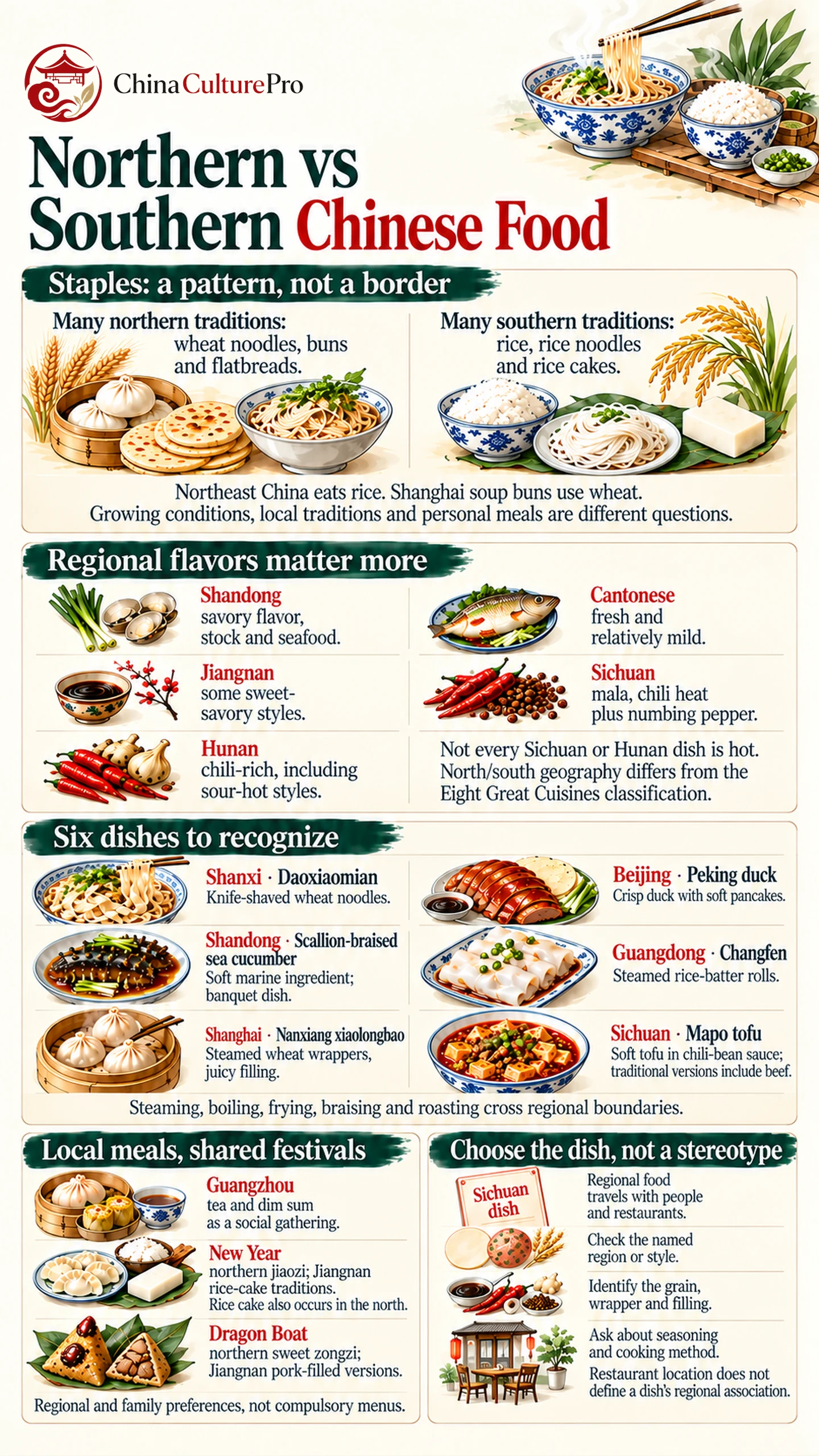
A bowl of noodles in a northern city and rice beside shared dishes in a southern home suggest a familiar contrast. But neither scene tells you everything about Chinese food. Comparing staples, flavors and local traditions is more useful than treating the country as two uniform cuisines—and it helps explain why a Shanghai soup bun can have a wheat wrapper.
Staples and Geography: Understanding the Rice–Wheat Pattern
The phrase “rice in the south, wheat foods in the north” (南米北面, nán mǐ běi miàn) summarizes a broad agricultural and culinary pattern. The Qinling Mountains–Huaihe River line is a useful geographical reference for contrasting climatic conditions, rather than a precise border between two menus. Relatively dry northern farmland has supported wheat and other grains; warmer, wetter southern areas have extensive rice-growing traditions. Water availability, terrain and local farming systems all matter.[1][2]
Grains become different kinds of food. Wheat flour can form stretchy noodles, filled wrappers, flatbreads and mantou (馒头, mántou), or steamed bread. Rice can be served as individual grains, cooked into porridge, or made into noodles and cakes. These forms affect how a meal is assembled: a bowl of rice can accompany several dishes, while a filled or topped wheat food can form a meal itself. Neither arrangement belongs exclusively to one region. A wheat-based meal also need not resemble a European-style bread meal: steamed bread, noodles and filled wrappers create different textures from the same grain. Conversely, the category “rice food” includes both loose grains and formed foods, so it says little about the finished shape.
Northeast China provides a clear qualification. Rice is a familiar staple there, alongside wheat foods and other grains. Describing all northern households as primarily noodle-eaters would erase this established pattern. Millet, corn, oats and other grains also complicate a simple two-crop picture; “north equals wheat” is a shorthand, not a complete inventory.[1]
The reverse qualification is just as useful. Shanghai’s Nanxiang xiaolongbao (南翔小笼馒头, Nánxiáng xiǎolóng mántou) uses an unleavened wheat-flour wrapper. It is a local Jiangnan specialty, not evidence that southern people only recently discovered flour. Food traditions have developed through exchanges as well as local agricultural resources.[3]
Keep three questions separate: what is grown in an area, what its established dishes use, and what a particular person eats today. They overlap without being identical. Throughout this comparison, “southern” includes examples from Jiangnan, the southern coast and the southwest; Cantonese food represents one part of that broad area.
Flavors: Why “Northern Salty, Southern Sweet” Falls Short
“Southern sweet, northern salty” (南甜北咸, nán tián běi xián) is a familiar summary, but it cannot predict the seasoning of an individual dish. More useful distinctions emerge when a region is named and the flavor is described precisely. Savory, sweet, sour, hot and numbing sensations can also coexist in one preparation.
- Shandong: This northern coastal tradition values savory flavor, good stock and the original character of ingredients. It includes seafood as well as grain foods; northern cooking cannot be reduced to meat and bread.[6]
- Cantonese cooking (粤菜, Yuècài): Freshness and relatively mild seasoning are important reference points. That does not make every dish unseasoned, steamed or free of a rich sauce.[4]
- Jiangnan: Some Jiangnan dishes combine sweetness with savory seasoning. This describes selected styles, not a claim that every meal—or every dish in Jiangsu and Zhejiang—tastes sweet.[4]
- Sichuan cooking (川菜, Chuāncài) and Hunan cooking (湘菜, Xiāngcài): Sichuan’s mala (麻辣, málà) combines chili heat with the numbing sensation of Sichuan pepper. Hunan is also known for chili-rich cooking, including sour-hot flavors, but its heat should not automatically be called numbing. Neither cuisine consists entirely of hot dishes.[5][6]
Mild, sweet and spicy describe different qualities rather than points on a single scale. A mildly seasoned food need not be sweet, and a hot dish can also taste savory or sour. Describe those qualities separately when comparing dishes: asking whether a preparation contains chili is a different question from asking whether it has Sichuan pepper’s numbing character.[5][6]
North and south are geographical groupings. The Eight Great Cuisines (八大菜系, bā dà càixì) name a different, conventional classification: Shandong, Sichuan, Guangdong, Jiangsu, Zhejiang, Fujian, Hunan and Anhui. Beijing and Shanghai also have their own traditions, although neither replaces a member of that eight-part list.[6]
Dishes and Cooking Methods: Six Regional Examples
These examples make the comparison visible through ingredients and texture. They are not six compulsory foods or a ranking of regional cooking. The restaurant setting also matters: a banquet dish does not represent what a household prepares every evening.
| Regional association | Dish and Chinese name | Ingredients, appearance and texture | Cooking and eating context |
|---|---|---|---|
| North: Shanxi | Daoxiaomian — 刀削面, dāoxiāomiàn | Knife-shaved wheat noodles with a thicker center and thinner edges; a firm, chewy bite. The tapered strips are visibly different from fine, evenly pulled noodles. | Boiled and served with broth or toppings; an everyday noodle-shop meal.[7] |
| North: Beijing | Peking duck — 北京烤鸭, Běijīng kǎoyā | Crisp duck skin and tender meat; slices commonly paired with thin pancakes, scallion and sweet bean sauce. Crisp skin contrasts with the soft pancake. | Roasted using different oven traditions, including open- and closed-oven styles; often a shared restaurant meal.[8] |
| North: Shandong | Scallion-braised sea cucumber — 葱烧海参, cōng shāo hǎishēn | Sea cucumber with fragrant scallion and a glossy sauce; soft, yielding texture with some elasticity. Despite its English name, sea cucumber is a marine animal. | A rich braised restaurant or banquet dish, illustrating northern coastal food rather than an everyday staple.[9] |
| South: Guangdong | Changfen — 肠粉, chángfěn | Thin rice-batter sheets, folded or rolled, sometimes around egg, meat or shrimp; smooth and gently resilient. Its name describes the roll shape, not an intestine ingredient. | Steamed and served with sauce, commonly as breakfast or a small tea-house dish.[10] |
| South: Shanghai | Nanxiang xiaolongbao | Thin wheat wrappers enclosing meat and savory liquid; delicate skin around a juicy filling. Meat jelly in the filling becomes liquid when heated. | Steamed filled buns served in small baskets; a local snack or restaurant order.[3] |
| South: Sichuan | Mapo tofu — 麻婆豆腐, mápó dòufu | Soft tofu in a savory chili-bean sauce with Sichuan pepper; traditional versions also include minced beef. Small meat granules contrast with the soft tofu cubes. | A saucy cooked dish commonly paired with rice; tofu as the main ingredient does not make it vegetarian.[11] |
Steaming, boiling, stir-frying, braising and roasting appear across regional traditions. These examples show how cooks use techniques with particular ingredients, not that the north owns roasting or the south owns steaming.
Dining and Festival Traditions
Guangzhou’s tea-house culture connects food with conversation. Dim sum (点心; Mandarin: diǎnxin) accompanies tea, allowing people to order small dishes while spending time together. Ordering small dishes over tea makes the gathering different from a quick, single-item breakfast. It is a local Cantonese tradition, not a description of every southern breakfast or a contrast with supposedly less sociable northern meals.[12]
Shared festivals offer two useful comparisons:
- Lunar New Year: Jiaozi (饺子, jiǎozi), or filled wheat dumplings, are strongly associated with New Year celebrations in many northern families. Making or eating them can be part of a family gathering. In Shanghai and other Jiangnan communities, nian gao (年糕, niángāo), or rice cake, is another familiar seasonal food, associated with rising higher from year to year. Rice-cake ingredients and sweet or savory uses vary. The comparison is about foods associated with the celebration, not a choice between two exclusive national menus. Rice cake is also eaten in northern communities; it should not be presented as a food confined to the south. The wider guide to Chinese New Year foods explains additional dishes and meanings.[13]
- Dragon Boat Festival: Zongzi (粽子, zòngzi) are leaf-wrapped rice parcels. Northern sweet examples may contain red dates or sweet bean filling; Jiangnan savory versions can contain pork, sometimes with salted egg yolk. Both sweet and savory choices exist beyond these regional tendencies. The zongzi guide covers their different forms and fillings.[14]
The zongzi comparison is particularly revealing: a northern sweet example and a southern savory one reverse the familiar flavor slogan. Festival associations express preferences and wishes; they do not establish a compulsory menu for every family.
Eating Across the Divide Today
Regional traditions travel with people, restaurants and food businesses. Serving a Sichuan dish in Beijing does not by itself change its regional association. Likewise, the presence of a noodle shop in Guangzhou does not overturn local rice-food traditions. Research comparing regional recipe collections also points to the importance of geographical proximity and exchange; climate alone does not explain culinary similarity.[15]
For choosing a meal, use three checks:
- Read the regional description: A named cuisine, locality or specialty usually tells you more than a broad “northern” or “southern” label. Restaurant location and a dish’s regional association are different clues.
- Identify the food itself: Look for the actual grain, wrapper, filling or main ingredient. A noodle may be wheat-based or rice-based, and a southern bun can contain wheat.
- Check seasoning and preparation: Ask whether the dish is sweet-savory, chili-hot, numbing, steamed, roasted or braised. Choose by the texture and flavor you want rather than expecting geography to guarantee them.
FAQs About Northern and Southern Chinese Food
Is southern Chinese food always spicy?
No. Southern food includes mild Cantonese preparations, sweet-savory Jiangnan dishes and chili-rich Sichuan and Hunan styles. Even regions famous for heat offer dishes with other flavor profiles. Identify the particular cuisine and dish rather than assuming one southern spice level.
Do people in northern China eat rice?
Yes. Rice is an established staple in Northeast China and is also eaten elsewhere in the north. Wheat foods remain important in many northern traditions, but the rice–wheat pattern does not describe every household or every meal.[1]
Are dumplings only northern Chinese food?
No. English “dumpling” covers several kinds of food. Northern jiaozi can be boiled, steamed or pan-fried; Shanghai soup buns and Cantonese filled dumplings have their own local traditions. The English category does not identify one region, wrapper or cooking method.[16]
Which style should I try first?
Start with a particular food and your preferred texture or flavor. Northern wheat noodles, Cantonese rice rolls and Sichuan saucy tofu offer quite different experiences. You can explore all three without choosing one half of China as better than the other.
Sources
[1] Farmers’ Daily via CCTV. 各地特色主食都有哪些
[2] China Meteorological Administration via China Weather. 秦岭 关系中国南北气候的山
[3] China Intangible Cultural Heritage Network. 南翔小笼馒头制作技艺
[4] World Federation of Chinese Catering Industry. Regional Eating Habits in China
[5] Hunan Provincial Government. 湘菜的个性
[6] National Immigration Administration. 欢迎来到中国:饮食文化
[7] China Intangible Cultural Heritage Network. 龙须拉面和刀削面制作技艺
[8] China Intangible Cultural Heritage Network. 全聚德挂炉烤鸭技艺
[9] Yantai Fushan Culture and Tourism Bureau. 福山大面、葱烧海参入选山东百种非遗美食名单
[10] Guangzhou Liwan District Government. 广式肠粉
[11] Ministry of Commerce, Time-Honored Brands Digital Museum. 陈麻婆
[12] Guangzhou Culture and Tourism Bureau. 广州早茶传承保护规定
[13] Shanghai Civil Affairs Bureau. 春节传统食品溯源
[14] State Administration for Market Regulation. 端午节吃粽子的消费提示
[15] Zhu et al., PLOS ONE. Geography and Similarity of Regional Cuisines in China
[16] Zhang Haimei, Chinese Social Sciences Today. 会“行走”的扁食