
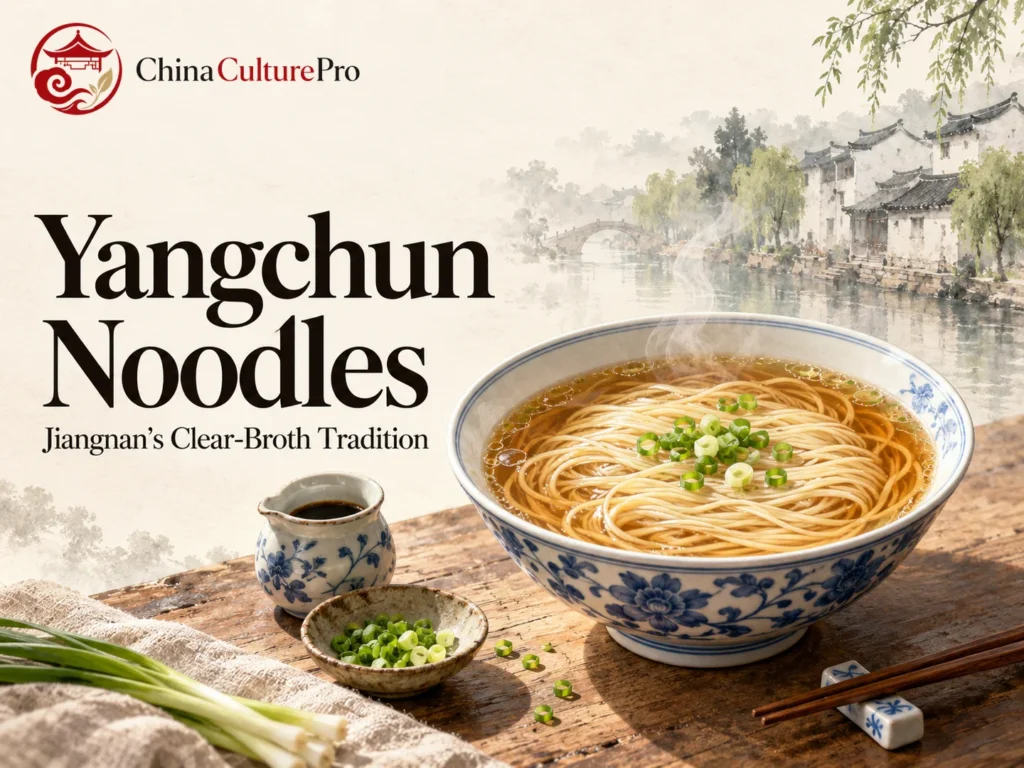

Quick Answer: What Are Yangchun Noodles?
Yangchun noodles (阳春面, yángchūnmiàn), also written yang chun mian, are a plain wheat-noodle dish associated with Jiangnan and the wider lower Yangtze region. The familiar soup version has three identifying features:
- Noodles: Usually fine wheat strands, without one compulsory width or special shaping method.
- Seasoning: A savory liquid base, soy sauce and aromatic fat, often finished with scallions or green garlic.
- Presentation: A bowl normally served without a substantial meat, seafood or vegetable topping.
“Plain” describes the bowl’s topping arrangement, not a vegetarian guarantee. Its clear-looking soup can contain soy sauce, animal stock or lard; neither its color nor the absence of visible meat establishes the ingredients.

A bowl can look almost bare yet smell richly savory. Its liquid and seasoning do much of the work. Among Chinese noodles, this understated dish rewards a closer look at what goes into the soup and what its menu names mean.
Noodles, Broth and the Role of Lard
Separate the noodle itself from the soup, seasoning and garnish. Yangchun names the finished dish, rather than a special noodle cut: fine wheat noodles are familiar, but shops can vary their thickness. Local preparations also differ in whether they use stock or seasoned hot water.[1]
| Component | What it contributes | How it can vary |
|---|---|---|
| Wheat noodles | The strands and their bite | Fine noodles are common; width and shape are not fixed. |
| Broth or water | The liquid carrying the seasonings | Bone stock, seafood-flavored stock or seasoned hot water may be used. |
| Soy sauce | Salt, savory flavor and color | The amount and seasoning differ; amber or brown soup can remain clear. |
| Aromatic fat | Fragrance and a rounded mouthfeel | Lard is traditional in many versions; sesame or other plant oils are alternatives. |
| Scallions or green garlic | Fresh aroma and a small green garnish | These small additions play a different role from a substantial topping. |
Lard can supply a recognizable pork aroma even when no meat sits on the noodles. In Yangzhou, shrimp-roe soy sauce is another documented source of flavor. These ingredients describe local practice, not a requirement for every bowl; a plant-oil version can still contain seafood seasoning.[2]
In a common assembly, soy sauce, fat and aromatics go into the bowl, hot liquid follows, and separately cooked noodles are added. The strands meet an already seasoned soup. As in other Chinese soup traditions, clear describes appearance: a transparent liquid need not be colorless or lightly seasoned.
What Plain Noodles Mean When Toppings Are Added
Jiaotou (浇头, jiāotóu) refers to the substantial accompaniments added to a noodle bowl. Sliced meat, shredded pork with preserved greens, shrimp or an egg can fill this role. A scattering of scallions is a garnish, not the same kind of addition. The distinction concerns the ingredient’s role in the meal, rather than its position on top.
The basic Yangchun order usually arrives without such a main topping. That leaves the wheat noodles and seasoned liquid as the center of the meal, but it does not prohibit extra food. Gaoyou diners may add an egg or order a freshly prepared accompaniment such as preserved greens with pork.[3]
Some additions rest directly on the strands; others arrive on a separate plate. A shop may continue to call the base Yangchun noodles after an extra has been ordered. The full menu description tells you more than a rigid rule about which toppings the name permits.
An Everyday Dish of Jiangnan and the Lower Yangtze
The bowl belongs to everyday eating across the lower Yangtze, from Jiangnan to communities north of the river. A familiar Shanghai expression is fine noodles in seasoned soup, part of the city’s broader Shanghai cuisine. Breakfast stalls and noodle shops make the dish a familiar choice for a simple meal.
Yangzhou and Gaoyou lie north of the Yangtze and are associated with Huaiyang cuisine. Jiangnan, in its literal geographic sense, refers to the area south of the river. The broader lower Yangtze region includes neighboring food traditions on both sides, with related dishes and distinct local habits.
Gaoyou also shows why one soup bowl cannot define every local order. Diners distinguish dry-tossed noodles, noodles with soup and an option called tuoshui (拖水, tuōshuǐ). Ask the shop to explain that local serving term rather than treating it as a promise of mild seasoning.[3]
What the Name Yangchun Refers To
Yangchun literally evokes a warm spring, but the dish is eaten beyond that season. One documented naming explanation links it to old coded language for the number ten and an early ten-cash bowl. A 2022 historical discussion traces this account through a 1941 newspaper column quoting a dictionary; the connection runs through the lunar tenth month’s name, “little spring.”[4]
That quotation chain supports an explanation of the name, rather than proving a sole inventor or an exact creation date. Two related menu names are guangmian (光面, guāngmiàn), plain noodles without a substantial topping, and qingtangmian (清汤面, qīngtāngmiàn), noodles in clear soup. Their use varies between shops.
How to Order Yangchun Noodles
Use the Chinese menu wording as a starting point, then confirm the bowl you will receive:
- Dish and serving style: Check whether the shop means soup noodles, a local dry version or another arrangement under the same name.
- Extras: Ask whether an egg, meat or preserved-vegetable topping is included or ordered separately.
- Liquid and fat: Ask about stock, lard, seafood seasonings and any oil substitution you need.
For vegetarian food, removing lard answers only the fat question. The stock and soy-sauce seasoning also need checking. An order with no topping may still contain animal ingredients that cannot be picked out after serving.
FAQs About Yangchun Noodles
Are Yangchun noodles vegetarian?
Not automatically. A plain-looking bowl may use pork fat, meat stock or shrimp-roe seasoning. Ask about the liquid, fat and seasonings together; replacing one animal ingredient does not establish that the others are absent.
Does clear broth mean there is no soy sauce?
No. Clear describes the liquid’s transparency, not a lack of color. Soy sauce can produce a clear amber or brown soup. Its presence is compatible with the dish’s clear-broth description.
Is Yangchun a special type of noodle?
It is a dish name, rather than a unique noodle-making technique. Fine wheat noodles are usual, but the name alone does not specify an exact width, ingredient formula or manufacturing method.
Sources
[1] Nanjing Local Gazetteers Office. 志说南京|金陵小吃之面条
[2] Jiangsu news report, Yangzhou. 两美食教授研制出阳春面汤卤调制出“方便速食”的产业配方
[3] Gaoyou Today, Yu Yongjun. 阳春面
[4] Xinmin Evening News, Zhu Chunxiang. 阳春面何以得名