

Quick Answer: What Defines Chinese Soup Culture?
Chinese soup culture encompasses everyday shared bowls, individual banquet servings and substantial breakfast soups. It includes quickly finished vegetable soups as well as broths cooked slowly with meat, bones or dried ingredients.
- Meal role: Soup may accompany dishes, introduce a meal or form its main component with bread, rice or noodles.
- Broths and textures: Clear broth, milky broth and thickened soup describe different qualities; appearance alone does not reveal every ingredient.
- Cooking methods: Direct boiling, longer cooking in a pot and indirect heating in a covered vessel produce different results.
- Regional and seasonal traditions: Local ingredients, household routines and seasonal preferences shape what goes into the bowl.
There is no nationwide rule for when soup must be served, how long it must cook or which ingredients it must contain. Cantonese slow-cooked soup is one influential tradition within this broader picture.
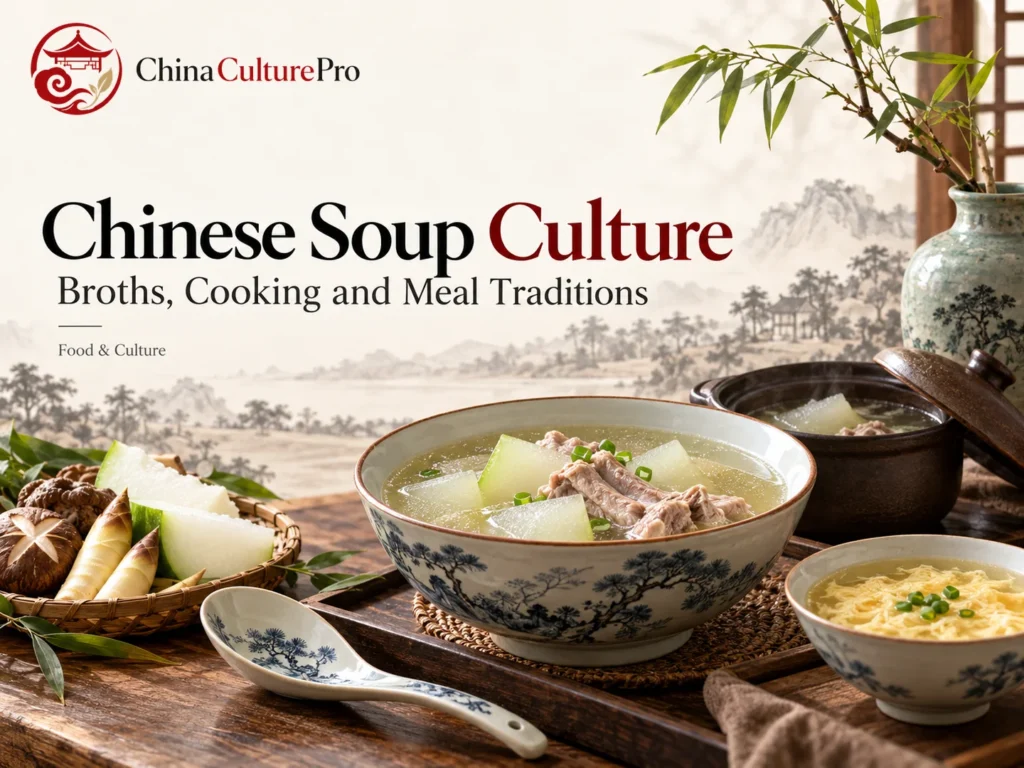
A bowl of egg-drop soup, a lidded pot of Cantonese broth and a breakfast bowl of beef soup can all arrive under the English label “soup.” One is finished quickly, another develops flavor through extended cooking, and the third may anchor an entire meal. Within Chinese food culture, these bowls have distinct ingredients, methods and places at the table.
How Soup Fits into Chinese Meals
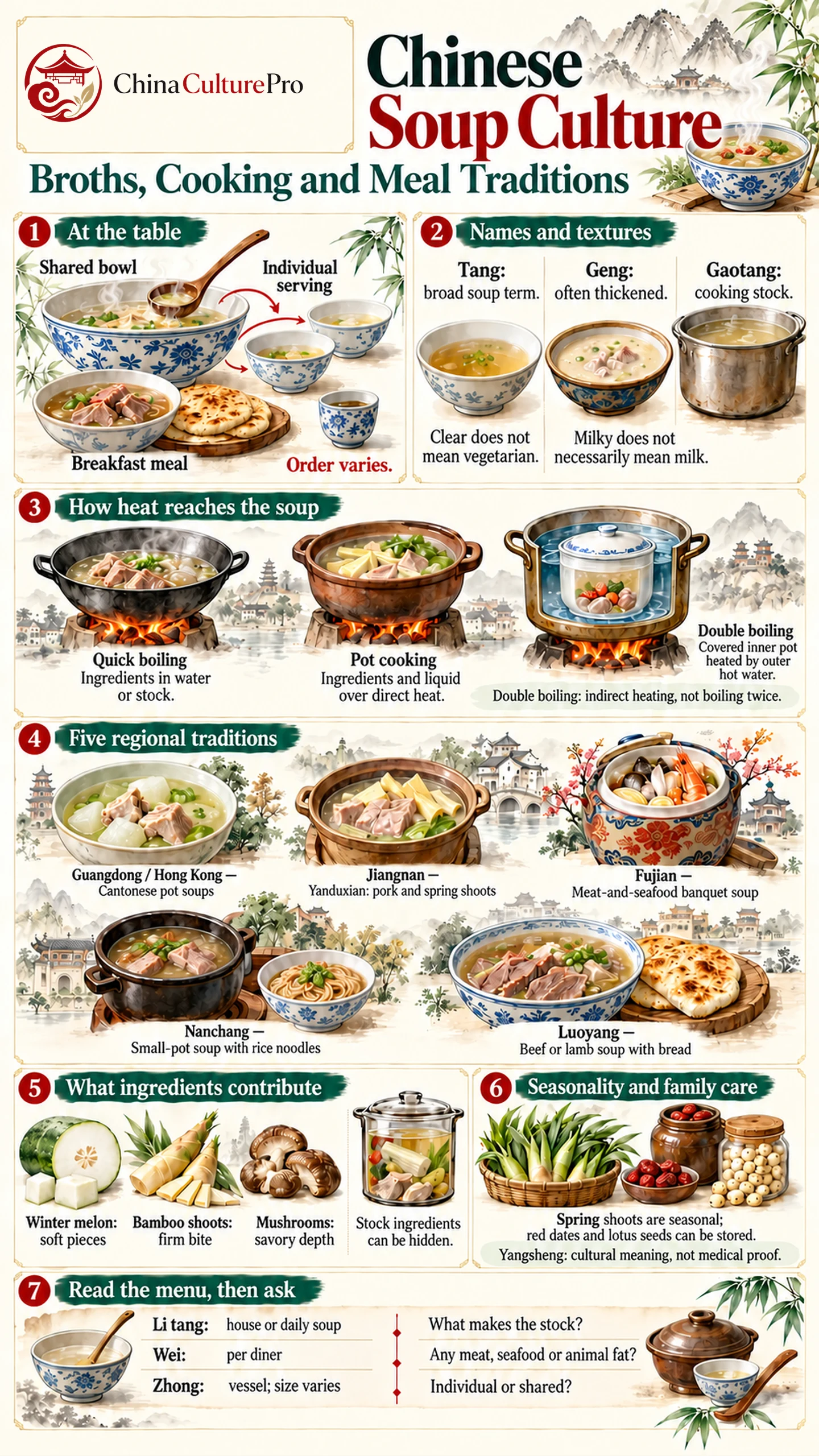
In Chinese home cooking, a family soup can sit beside the other dishes in a shared serving bowl. Diners use a serving ladle to fill their own smaller bowls. At a banquet, soup may instead arrive in individual portions, although a whole pot can also be presented for sharing. Breakfast soups follow another pattern: a bowl of beef or lamb soup with bread can be the center of the meal rather than an additional course.
Some Cantonese meals begin with soup before rice and other dishes. This is a recognizable regional custom, not an obligatory sequence throughout Guangdong, Hong Kong or China. Elsewhere, soup may come with the dishes or be enjoyed toward the end. Household preference, the occasion and restaurant service all matter; “southerners first, northerners last” is too rigid a rule for reading an actual table.[1]
The solid ingredients have different roles, too. Winter melon, mushrooms, tofu and suitable pieces of meat may be intended for eating with the liquid. Bones and other stock-making materials may be strained out. Whether the meat is served or strained out depends on the preparation. Chinese soup traditions include eating the solids as well as drinking the broth.
Understanding Tang, Geng and Soup Stocks
Three terms help distinguish a finished dish from its texture and its cooking base:
- Tang (汤, tāng): The broad Chinese word for soup. It does not guarantee a clear liquid, a meat-based recipe or a particular cooking time. A light egg-drop soup and a substantial meat soup can both belong here.
- Geng (羹, gēng): On many modern menus, a soup with a thicker, smoother consistency, often achieved with starch. This is a useful contemporary distinction rather than a rule covering every historical use of the word. Some soups gain body from their ingredients instead of added starch.[2]
- Gaotang (高汤, gāotāng): A prepared stock used as a cooking base. Chicken, pork bones and other animal ingredients are common, but the actual formula must be checked. Stock may become a finished soup or contribute flavor to another dish.
Qingtang (清汤, qīngtāng) means clear soup or broth; naitang (奶汤, nǎitāng) describes a milky-looking broth in relevant culinary usage. These labels describe appearance and preparation, not a reliable dietary classification. A clear broth can contain chicken, pork or dried seafood.
Milky whiteness can arise when cooking disperses fat and protein into the liquid, creating an emulsion. Milk is not necessary for that effect, although a particular kitchen may add dairy or other ingredients. Color therefore proves neither that a soup contains milk nor that it is dairy-free.[3]
A hot-and-sour soup may have the thickened texture associated with geng while its familiar English or Chinese menu name still uses “soup.” Treat these terms as reading aids rather than mutually exclusive boxes.
Quick Boiling, Slow Cooking and Double Boiling
The useful distinction is how heat reaches the ingredients and whether the broth is being made or merely finished. A soup assembled in minutes may start with stock prepared much earlier. A long cooking time is not a universal measure of quality: tender greens, egg ribbons and delicate seafood have different requirements from stock-making bones.
| Method | What happens in the kitchen | What it helps explain |
|---|---|---|
| Guntang (滚汤, gǔntāng), a quickly finished soup | Ingredients are added to boiling water or prepared stock and cooked directly in the liquid. | Fresh vegetables, sliced ingredients or egg can become a soup without a prolonged final cooking stage. |
| Baotang (煲汤, bāotāng), soup cooked in a pot | Ingredients and liquid cook together over direct heat. Laohuo tang (老火汤, lǎohuǒ tāng), often called old-fire soup, is associated with extended cooking in Cantonese practice. | Flavor develops through contact between ingredients and liquid. The heat level and duration depend on the recipe; “slow-cooked” does not mean every soup follows an identical low simmer.[5] |
| Geshui dun (隔水炖, géshuǐ dùn), indirect water-bath cooking | A covered inner vessel holds the soup while hot water in an outer pot transfers heat indirectly. | The soup is kept separate from the outer water. This is the principle commonly described in English as double boiling.[4] |
“Double-boiled” refers to the two-vessel arrangement, not an instruction to boil the same soup twice. A covered ceramic pot is not necessarily airtight or pressure-sealed, and the soup’s ingredients do not sit loose in the outer water. Restaurants may also use steaming equipment to heat individual covered vessels.[4]
A lid and a ceramic bowl alone do not establish that a soup was double-boiled; they may simply be serving ware. Likewise, the general Chinese term for stewing can have broader uses than this particular water-bath technique. For the wider vocabulary of steaming, simmering and other processes, see Chinese cooking methods.
Regional Chinese Soup Traditions to Recognize
These examples show how ingredients and meal roles change across regions. They are recognizable traditions, not fixed menus followed by every household. A single region can have light everyday soups, richly flavored stocks and special-occasion dishes side by side.
| Region and example | Ingredients or character to recognize | Place in the meal |
|---|---|---|
| Guangdong and Hong Kong: Cantonese pot soups | Meat or bones may be paired with vegetables, dried ingredients or plant materials. Winter melon and pork-rib soup is one familiar combination; quick and indirectly heated soups also belong to Cantonese cuisine.[1][5] | Family meals and hospitality; extended cooking is one style within a larger soup repertoire. |
| Shanghai and Jiangnan: Yanduxian (腌笃鲜, yāndǔxiān) | Salted pork, fresh pork and spring bamboo shoots create a savory, often pale broth. Tofu knots appear in some versions.[6] | A seasonal shared dish associated with spring and Shanghai cuisine. |
| Fujian: Buddha Jumps Over the Wall (佛跳墙, fótiàoqiáng) | Elaborate versions combine meat, dried seafood and mushrooms, often with wine. Abalone and dried scallops are examples, not a compulsory universal formula.[7] | A rich banquet dish in Fujian cuisine; the dedicated Buddha Jumps Over the Wall guide covers it in more detail. |
| Nanchang: Waguan weitang (瓦罐煨汤, wǎguàn wēitāng) | Small earthenware pots hold individually prepared soups with varying meat and other ingredients.[8] | A familiar breakfast pairing with mixed rice noodles, placing soup within the everyday food culture of Jiangxi. |
| Luoyang: beef and lamb soups | Meat broths accompany bread or strips of bread. The city’s soup breakfasts also extend beyond these two meats.[9] | A substantial morning meal within the broader traditions of Henan cuisine. |
A Nanchang earthenware pot and a Cantonese covered soup vessel can look similar on the table while belonging to different cooking arrangements. Vessel shape, regional identity and heating method are separate clues. The regional name tells you where to begin asking questions, rather than supplying a complete ingredient list.
Ingredients, Seasonality and Traditional Nourishment
Ingredients That Build Flavor and Texture
Soup ingredients do more than flavor the liquid. Winter melon brings soft, absorbent pieces; bamboo shoots contribute a firmer bite; tofu adds tender solids. Chinese mushrooms can provide savory depth in both vegetable and meat-based preparations. Dried ingredients produce a different result from their fresh counterparts, so an apparently simple bowl may involve several layers of preparation.
Some combinations are especially useful to recognize: winter melon with pork ribs, fresh and salted pork with spring bamboo shoots, or mushrooms with tofu. Each connects a broth with ingredients that can remain part of the finished dish. Chicken, bones or dried seafood may instead form a less visible background. Seeing only vegetables on top does not establish what was used underneath.
Texture also depends on the kitchen’s choices. Starch, emulsified fat and soft cooked vegetables give soups body in different ways. Thickness alone is not a ranking of richness, ingredient quality or nutritional value.
Seasonality, Family Care and Yangsheng
Yangsheng (养生, yǎngshēng), often translated as nourishing or cultivating life, provides one cultural framework for understanding soup traditions. Families may speak of ingredients as “cooling,” “warming” or “moistening.” These are traditional food-culture categories, not proof that a bowl produces a specific medical effect. Ethnobotanical records document the use of plants in Cantonese soups and the meanings people attach to them; recording a belief does not establish that it treats illness.[10]
Seasonality can mean several things. Fresh bamboo shoots connect a pot of yanduxian with spring produce. Red dates and dried lotus seeds, by contrast, can be stored and used beyond their harvest season. A household’s choice may reflect availability, remembered family combinations or the wish to prepare something comforting for a visitor.
The act of making soup can therefore express care without requiring a therapeutic claim. Choosing ingredients, tending a pot and sharing the result are part of the tradition. Using a plant also found in Chinese herbal medicine does not turn an ordinary soup into a prescribed treatment.
Reading Soup Menus and Checking Ingredients
Three menu labels help identify the serving, though they do not provide a complete recipe:
- Li tang (例汤, lìtāng): The house or daily soup. Its ingredients can change, and the label does not mean it is free.
- Wei (位, wèi): A person or place setting; on a menu, pricing “per wei” commonly means per diner. A soup may also be marked for two or three people.[11]
- Zhong (盅, zhōng): A small cup or lidded vessel, also used as a serving measure. It does not establish a standard volume or prove that the portion is for exactly one person.
Use the wider Chinese food names guide to decode ingredients and methods, then ask about what the name leaves out:
- What ingredients are used to make the broth? — 汤底是用哪些原料熬的?
- Does the soup contain meat, seafood or animal fat? — 汤里有没有肉、海鲜或动物油脂?
- Is this serving for one person or for sharing? — 这一份是单人份还是多人共享?
For Chinese vegetarian food, check the stock as well as the visible solids. A clear mushroom soup may still use chicken stock or animal-based seasoning.
Tong sui (糖水, tángshuǐ) belongs to the separate Chinese sweet-soup tradition. “Tong sui” is the familiar Cantonese-derived English name; the tone-marked reading here is Mandarin. These dessert soups have a different role from the savory meal soups discussed above.
FAQs About Chinese Soup Culture
Is Soup Served Before or After a Chinese Meal?
Either is possible. Soup before rice is familiar in Cantonese dining, but the sequence also depends on the household, occasion and restaurant. Elsewhere, soup may accompany the dishes or come toward the end; no national timetable applies.
Does Double-Boiled Soup Mean It Is Boiled Twice?
No. The name describes indirect heating, usually with a covered soup vessel inside an outer container of hot water. It refers to the arrangement of vessels rather than a required number of boiling cycles.
Why Are Some Chinese Broths Milky White?
Cooking can disperse fat and protein into the broth to form a pale emulsion. Milk is not required, although individual recipes may add it. Check ingredients directly if dairy matters to you.
Is Clear Chinese Soup Vegetarian?
Not necessarily. Chicken, pork bones or dried seafood can produce clear broth. Ask about the stock, seasoning and solid ingredients; the color and a vegetable topping cannot answer that question.
Are Chinese Herbal Soups the Same as Medicine?
An ordinary soup made with traditionally valued plants is food, not evidence of a treatment. Traditional food beliefs should be distinguished from clinically established effects and from a preparation specifically prescribed by a qualified practitioner.
Sources
[1] ChinaCulture. Cantonese Soup
[2] Taiwan Ministry of Education. Revised Mandarin Chinese Dictionary: 羹
[3] Guan, H., et al. Migration of Nutrient Substances and Characteristic Changes of Chicken White Soup Emulsion from Chicken Skeleton during Cooking
[4] MICHELIN Guide. Restaurant Secrets: Perfecting Double-Boiled Soups at MICHELIN Restaurants in Singapore
[5] MICHELIN Guide. Restore your yin and yang: The extraordinary Cantonese soups from Hong Kong MICHELIN restaurants
[6] Shanghai Municipal Government. ‘Yanduxian’: A taste of spring in a single pot
[7] Fujian Department of Commerce. 福建风味—热菜菜谱—佛跳墙
[8] Xinhua. 唤醒一座城市的瓦罐煨汤
[9] CRI, from Luoyang Culture and Tourism. 顿顿不重样!洛阳特色早餐,你吃过几种?
[10] Liu, Y., et al. Plants traditionally used to make Cantonese slow-cooked soup in China
[11] Dragon G. Restaurant menus