
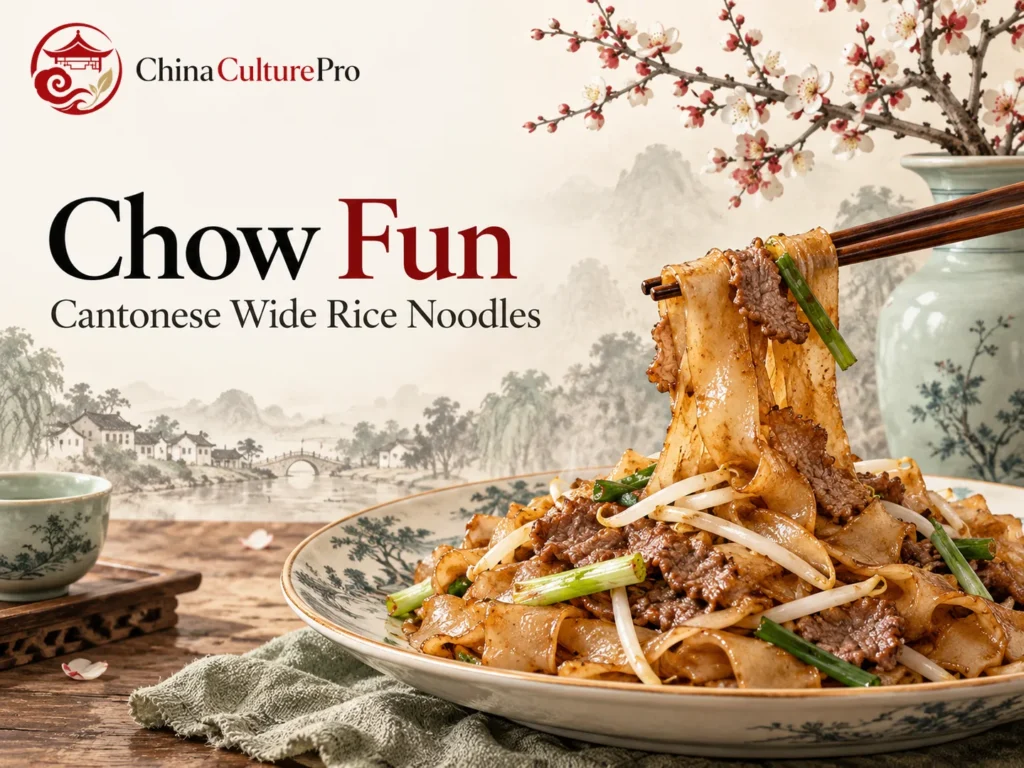

Quick Answer: What Is Chow Fun?
Chow fun (炒粉, chǎofěn) usually means a Cantonese dish of stir-fried wide rice noodles on English-language menus.
- Noodles: The broad, flat rice ribbons are ho fun (河粉, héfěn), also spelled hor fun.
- Cooking: The noodles are stir-fried with seasonings and other ingredients; they remain tender and chewy rather than becoming a crisp noodle cake.
- Variations: Dry versions have little free sauce, while saucy versions come with gravy. Beef is a familiar choice, but chicken, shrimp and vegetables also appear.
The noodle ingredient and the finished dish have related names, but they are not interchangeable terms.
A menu may list wide rice noodles on one page and a beef stir-fry on another, leaving you wondering whether they are the same thing. This guide explains the names, noodle ingredients and dry or saucy finishes within the wider world of Chinese noodles.
Chow Fun, Ho Fun and He Fen: What the Names Mean
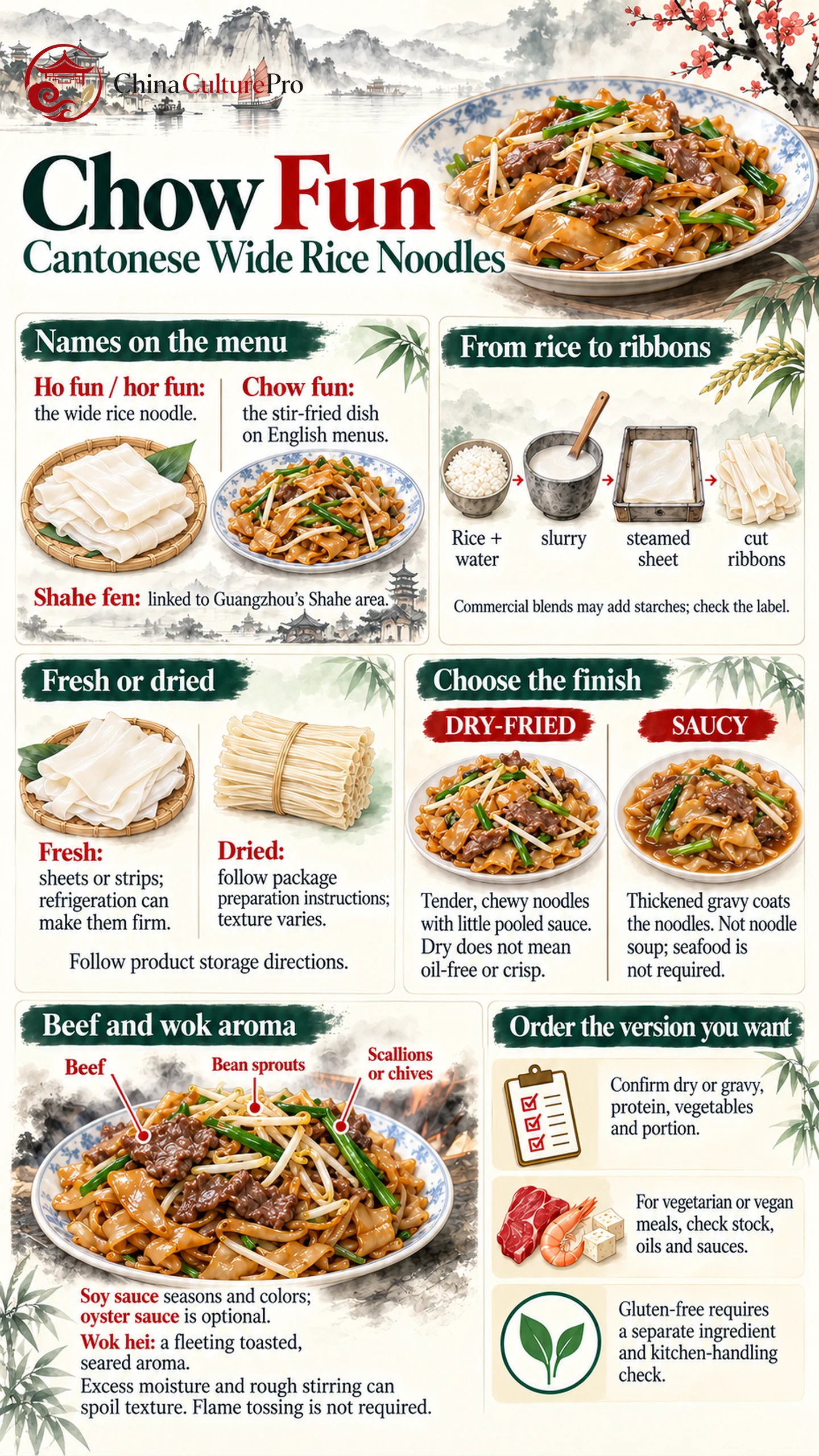
Ho fun and hor fun are Cantonese-derived spellings for the noodles; he fen represents the Mandarin pronunciation. Shahe fen (沙河粉, shāhéfěn), the fuller name associated with Guangzhou’s Shahe area, connects the food to a local rice-noodle tradition. Its traditional production technique entered China’s national intangible cultural heritage list in 2021. That designation concerns the craft, not every dish made with the noodles.[1]
The word chow signals frying in Cantonese menu terminology.[10] Dry-fried beef chow fun (干炒牛河, gānchǎo niúhé) is a well-known finished dish using these noodles. The tone-marked forms here show Mandarin pronunciation; chow fun and ho fun are Cantonese-derived menu spellings.
Chinese chǎofěn is broader than this particular dish and can describe other fried rice-noodle preparations. On an English menu, look for the noodle description, protein and sauce together. This naming distinction is especially useful when exploring Cantonese cuisine.
Wide Rice Noodles: Ingredients, Fresh and Dried Forms
Rice gives ho fun its identity. In the traditional process, soaked rice is ground with water, spread into a thin layer and steamed into a sheet. The sheet is then cooled and cut into ribbons. These are not strands rolled from a wheat dough: steaming sets the rice mixture before the noodles reach the stir-fry pan.[1]
Rice and water can form the basic noodle, but a commercial ingredient list may include additional starches. For example, some packaged wide rice noodles contain modified tapioca starch. Neither a white appearance nor a broad ribbon shape proves a particular formula. There is also no single width that defines every product sold for chow fun.[6]
The difference between rice and wheat noodles begins with the base ingredient. Both a noodle’s base ingredient and its product label matter more than how pale, wide or chewy it looks.
Fresh noodles may be sold as stacked sheets or ready-cut strips. They are already steamed during manufacture, so “fresh” does not mean raw dough. Their moist surfaces can cling together, and refrigeration can make them firm and harder to separate. Pulling a cold block apart forcefully can tear the ribbons. Follow the product’s storage directions; keeping it indefinitely at room temperature is not a solution to firmness.[2]
Dried wide rice noodles offer another option, particularly where fresh ho fun is unavailable. They need preparation before stir-frying, but whether that means soaking, cooking or another treatment depends on the package. Their thickness and starch blend affect the result, so a dried substitute may have a different chew from a fresh sheet noodle. There is no universal preparation time that works for both.[10]
Dry-Fried and Saucy Chow Fun
The most useful menu distinction is the finish: a relatively dry plate of seasoned noodles or one with an obvious gravy. “Dry” and “wet” describe how the dish is served, not whether the rice noodles began fresh or dried.
| Feature | Dry-fried chow fun | Saucy or wet-fried chow fun |
|---|---|---|
| Sauce on the plate | Seasoning coats the ribbons, with little pooled liquid | A thickened gravy coats or covers the noodles |
| Main texture | Supple and chewy, with a comparatively dry finish | Slippery and moist, with more sauce around each mouthful |
| Cooking emphasis | Frying the noodles and ingredients without excess liquid | Combining the noodles with a separately prepared or finishing gravy |
| Familiar example | Dry-fried beef chow fun | Beef with greens or a black bean and pepper gravy |
A saucy black bean and pepper version, for example, brings fermented-bean savoriness and crisp vegetables to the rice noodles. That combination is one version, not a rule that every wet-fried dish must follow. Gravy-based chow fun is distinct from rice noodles immersed in a bowl of soup.[3]
Dry-fried noodles still use oil and liquid seasonings. They need not be crunchy, and the name makes no promise about oil quantity. Conversely, a gravy finish does not require seafood. Choose by the sauce and texture you want, then check the accompanying ingredients.
Beef Chow Fun: Ingredients and Wok Hei
Beef chow fun shows how a short ingredient list can create contrasting textures. Thin beef slices bring meaty flavor; bean sprouts add crunch, while scallions or yellow chives provide a fresh aromatic note. Light and dark soy sauces supply savory seasoning and deeper color respectively.[4] Oyster sauce appears in some marinades or sauces, but other versions omit it.[5]
The Cantonese expression wok hei (镬气, huòqì in Mandarin), often translated as “breath of the wok,” describes the fleeting toasted, seared aroma associated with skillful hot-wok cooking. It is part of the appeal of a dry-fried plate. A bitter, blackened surface is not the same effect, and a darker soy-colored noodle does not prove stronger wok hei.[2]
Noodle integrity matters just as much as aroma. Excess liquid and an overcrowded pan can leave the ingredients steaming in accumulated moisture. Repeated rough stirring can tear the soft rice ribbons. Separating the noodles appropriately and handling them gently helps preserve recognizable strips instead of small, sticky fragments.[2][5]
Cooks adjust the order of ingredients and handling to the noodles and equipment available. Flame tossing is not a requirement, and useful results are possible in a suitable skillet. The broader distinctions between frying, steaming and other techniques belong in our Chinese cooking methods guide.[5]
Ordering Chow Fun and Checking Ingredients
Chow fun can be a meal for one or a shared plate alongside other dishes. It is not restricted to a dim sum session or a formal banquet. The menu’s portion description is more useful than assuming that every restaurant serves the same quantity.[5]
Three checks help narrow your choice:
- Style: Ask whether the noodles are dry-fried or served with gravy. Confirm chili separately if you have a heat preference; sauce color alone does not establish spiciness.
- Protein and vegetables: Check whether the dish contains beef, chicken, shrimp or a vegetable combination. Changing the visible protein does not necessarily change its marinade or sauce base.
- Dietary ingredients: For a vegetarian or vegan order, ask about oyster sauce, meat stock and cooking fats as well as the main ingredients. A vegetable version is not automatically plant-based from start to finish.
Our Chinese food names guide helps with menu terminology, while the Chinese vegetarian food guide explains ingredient checks. Gluten-free requirements need their own confirmation, separate from whether a dish contains meat.
FAQs About Chow Fun
How does chow fun differ from chow mein?
Chow fun usually uses wide rice noodles. Chow mein (炒面, chǎomiàn) generally uses wheat noodles, often with egg. Chow mein can be soft or crisp, so crunch alone is not the distinction. See chow mein vs lo mein for the cooking-method comparison.[8]
Is chow fun the same as mei fun?
No. On many English-language Chinese menus, mei fun (米粉, mǐfěn) means thin rice vermicelli, while chow fun uses broad, flat rice ribbons. Both can be rice-based, but their shapes and texture differ. Read the noodle description rather than relying on “rice noodles” alone.[9]
Is chow fun gluten-free?
Not automatically. A rice-based noodle can be gluten-free, but wheat-containing soy sauce, marinades and other ingredients may change the finished dish. Confirm the noodle label, sauces and kitchen handling rather than treating the dish name as a guarantee.[7]
Can dried rice noodles be used for chow fun?
Yes. Suitable dried wide rice noodles can replace fresh ho fun, although the texture may differ. Follow their package instructions before stir-frying; do not transfer a soaking or cooking time from another noodle product simply because both are labeled rice noodles.[10]
Sources
[1] China Intangible Cultural Heritage Network. 米粉制作技艺(沙河粉传统制作技艺)
[2] The Woks of Life. Beef Chow Fun
[3] Made With Lau. Beef Chow Fun with Gravy
[4] Lee Kum Kee. 干炒牛河
[5] Maggie Zhu. Beef Chow Fun (干炒牛河)
[6] A Taste of Thai. Rice Noodles
[7] U.S. Food and Drug Administration. Questions and Answers on the Gluten-Free Food Labeling Final Rule
[8] Made With Lau. Chicken Chow Mein
[9] The Woks of Life. Singapore Noodles (Singapore Mei Fun)
[10] Jason Farmer. Beef Chow Fun Recipe (Dry-Fried Beef Ho Fun)