

Quick Answer: What Shaped Chinese Food History?
Chinese food history grew through thousands of years of regional adaptation. Four forces repeatedly changed what people grew, cooked and ate:
- Agriculture and staples: Millet and rice farming, the spread of wheat, and later American crops reshaped everyday sources of food.
- Processing and cooking: Pots, mills, fermentation, stoves and skilled kitchen work expanded the ways ingredients could be prepared.
- Trade and migration: Merchants, migrants and communities carried crops, techniques and preferences between regions and across borders.
- Cities and social life: Markets, restaurants, religious practices and differences in wealth helped shape meals and recognizable regional styles.
Change was uneven. A court banquet, an urban worker’s meal and a farming household’s dinner could belong to the same period yet contain very different foods.
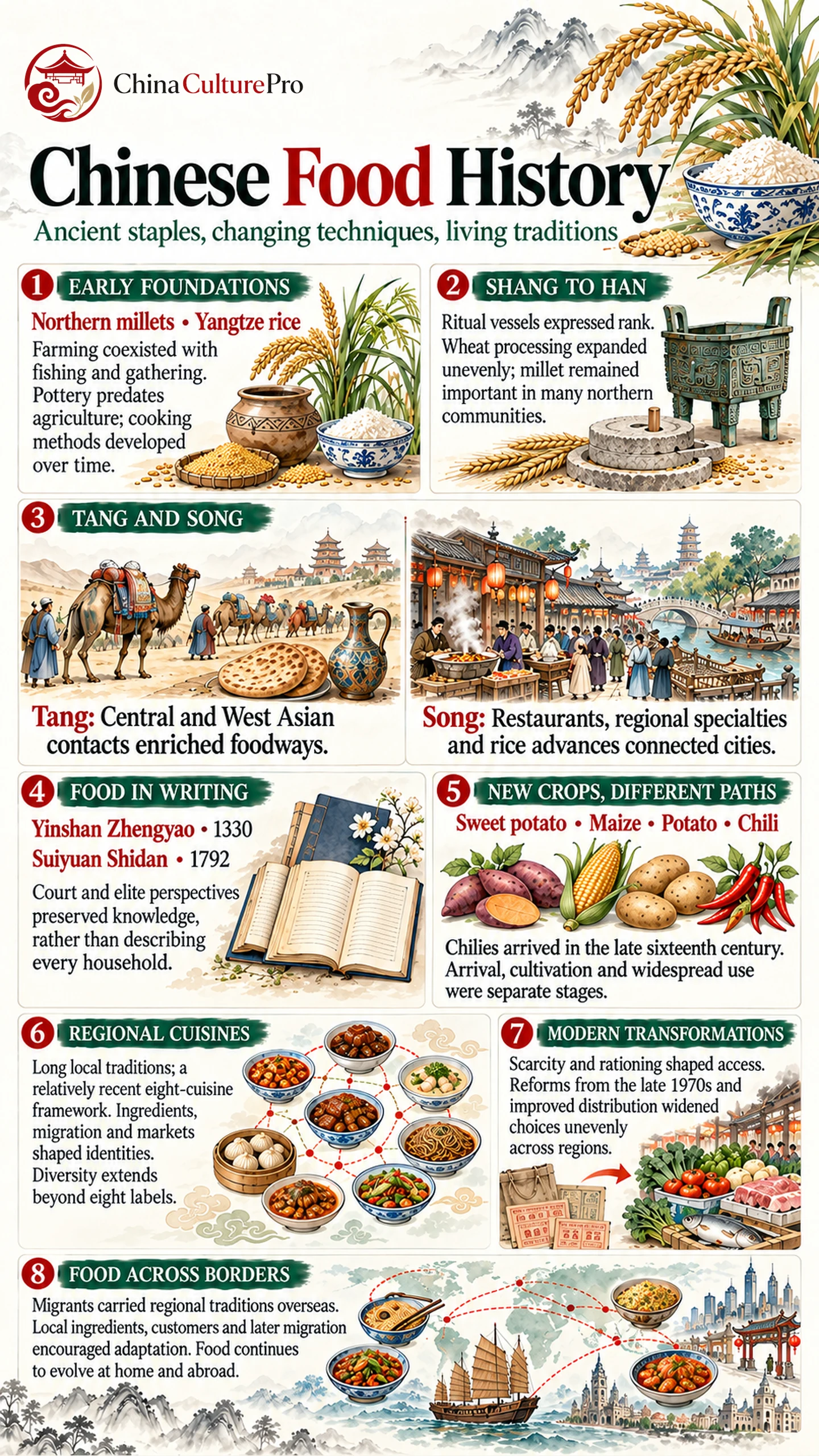
Rice, noodles, tofu and chili-rich dishes carry different histories. Some grew from early farming traditions; others depended on new crops, processing skills or long-distance exchange. Chinese food history connects these layers rather than tracing a single ancient menu. The timeline below follows the changes that made today’s regional food cultures possible, while keeping everyday meals in view alongside celebrated feasts.
Chinese Food History at a Glance
These periods mark useful turning points. Changes often crossed dynastic boundaries, and familiar foods could take centuries to spread beyond their first recorded locations.
| Period | Major developments | Lasting significance |
|---|---|---|
| Neolithic farming communities | Millet cultivation in northern regions; rice farming in the Yangtze region; varied combinations of farming, fishing and gathering | Early regional foundations for staple foods |
| Shang to Han, c. 1600 BCE–220 CE | Ritual food vessels, expanding crop choices, grain milling and fermented seasonings | Links between food, technology, status and ceremonial life |
| Tang, 618–907 | Active exchange with Central and West Asia; diverse urban food markets | Wider circulation and adaptation of ingredients and eating practices |
| Song, 960–1279 | Commercial cities, restaurant menus, regional specialties and improvements in rice cultivation | A stronger connection between agriculture, markets and dining out |
| Yuan, 1271–1368 | Mongol-era exchanges and the court dietary manual of 1330 | Written evidence of food knowledge crossing cultural boundaries |
| Ming and Qing, 1368–1912 | American crops, changing agriculture and influential culinary writing | New staples and seasonings became part of local traditions |
| Nineteenth to mid-twentieth centuries | Overseas migration, restaurant adaptation, war and food shortages | Chinese food histories expanded abroad while supply at home remained uneven |
| Later twentieth century onward | Market reforms, improved distribution, refrigeration and continued migration | Greater access to varied foods and faster circulation of regional cooking |
Early Foundations: Millet, Rice and Ancient Foodways
Early Chinese food cultures developed across different environments. In the drier north, foxtail millet (粟, sù) and broomcorn millet (黍, shǔ) became important crops. In the Yangtze region, communities developed rice agriculture within landscapes also rich in fish, aquatic plants and other wild resources. By 6000–5000 BCE, evidence already indicates broad regional differences in staple consumption.[1]
These were overlapping food systems. A household could cultivate grain, gather nuts or fruits, fish and keep animals. The balance depended on local conditions and changed over time. Farming added dependable food supplies and new demands for labor, storage and processing, while older ways of obtaining food continued beside it.
The two millets are different crops, both with waxy and non-waxy varieties that produce different cooking qualities. Preparation mattered too: pounding, husking, grinding and cooking could turn harvested grain into several kinds of food, from whole-grain meals to flour-based preparations.
Pottery belongs to a longer technological story than farming alone. Finds from Xianrendong in Jiangxi place pottery use well before agriculture. Over subsequent millennia, cooking vessels helped people heat food in liquid, while specialized steaming equipment developed as part of later food-processing traditions.[2] Roasting and other uses of fire also remained important; these cooking methods developed alongside one another.
This history explains why today’s northern and southern Chinese food cannot simply be projected backward. Northern prehistoric staples were strongly associated with millet, whereas wheat flour products gained importance later. Southern rice cultivation likewise expanded and changed through new varieties, irrigation and settlement. An excavated grain or cooking residue identifies a particular place and context; a regional dietary pattern requires evidence from many such contexts.
Shang to Han: Food, Ritual and Changing Techniques
During the Shang and Zhou periods, food and drink were central to ritual and political authority. Bronze vessels such as the ding (鼎, dǐng), a cooking or serving vessel, and gui (簋, guǐ), used for grain offerings, helped express rank and obligations to ancestors. Their materials, forms and ceremonial use illuminate the resources available to powerful households.[3]
Everyday food depended on a wider range of circumstances. Grain supplied much of people’s energy, while access to meat, fish, vegetables and fermented foods varied with wealth, ecology and season. The contrast between a spectacular elite feast and a modest grain meal is useful, but individual communities combined foods in different ways.
Wheat had reached China long before the Han dynasty. Its adoption was gradual and geographically uneven. By Han times it was important in parts of northern China, while millet remained particularly significant in other areas. Evidence from the Guanzhong Basin near Chang’an, for example, supports the continued importance of millet in Western Han farming.[4]
Processing helps explain this uneven transition. Boiling whole grain and milling flour offered different textures and required different equipment and skills. As mills and flour preparation developed, cooks had more scope for breads and other dough foods. Milling made wheat increasingly useful as a flour crop, but its place in meals still depended on regional supplies and established preferences.
Fermented sauces and preserved ingredients added another layer to cooking. Foods such as fermented beans became useful seasonings, while drying and salting helped households manage food across seasons. The broader Chinese fermented foods tradition developed through many ingredients and processes.
Han tombs preserve unusually tangible evidence. Lady Dai’s tomb at Mawangdui contained food remains, containers and inventories that reveal a wealthy household’s provisions.[3] Such finds complement stoves and granary models, which also expressed hopes for abundance after death. They illuminate particular lives rather than supplying a universal ancient menu. Tofu and noodles likewise have histories of changing evidence and preparation that exceed any single inventor legend.
Tang and Song: Cultural Exchange and Urban Food Markets
Tang Trade and Cultural Exchange
Tang China connected many communities through diplomacy, trade, migration and imperial expansion. Chang’an, today’s Xi’an, offered a market for goods and practices associated with Central and West Asia. Wine vessels, imported styles and descriptions of dining reveal a society in which food could express cosmopolitan taste.[5]
Grape wine and breads associated with western regions are useful examples. Hubing (胡饼, húbǐng), a broad historical name for western-associated baked breads, became familiar in Tang markets. Grapes, breads and dairy foods each had earlier and more complicated histories of exchange; their visibility in Tang life should be understood as part of continuing contact rather than a shared first arrival.
Merchants and migrants also adapted foods to local supplies and preferences. The Silk Road was a changing network of routes and communities, so culinary exchange happened through repeated encounters. Court fashions, urban purchases and rural food supplies followed different rhythms.
Buddhist dietary practices provided another setting for change. Chinese Buddhist commitments to abstaining from meat had developed before the Tang and helped sustain distinctive temple foodways. They formed one influential strand of Buddhist vegetarian cuisine within a much broader range of eating practices.
Song Restaurants and Expanding Urban Tastes
In the Song period, Kaifeng and later Hangzhou supported lively urban food economies. Tea houses, wine shops, stalls and restaurants served customers with differing tastes and budgets. Written accounts describe menus and diners ordering particular dishes, providing unusually detailed evidence of commercial dining.[6]
Restaurants serving regional food made local differences visible to urban customers. A migrant could seek familiar flavors, while another diner could encounter food associated with a distant region. These businesses helped turn place-based preferences into marketable specialties, a process that continued long after the Song.
The agricultural foundations mattered too. Early-ripening rice varieties, including introductions associated with Champa in present-day Vietnam, joined improvements in irrigation and cultivation. Together with river transport, these developments supported expanding production and specialization in the south.[7] Urban dining depended on farmers, transport workers, merchants and kitchen labor as well as fashionable patrons.
The surviving accounts are richest for prominent cities. They show an important transformation in Song society, while rural households participated in markets to different degrees. A modern dish sharing a historical name may retain an association or idea without preserving an unchanged recipe.
Yuan to Qing: New Ingredients and Culinary Writing
Court and Household Food Knowledge
Mongol rule connected food practices across a large imperial world. The dietary manual Yinshan Zhengyao (饮膳正要, Yǐnshàn Zhèngyào), presented to the Yuan court in 1330, records interactions among Chinese, Mongolian and West Asian food knowledge. It includes recipes and ideas about the properties of food, reflecting the specialized world of court provisioning and dietary thought.[8]
Several centuries later, Suiyuan Shidan (随园食单, Suíyuán Shídān), published in 1792, expressed a different kind of authority. Its author, Yuan Mei, discussed ingredients, preparation and taste from the perspective of an educated, well-connected eighteenth-century diner. The work ranges across cooking advice, recipes and judgments rather than describing a single standardized national cuisine.[9]
These texts preserve valuable knowledge, but their purposes and audiences matter. A court manual and a literary gastronome’s book offer different views of food. Their health theories belong to the history of ideas, while their recipes and preferences provide evidence of particular cultural settings. Written circulation could carry techniques and judgments beyond the kitchens where they originated, alongside the practical knowledge transmitted through households and professional training.
American Crops and Their Uneven Adoption
From the sixteenth century onward, crops originating in the Americas entered China through several routes. Arrival, cultivation, regular consumption and regional importance were separate stages. Local soils, growing conditions, markets and household needs influenced whether a new plant became an everyday food.[10]
| Crop | Important historical change | Why adoption varied |
|---|---|---|
| Sweet potato | Added a substantial food source in parts of the southeast and later elsewhere | Planting material, suitable conditions, promotion and household needs shaped its spread |
| Maize | Became important in many upland farming areas | Cultivation expanded at different rates across regions and settlements |
| Potato | Added another crop suited to many cool or mountainous environments | Routes and timing were multiple; widespread local use developed unevenly |
| Chili pepper | Became a major seasoning in several regional cuisines | Ornamental, culinary and other uses overlapped; adoption differed by province |
Sweet potatoes could supplement grain supplies and support food production in places where established crops were less productive. Maize also contributed to changing upland agriculture. Their spread interacted with settlement and population pressures; new crops expanded options without removing the possibility of hunger or poor harvests.
Chilies provide the clearest example of an imported ingredient becoming deeply local. They reached China in the late sixteenth century and gradually entered regional cooking. The transformation unfolded over generations, with different documentary histories in Guizhou, Hunan, Sichuan and other provinces.[11]
Earlier Chinese cooks already used pungent ingredients, including ginger and Sichuan pepper. The numbing sensation of Sichuan peppercorns is distinct from chili heat. Their combination helped create familiar mala (麻辣, málà), or numbing-and-hot, flavors, while Hunan and other cuisines developed different uses of fresh, dried or preserved chilies. A shared introduced crop produced several local traditions.
From Local Traditions to Recognized Regional Cuisines
A regional cuisine (菜系, càixì) takes shape through relationships among ingredients, techniques, communities and markets. Local conditions influence what is available; transport and trade influence what can be obtained; cooks and diners help decide which preparations become recognizable specialties.
Consider the contrast between a coastal fish market and an inland trading city. Each draws on a different supply network, yet ingredients and cooks can move between them. Migrant communities establish businesses, customers seek foods associated with home, and successful restaurants give those associations a public identity. Regional food therefore develops through movement as well as continuity.
The familiar Eight Chinese Cuisines framework names Shandong, Sichuan, Guangdong, Jiangsu, Zhejiang, Fujian, Hunan and Anhui. It organizes several influential traditions, but the scheme itself is relatively recent. Its apparent neatness should be separated from the much longer and more varied histories of cooking in those places.[12]
The distinction is important for Sichuan. Its food history includes longstanding local ingredients and practices, later reshaped by chilies, migration and commercial life. The modern cuisine contains many flavors beyond mala; a single seasoning cannot explain the entire tradition. Nor does the eight-part framework fully represent places such as Yunnan, Xinjiang, Guizhou, or the range of home and minority-community cooking across China.
Cuisine labels are useful guides to connections and differences. They become more informative when attached to a particular period, place or cooking community. For an introduction to today’s dishes and staples, the broader Chinese food guide provides a starting point beyond the historical sequence here.
Modern Chinese Food: Scarcity, Reform and Global Migration
Twentieth-Century Changes Within China
Twentieth-century food history includes interruption and scarcity alongside culinary creativity. War displaced people and disrupted production and distribution. Later, state procurement and rationing shaped how many urban residents obtained grain and other necessities. Grain coupons became a familiar part of household life from the 1950s, with most grain rationing dismantled during the early 1990s.[13]
The famine associated with the Great Leap Forward brought catastrophic hunger, with severe regional differences. Its place in food history concerns access, policy and survival rather than celebrated recipes.[14] Rural and urban experiences also differed, so neither ration coupons nor a single family’s memories describe the whole country.
Market reforms beginning in the late 1970s gradually changed farming incentives, trade and restaurant life. Improved transport, refrigeration and distribution widened access to ingredients in many places. Restaurants could reach more customers, while households encountered a broader selection of foods.
These changes did not arrive at the same speed everywhere. Income, location and infrastructure continued to affect choices. Industrial food production, chains and takeaway services now exist alongside household cooking, local markets and specialized regional kitchens. Modern Chinese food culture contains these overlapping ways of obtaining and sharing meals.
Diaspora and Continuing Regional Adaptation
From the nineteenth century onward, migrants carried food practices to Southeast Asia, the Americas and elsewhere. Southern Chinese communities played a major role in many early restaurant networks, while later migrations brought a wider range of regional backgrounds. Each destination offered different ingredients, customers and conditions for operating a business.
In the United States, restaurant workers adapted dishes and service to local markets while maintaining food connections within Chinese communities. Chop suey became one prominent example of this commercial and cultural encounter. The history involves immigrant labor and entrepreneurship as well as changing flavor preferences.[15]
Adaptation could mean substituting an available vegetable, altering a sauce or developing a dish for new customers. Later arrivals could introduce other regional dishes alongside established Chinese-American menus. These processes produced both continuity and invention; they cannot be explained by a single division between “authentic” and “inauthentic.”
The comparison between Chinese food and Chinese-American food explores those differences more closely. The wider story of Chinese food around the world connects them to other destinations. Across these settings, cooks continue to turn inherited skills, changing supplies and new audiences into living food traditions.
FAQs About Chinese Food History
How Far Back Does Chinese Food History Go?
There is no single starting date. Food gathering and the use of fire long predate farming. Neolithic millet and rice agriculture established important regional foundations, while later artifacts, inscriptions and texts reveal increasingly detailed evidence of meals, rituals and cooking.
What Did People Eat in Ancient China?
Staple grains were central, but their importance varied by region and period. Millet, rice and later wheat combined with vegetables, gathered foods, fish or meat according to access. Wealthy households left unusually rich evidence; their provisions should not be treated as everyone’s daily diet.
When Did Chili Peppers Reach China?
Chili peppers reached China from the Americas in the late sixteenth century. Their cultivation and culinary importance developed unevenly over the following centuries. Sichuan pepper was already used earlier and provides a different sensation from the heat of chilies.
Are the Eight Great Cuisines Ancient Classifications?
The regional traditions have long histories, but the familiar eight-cuisine scheme is a relatively recent way of organizing them. It is a useful introduction to several major styles, rather than a fixed framework that ancient cooks followed or a complete map of Chinese food.
Sources
[1] Xinyi Liu and Rachel E. B. Reid. The prehistoric roots of Chinese cuisines: Mapping staple food systems of China, 6000 BC–220 AD
[2] Xiaohong Wu and colleagues. Early Pottery at 20,000 Years Ago in Xianrendong Cave, China
[3] Smithsonian Institution, Freer Gallery of Art and Arthur M. Sackler Gallery. The Art and Archaeology of Ancient China
[4] Jingwen Liao and colleagues. The Millet of the Matter: Archeobotanical Evidence for Farming Strategies of Western Han Dynasty Core Area Inhabitants
[5] Hong Kong Palace Museum. A Movable Feast: The Culture of Food and Drink in China
[6] Adam Yuet Chau. Culinary subjectification: The translated world of menus and orders
[7] Columbia University, Asia for Educators. Rice Cultivation
[8] Paul D. Buell and Eugene N. Anderson. A Soup for the Qan
[9] Yuan Mei, translated and annotated by Sean J. S. Chen. Recipes from the Garden of Contentment
[10] Institute for the History of Natural Sciences, Chinese Academy of Sciences. 明清时期的农业
[11] Brian R. Dott. The Chile Pepper in China: A Cultural Biography
[12] Fuchsia Dunlop, interview. Fuchsia Dunlop on the Story of Chinese Food
[13] People’s Daily. 告别粮票20年 从短缺到充裕
[14] Chris Bramall. Agency and Famine in China’s Sichuan Province, 1958–1962
[15] Yong Chen. Chop Suey, USA: The Story of Chinese Food in America