


Quick Answer: What Were Yamen Offices?
A yamen (衙门, yámén) was a government office in imperial China and could also mean the compound where that office worked. At county level in the Qing dynasty, the county magistrate (知县, zhīxiàn) handled both administration and justice. [1]
- Magistrate: Supervised revenue collection, heard cases and reported to higher authorities.
- Clerks (书吏, shūlì): Prepared, registered and kept the papers that moved decisions through the office.
- Runners (衙役, yáyì): Carried notices, brought people before the office and did other work outside the hearing hall. [2]
The county office is one example. The same term also applied to offices at other levels, including the prefecture. [3]
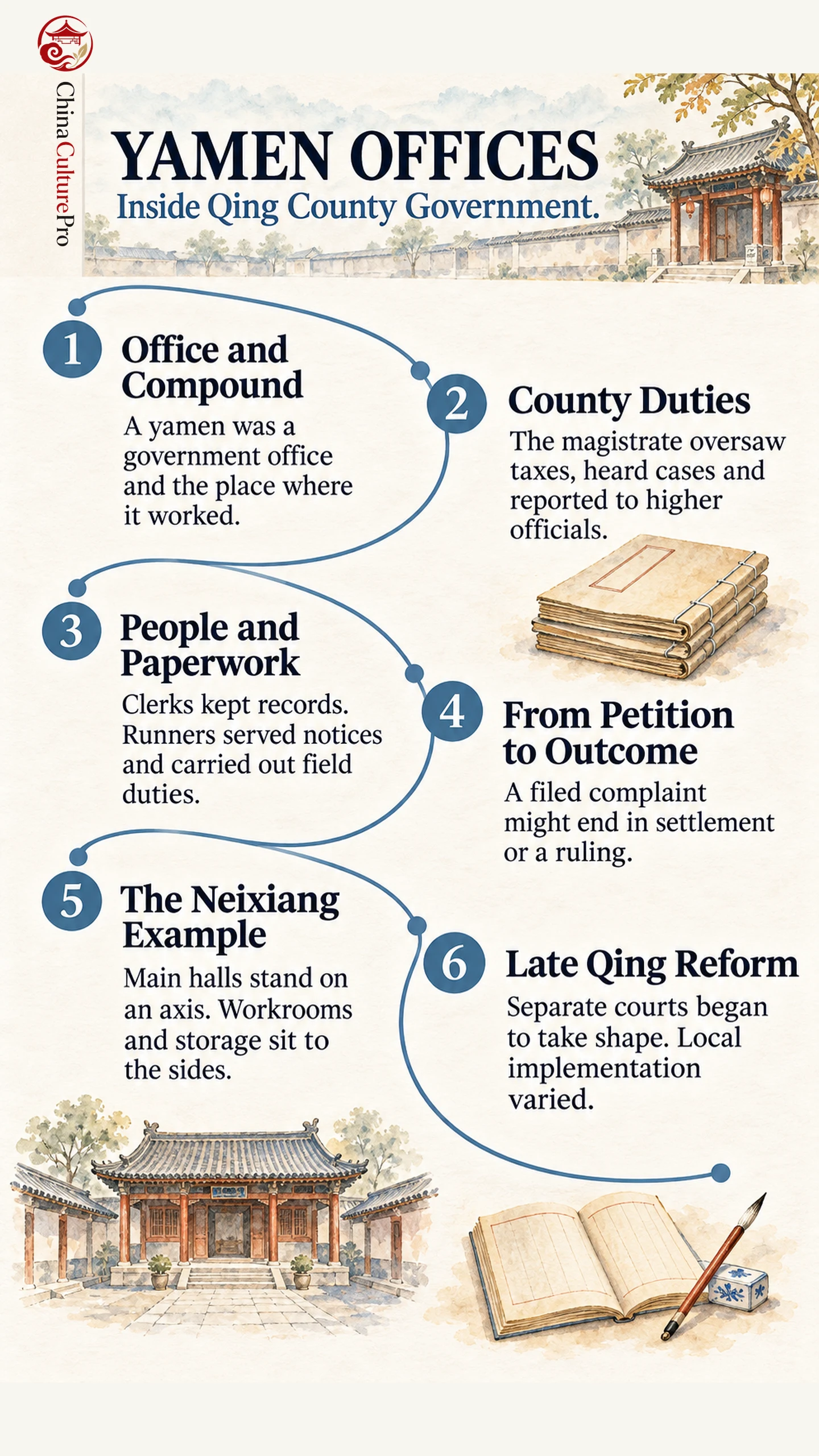
The hearing hall is often the first room readers imagine when a novel mentions a yamen. Much of the work happened before anyone reached it. A petition had to be read and acted on, orders had to be carried into the county, and replies had to come back on paper.
What a County Yamen Had to Do
For much of the Qing dynasty, the county was the lowest territorial tier normally headed by an official directly appointed by the central government. The magistrate answered to officials above him, so the office handled business in two directions. It received instructions and reported upward while managing obligations and disputes within the county. [1][3]
Land-tax collection and litigation illustrate the range of that work. Revenue work involved keeping accounts and meeting obligations to higher authorities. A dispute could require reading a complaint, getting statements and deciding how the case should proceed. Both jobs passed through the same institution. [1]
The county was also one level in a judicial hierarchy. Local action and the final disposition of a serious criminal case could belong to different authorities. A county record of investigation or a proposed penalty therefore needs to be read alongside any surviving records of higher review. [1]
Who Actually Ran the Office?
Official rank tells you who had authority to sign or decide. The roster leaves much of the work behind a decision invisible. The imperial examinations help explain the career track of many appointed officials. The clerks and runners behind them followed different routes into service. [1][2]
| Role | Typical work | Record to look for |
|---|---|---|
| Magistrate | Directed county business and heard cases | Orders and judgments |
| Clerks | Prepared accounts, drafts and case papers | Registers, drafts and copies |
| Runners | Delivered summonses and performed field duties | Service and investigation reports |
| Specialists | Provided technical expertise as needed | Reports tied to the specialist’s assignment |
Specialists varied by office. Some Qing counties employed a yin-yang officer, a specialist consulted on such matters as choosing auspicious dates. The position shows how technical and ritual work entered county administration. [3]
Ba County in Sichuan offers a second distinction. For much of the late nineteenth century its authorized runner quota was 69, yet the office routinely relied on more people. Read the quota as a staffing rule and the local records as evidence of the labor actually available to the office. [2][3]
How a Complaint Became a Case
A dispute over land or debt could begin among relatives or neighbors. Filing a petition introduced the county office into the dispute, but a file could still end with a settlement arranged outside the hearing hall. An order from a magistrate could change the terms on which the parties negotiated without producing a formal judgment. [4]
To see which path a case took, distinguish the original petition from the order written on it and from any later return or decision. The petition gives one party’s version. The order shows what the office instructed someone to do. A later document may show whether the parties appeared, settled or received a ruling. A missing ending leaves the outcome open. [4]
A published study follows 628 surviving disputes over land, debt, marriage and inheritance across records from Ba County, Baodi and two jurisdictions in Taiwan. The sample establishes that such disputes reached Qing offices. Disputes settled locally without a petition fall outside that count. [4]
What the Neixiang Compound Can Tell Us
At the surviving Neixiang county yamen in Henan, the gate and three principal halls are arranged along a central axis. Workrooms, storage and a prison occupy spaces off that axis. The compound shows how an official hearing space sat within a working administrative complex. [5]
The building and the Ba County records answer different questions. The building shows how one county arranged its rooms and thresholds. The records show who processed business and how the staff organized themselves in another county. Use each type of evidence for its own county before drawing comparisons. [2][5]
What Changed in the Late Qing?
Late Qing reforms challenged the concentration of county administration and judging in the same hands. Reformers debated appointments, finances and the structure of county government. The court also began organizing a separate judicial system, extending its reorganization to provincial and local levels in 1907. [6][7]
Implementation varied. When reading a document from the transition, check the date, place and issuing office before assuming who had jurisdiction. A published court plan tells you what the state intended to establish. A case record from the same place can help show which institution actually handled a particular matter. [7]
FAQs About Yamen Offices
Does yamen mean courthouse?
“Government office” or “official compound” is the broader translation. A county yamen could hear cases, but its work also covered taxes, accounts and official correspondence.
Were yamen runners police officers?
They carried out tasks that can sound like police work, such as serving summonses and bringing people in. The same personnel could also be assigned messenger, guard or other duties.
Is a yamen office connected to the Battle of Yamen?
The Battle of Yamen (崖门海战, Yámén Hǎizhàn) uses a Guangdong place name written 崖门. The office word is written 衙门. [8]
Sources
[1] Ch’ü T’ung-tsu. Local Government in China Under the Ch’ing
[2] Bradly W. Reed. Talons and Teeth: County Clerks and Runners in the Qing Dynasty
[3] Journal of Chinese History. Bureaucracy from the Bottom Up: Diviners in Qing Local Governance
[4] Philip C. C. Huang. Between Informal Mediation and Formal Adjudication
[5] Neixiang County Government. Neixiang County Yamen Heritage Record
[6] Wei Guangqi. The Practice and Theory of County Administration Reform in the Late Qing Dynasty
[7] University of Chicago. Dissertation on the Expansion of Lower-Level Courts
[8] Jiangmen Municipal Government. Song–Yuan Naval Battle at Yamen