


Quick Answer: How Did the 1911 Revolution Spread?
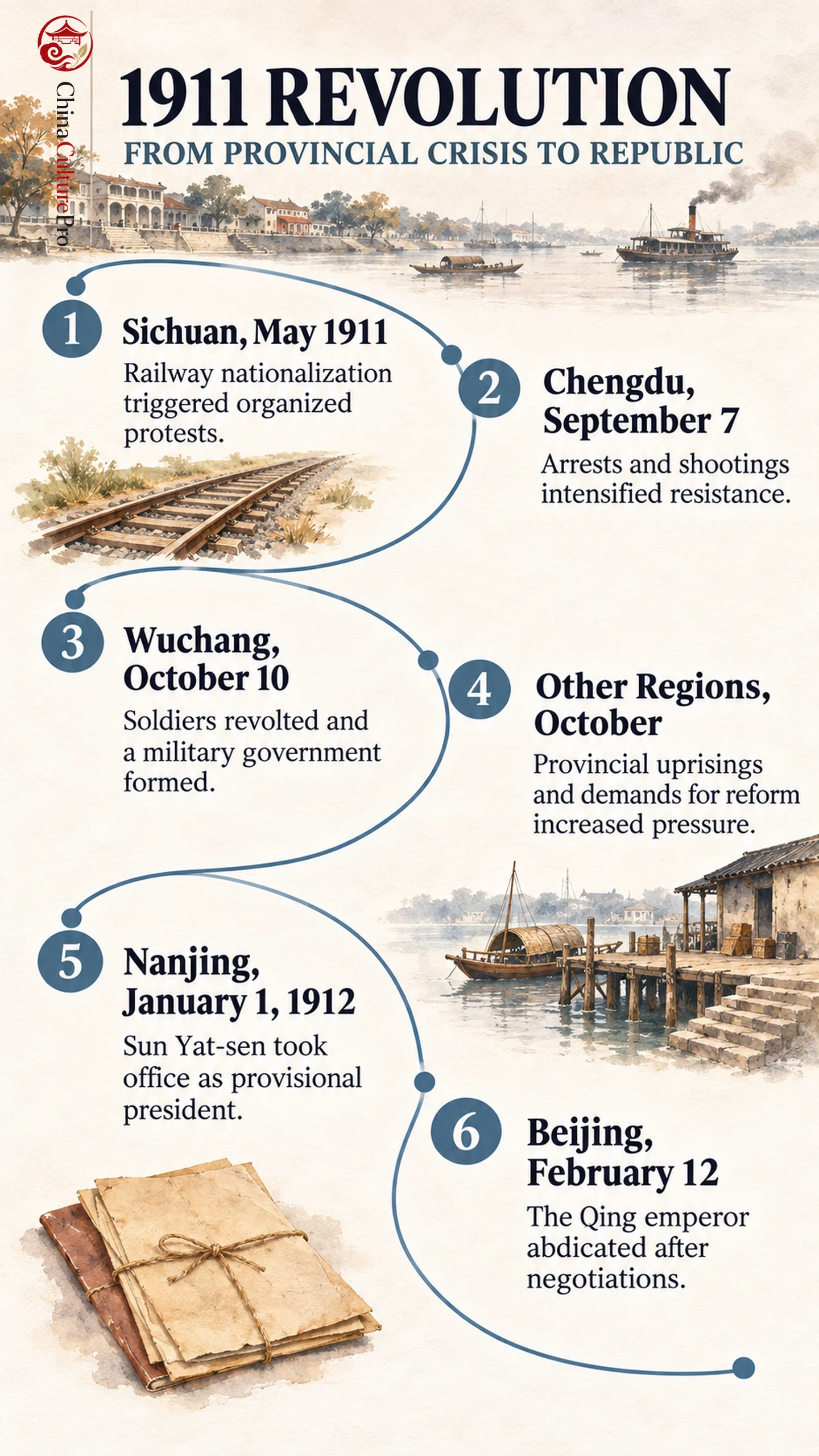
The 1911 Revolution, or Xinhai Revolution (辛亥革命, Xīnhài Gémì), ended Qing imperial rule and brought the Republic of China into being. It spread because local groups took different kinds of action before and after the Wuchang Uprising (武昌起义, Wǔchāng Qǐyì) on October 10, 1911. [1][3][4]
- Sichuan: Resistance to railway nationalization became an armed regional crisis. [2]
- Hubei: A military revolt seized Wuchang and produced a rival provincial government. [3]
- Nanjing and Beijing: Revolutionary delegates organized a provisional republic while negotiations secured abdication. [4][5]
The provincial breakaways, presidential inauguration and imperial abdication occurred in distinct stages from October 1911 to February 1912. [3][4]
On November 1, 1911, Qing forces recovered Hankou, one of the three cities that now make up central Wuhan. By then, the movement had already spread to cities outside Hubei. A military victory at one port could not reverse decisions already being made in other provincial capitals. [3]
Sichuan: When a Railway Dispute Became a Political Crisis
The late Qing state moved in May 1911 to nationalize major railway projects that had drawn investment from the provinces. Sichuan investors and organizers disputed how the transfer would handle their financial stakes and who would control the railway. Public meetings, petitions and the press gave the Railway Protection Movement (保路运动, Bǎolù Yùndòng) a way to reach people beyond the company’s managers. [2][6]
Railway funding had made some taxpayers shareholders in the Sichuan-Hankou company. That connection helps explain why changing its ownership raised questions about money already collected through taxation, as well as who would direct future construction. [10]
On September 7, Sichuan’s acting governor-general arrested movement leaders in Chengdu. Troops fired on people who gathered afterward. The shootings helped turn a dispute that had used petitions and public meetings into open resistance in parts of the province. The firing is better established than the numbers reported in later accounts. [2][7]
Sichuan mattered to the wider revolution because the court had to confront a major crisis there while other provincial movements developed. The railway dispute explains why the authorities were under pressure. Organizing inside the Hubei New Army made revolt possible in Wuchang. [1][2]
Hubei: What the Wuchang Uprising Changed
A bomb accidentally exploded on October 9 in the Russian concession at Hankou, exposing some of the plotters and prompting a crackdown. Soldiers already involved in revolutionary organizing then faced a choice between acting quickly and risking further arrests. [9]
Soldiers in Hubei’s New Army broke with the Qing at Wuchang on October 10. Revolutionaries gained control of the three Wuhan cities during the opening days, and Li Yuanhong (黎元洪, Lí Yuánhóng), a brigade commander, was brought in to head the new military government. Leading local gentry and merchants joined the new authority. [1][3]
The military government turned a barracks revolt into a claim to govern. That claim gave provincial elites elsewhere a possible ally and an example to follow. Qing troops and naval forces still mounted a counteroffensive, and the rebels lost Hankou. To assess what happened next, track control of cities separately from recognition of a new government. [3]
How Other Regions Responded
The dates below mark different kinds of action. An uprising in a provincial capital, an armed demand for reform and the entry of a city into the revolutionary camp each affected the balance of power in a different way. [1][3]
| Place and date | What changed | Why it mattered |
|---|---|---|
| Changsha and Xi’an, October 22 | The uprising spread to the capitals of Hunan and Shaanxi. | Qing authorities faced challenges in several regions while fighting continued in Hubei. |
| Taiyuan and Luanzhou, October 29 | An uprising in Shanxi coincided with officers’ demands for reform at Luanzhou. | The court faced pressure from both sides of Beijing. The officers’ demands and the uprising had different goals. |
| Nanjing, December 2 | Nanjing joined the revolutionary camp after fighting. | The city subsequently became the seat of the provisional republic. |
Even two places that rejected Qing rule could differ over who would lead next. In Hunan, cooperation among military and civilian elites helped maintain order during the transfer of power, after earlier popular unrest had raised fears about public order. The revolution also put Manchu banner communities at risk, with outcomes ranging from survival to severe violence. Those differences disappear in a simple list of provinces that changed sides. [1][3]
How Nanjing and Beijing Reached a Settlement
Delegates elected Sun Yat-sen (孙中山, Sūn Zhōngshān) provisional president in Nanjing in December. He took office on January 1, 1912. The Qing court still existed in Beijing, where it had recalled Yuan Shikai (袁世凯, Yuán Shìkǎi) and relied on him to deal with the military and political crisis. [3][4]
Negotiations between north and south produced the abdication of the child emperor on February 12. The court authorized Yuan to organize a republican government. The Nanjing assembly elected him provisional president three days later. Read those events in order: the republic had a provisional government before the Qing throne relinquished its claim. [4][5]
The agreement ended the dynasty and joined competing claims to central authority under a presidency. It left the new republic with the problem of making that authority effective across provinces with their own military and political leaders. The broader Chinese history timeline places this change between imperial and Republican rule. [3][4][6]
How to Read the Evidence Across Regions
Choose the source by the scale of the question. Sichuan newspapers, petitions and protest materials show what participants said they were defending, though their language cannot establish what everyone wanted. A comparative study of Hunan and Hubei can trace how provincial coalitions formed. It cannot stand in for records from every province. [1][2][6]
The Chinese minister’s February 14 note to the United States is direct evidence of how the new authorities communicated abdication overseas. The note records the reported transfer of power and the authority claimed for Yuan. For the balance of power that made it possible, compare regional military and political records. [3][5]
FAQs About the 1911 Revolution
Why is it called the Xinhai Revolution?
Xinhai (辛亥, xīnhài) names the traditional calendar year that included October 1911, one of sixty year names in the cycle. The name refers to the year in which the Wuchang revolt began. [8]
Did Sun Yat-sen lead the Wuchang Uprising?
Soldiers in Hubei launched the uprising. Sun became provisional president after the movement had spread and delegates met in Nanjing. [1][3][4]
Did the 1911 Revolution end in 1911?
The uprising and initial provincial breakaways occurred in 1911. The Qing abdication and transfer of the provisional presidency followed in February 1912. [3][4]
Sources
[1] Joseph W. Esherick. Reform and Revolution in China: The 1911 Revolution in Hunan and Hubei
[2] University of California San Diego. The Making of Modern Chinese Politics
[3] Edward J. M. Rhoads. The 1911 Revolution, in Manchus and Han
[4] U.S. Office of the Historian. The Second Assistant Secretary to the Secretary of State
[5] Chinese Legation, Washington. The Chinese Minister to the Secretary of State, February 14, 1912
[6] University of California Santa Barbara. The Political Transformation of 1911
[7] Brill. No Place for Good Memories: Chengdu 1911
[8] University of Hawaiʻi at Mānoa Library. Sun Yat-sen, Hawaii and the Chinese Revolution
[9] Edward A. McCord. The 1911 Revolution in Hubei, in The Power of the Gun
[10] Modern China. Taxation, Trust, and Government Debt: State-Elite Relations in Sichuan, 1850–1911