


Quick Answer: What Was the An Lushan Rebellion?
The An Lushan Rebellion, also called the An Shi Rebellion (安史之乱, Ān Shǐ zhī luàn), was a civil war against China’s Tang dynasty from 755 to 763. The general An Lushan (安禄山, Ān Lùshān) founded a rival regime called Yan (燕, Yān). The Tang recovered its capitals with Uyghur help, but the rival regime fought on. [1][6][7]
- 755–756: Rebels rose in the northeast and captured Luoyang and Chang’an.
- 757–763: The Tang retook both capitals in 757. Fighting continued until the final Yan leadership collapsed.
- After the war: Some regional commanders retained substantial power under nominal Tang authority. [1][5][6][7]
A Tang court remained in power, but it had to work with military commanders it could no longer readily replace in some regions.
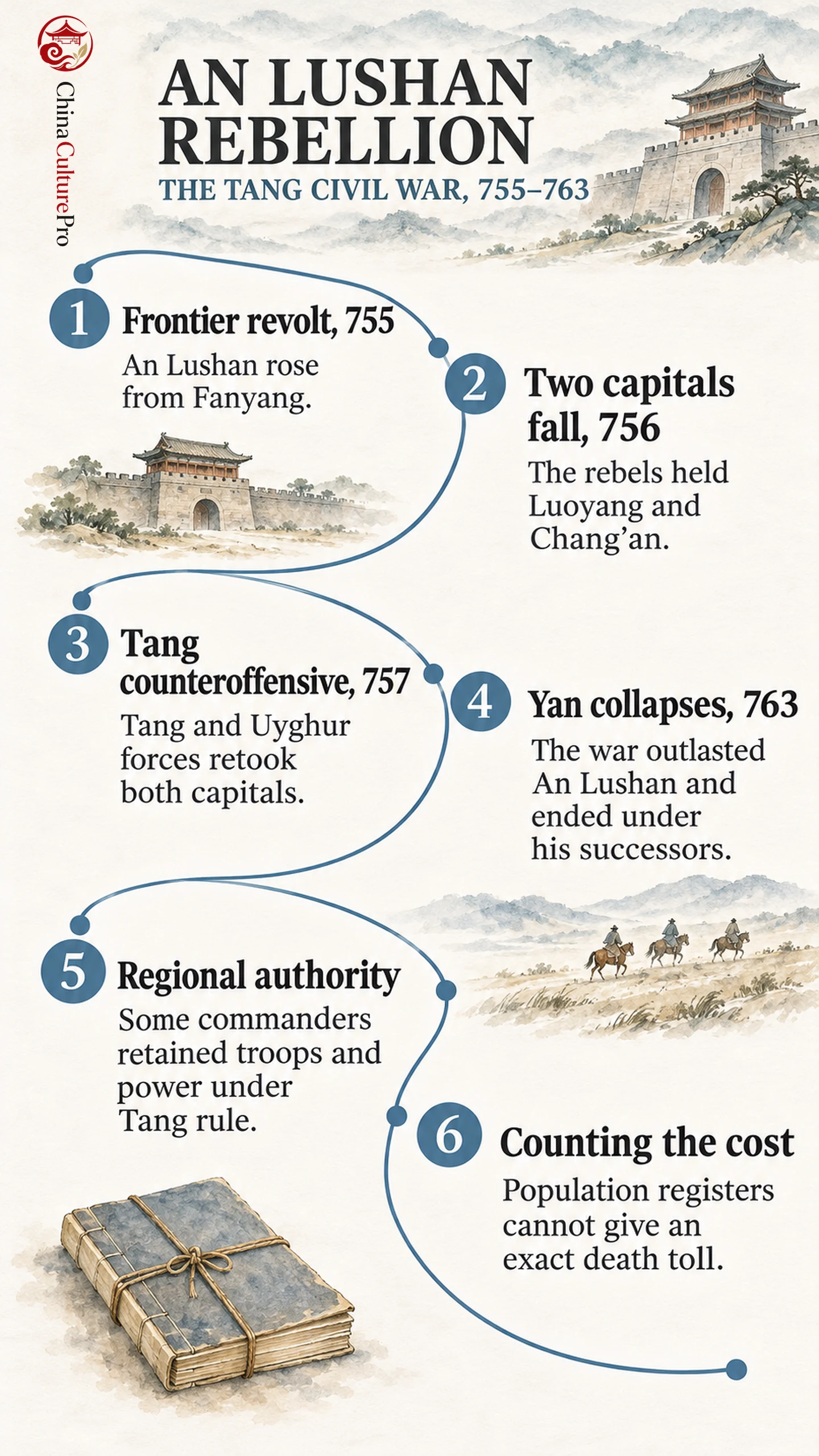
Chang’an and Luoyang changed hands during the war. Their capture and recovery mattered, but the fate of the two capitals tells only part of the story. The Tang also needed troops and resources from military commands far beyond them. [2][6]
Why a Tang General Could Challenge the Court
During the reign of Emperor Xuanzong (唐玄宗, Táng Xuánzōng), the court relied on frontier armies. A military commissioner (节度使, jiédùshǐ) commanded troops in a designated region. An Lushan held three commands in the northeast, giving him access to the troops and supplies needed to sustain a major revolt. The institutional background belongs to the wider history of the Tang dynasty. [2][3]
At court, An Lushan was at odds with the chief minister Yang Guozhong (杨国忠, Yáng Guózhōng). When An mobilized, he claimed to be moving against Yang. That was the justification he gave his troops. His subsequent claim to imperial authority at Luoyang shows how far the campaign went beyond removing a minister. [3][7]
An Lushan’s Sogdian background is part of the story of Tang frontier service. The allegiances of frontier troops varied. The court that fought his army also relied on troops from outside the empire, including its Uyghur allies. [1][2][6]
From Fanyang to the Loss and Recovery of the Capitals
The key dates show why the loss of a capital, the death of a leader and the collapse of a regime need separate entries. [3][4][5][7]
| When | What happened | What changed |
|---|---|---|
| Late 755 to early 756 | An Lushan rose from Fanyang, took Luoyang and declared himself emperor of Yan. | The rebels established a rival court in the eastern capital. |
| 756 | Rebel forces broke through the defenses at Tong Pass (潼关, Tóngguān) and entered Chang’an. | Xuanzong fled southwest and the Tang continued under a new emperor. |
| 757 | An Lushan was killed and his son succeeded him. Tang and Uyghur troops recovered Chang’an and Luoyang. | Yan lost the capitals, while its leadership and armies continued to fight. |
| 759–763 | Shi Siming (史思明, Shǐ Sīmíng) took over Yan and recovered Luoyang. The Tang coalition took it again in 762. | The remaining Yan resistance collapsed in 763. |
Tong Pass guarded the eastern approach to Chang’an. After it fell, the fleeing court stopped at Mawei, where the escort turned on Yang Guozhong and Yang Guifei (杨贵妃, Yáng Guìfēi) was forced to die. The crown prince moved separately and took the throne as Emperor Suzong (唐肃宗, Táng Sùzōng). The loyalist army now had an emperor under whose authority it could organize the counteroffensive. [4][7]
The rebel succession began with An Qingxu (安庆绪, Ān Qìngxù) after his father’s death. Shi Siming displaced him. Shi Siming’s son Shi Chaoyi (史朝义, Shǐ Cháoyì) led the final phase and died in 763 after other commanders had switched sides. [1][5][7]
Why the Tang Victory Changed Provincial Power
Uyghur forces helped the Tang recover the imperial cities. After the 762 recapture, they sacked Luoyang. The same alliance could therefore be decisive for the court and devastating for the people of a recovered city. [2][6]
The court also accepted the surrender of commanders who could still hold territory. In parts of the north, particularly in Hebei, the central government had to negotiate with military governors who retained their own troops. Recognizing the Tang emperor and letting the court replace local commanders were different matters. [1][5][6]
The settlement varied by province. The court could still muster force and govern directly in important areas, while some northern commands operated with considerable autonomy. Farther afield, the war strained Tang capacity in Inner Asia and shifted its relations with powerful neighboring states. [1][2][6]
In 763, after the Yan regime had fallen, a Tibetan army occupied Chang’an. That was a separate invasion, and it shows how vulnerable the capital remained even after the civil war ended. The court also needed to rebuild its revenues. In the decades after the rebellion, the state sought revenue through new fiscal arrangements, including a greater role for monetized taxation. The move toward those arrangements continued well beyond the restoration of the capitals. [6][9][10]
What Chronicles, Registers and Poetry Can Tell Us
The Zizhi Tongjian (资治通鉴, Zīzhì Tōngjiàn) was compiled under the Song dynasty from earlier records. Its entry for 763 preserves earlier versions that disagree about how the last Yan ruler died. The end of organized Yan resistance is a firmer chronological marker than every detail of the pursuit. [5]
The war caused deaths and displacement, particularly in northern regions such as Hebei and Henan. The often repeated figure of 36 million deaths cannot be read straight from population registers. Displaced households, incomplete reporting and the reduced reach of tax registration all affect the figures. Those totals measure the population the state recorded at two points, under very different conditions. [1][2]
Poems by Du Fu (杜甫, Dù Fǔ) can offer a different sort of evidence, giving readers a sense of how an individual described loss, separation and relief. Read a poem for its perspective and a chronicle for its account of events. Neither supplies a complete count of the dead. [2][8]
FAQs About the An Lushan Rebellion
Why is it also called the An Shi Rebellion?
An and Shi are the surnames of An Lushan and Shi Siming, two leaders of the rebellion. The shorter name signals that the war continued after An’s death. [1][7]
When did the An Lushan Rebellion end?
Organized resistance by the Yan regime ended in 763. The Tang recovery of both capitals in 757 was an earlier turning point. [5][7]
Did the rebellion end the Tang dynasty?
The Tang survived until 907. The war changed how the court exercised power in the provinces, and later crises further weakened the dynasty. [1][2]
Sources
[1] Oxford Bibliographies. An Lushan Rebellion (755–763)
[2] David A. Graff. The Reach of the Military: Tang
[3] Sima Guang. Zizhi Tongjian, Volume 217
[4] Sima Guang. Zizhi Tongjian, Volume 218
[5] Sima Guang. Zizhi Tongjian, Volume 222, Siku Quanshu Edition
[6] Richard von Glahn. Economic Transformation in the Tang–Song Transition (755 to 1127)
[7] SOAS University of London. Buddhism and the State in Medieval China
[8] Columbia University, Asia for Educators. Du Fu and the An Lushan Rebellion
[9] Cambridge University Press. The Fall of the Tang, Introduction
[10] Christian Lamouroux and Richard von Glahn. Public Finance