

Quick Answer: How Did Mongol Rule Shape Chinese Culture?
Mongol rulers established the Yuan dynasty (元朝, Yuán Cháo) under Kublai Khan (忽必烈, Hūbìliè) and completed the conquest of the Southern Song in 1279. They adapted existing institutions, changed access to office and used several languages to govern. Scholars and artists responded through choices about official service, painting and performance. [1][2][4][6][8]
- Government: Yuan officials used both inherited forms of administration and Mongol practices.
- Learning: The revived examinations distinguished among groups of candidates.
- Culture: A metal pass, a painted scroll and a stage play preserve different kinds of evidence. [1][2][3][5][7][8]
The same government that supported classical learning commissioned a new script for its multilingual domain. [3][4][5][7][8]
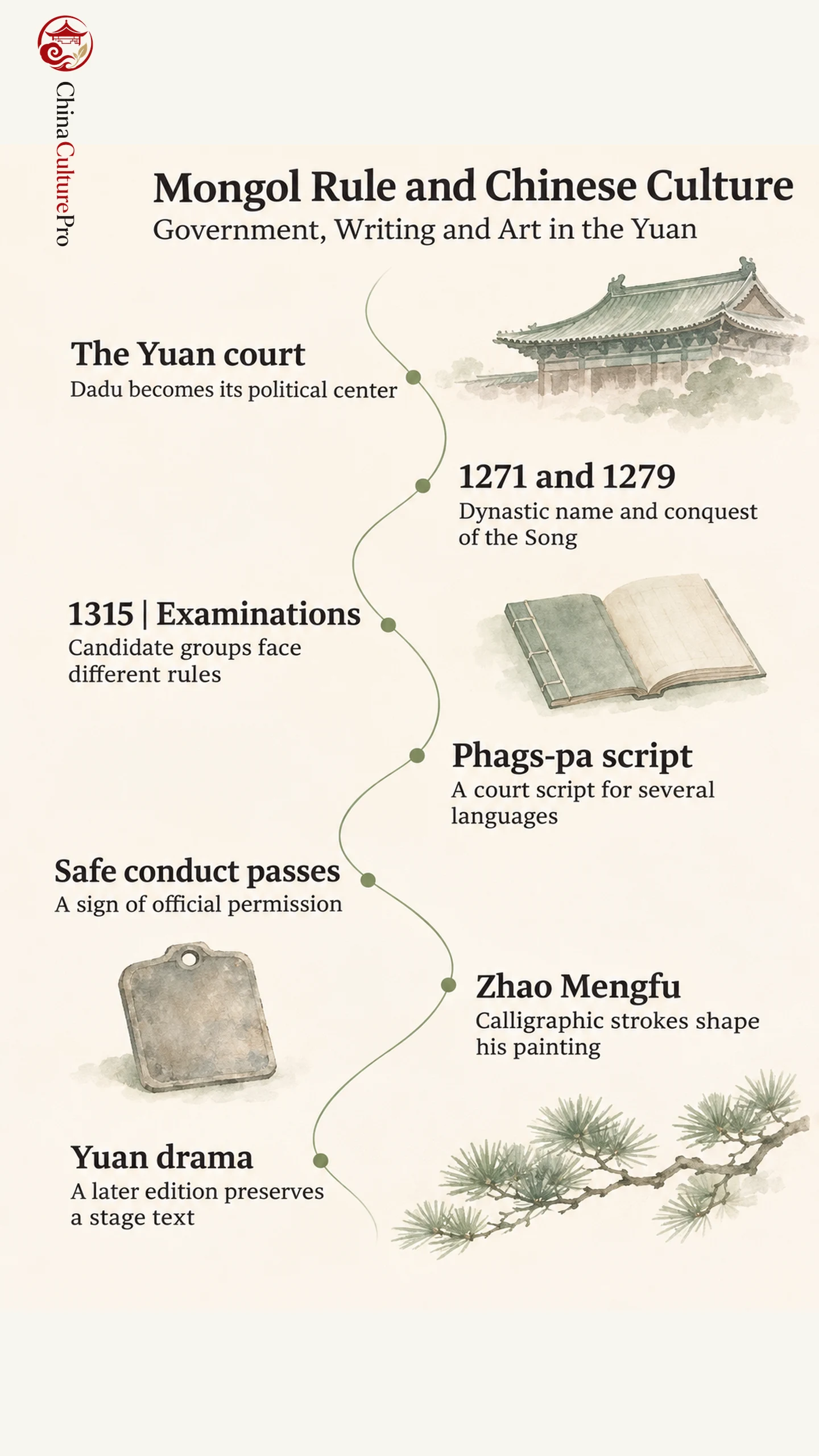
A metal pass could carry the authority of the Mongol court even if its reader could not decipher the letters. Surviving Yuan objects help show where imperial rules took hold and where people relied on older practices.
How the Yuan Court Governed a Diverse Population
The Mongols ruled parts of northern China before Kublai Khan proclaimed the Yuan dynasty in 1271. The defeat of the last Southern Song forces in 1279 brought the south under Yuan rule. The capital, Dadu (大都, Dàdū), stood at the site of modern Beijing. Its design drew on established models of Chinese capital planning while serving a court with ties across the steppe. [1][2][4]
The court used Chinese bureaucratic offices while relying on personal ties to the ruling house and people who could work across languages. An official’s opportunities might depend on family background, earlier service or the ability to write and translate. These paths mattered alongside classical education. [1][2][3][4]
What Examinations Changed for Scholars
An edict of 1313 set out plans for civil service examinations, and the first regular cycle culminated in the capital in 1315. Classical learning was central to the examinations. The approved readings reflected Neo-Confucian interpretations, giving those interpretations a new role in recruitment. [1][3]
The regulations assigned places to four groups, including Mongol candidates, people grouped as Semu, subjects from the north and subjects of the former Southern Song. Semu included people of several origins, among them Central and West Asians. Mongol and Semu candidates faced two sessions at the capital examination, while the other track had three. These classifications shaped access to office. People in the same category could still have very different careers and resources. The History of Yuan also lists ways to gain office through recommendations, schools or service as a clerk. [1][2][3][10]
Where the New Script Was Used
Kublai commissioned the Tibetan Buddhist scholar Phags-pa to devise a writing system that could represent several languages. The scholar presented the Phags-pa script (八思巴文, Bāsībā Wén) to the court in 1269. It appeared on some edicts, seals, money and passes. Its use outside these settings remained limited, and the Yuan established offices that employed people who could translate documents or interpret speech. Historian Morris Rossabi traces a related institutional practice in the Ming, when the new dynasty established colleges for translators and interpreters. [4][9]
One late-thirteenth-century iron pass at the Metropolitan Museum of Art carries a silver-inlaid inscription in the script. The text invokes imperial authority. A bearer could display a pass to show official permission. Some passes entitled travelers to services at relay stations along the roads. The pass shows where the court could give the script a practical role, even with few people able to read it. [4][5]
What a Painting and a Play Reveal
Zhao Mengfu (赵孟頫, Zhào Mèngfǔ) came from the former Song ruling family and accepted office under the Yuan. His friend Zhou Mi remained outside official service. They stayed in contact, and Zhao painted a landscape for him in 1295. He developed a style that linked painting to Chinese calligraphy. In his handscroll Twin Pines, Level Distance, dated around 1310, strokes used for writing also shape the trees and rocks. The Met identifies the rock strokes with a cursive writing technique and the pine outlines with forms associated with seal script. [6][7]
The Yuan court patronized theater, which also took shape beyond the palace. On stage, zaju (杂剧, zájù) combined dramatic action with songs. Injustice to Dou E, by Guan Hanqing (关汉卿, Guān Hànqīng), tells of a woman wrongfully condemned. The play belongs to an early form in the wider history of Chinese opera. A widely studied version survives in the Ming anthology A Selection of Yuan Plays. It preserves the dramatic text, including the placement of songs, but leaves many details of Yuan staging uncertain. [8][9]
FAQs About Mongol Rule and Chinese Culture
Did Mongol rule in China begin in 1271 or 1279?
Kublai proclaimed the Yuan dynastic name in 1271. The conquest of the Southern Song was completed in 1279. Mongol forces had already gained control of parts of northern China before either date. [1][2][4]
Did the Phags-pa script replace Chinese characters?
The Phags-pa script appeared on official items including passes and seals. Chinese characters continued in use and the court still depended on people who could translate and interpret. [4][5][9]
When were the civil service examinations restored?
The court announced examination regulations in 1313. The restored cycle reached the capital examinations in 1315. The two dates refer to the authorization and the first round under it. [1][3]
Sources
[1] Linda Walton. The Mongol Yuan Dynasty in China, in Middle Imperial China, 900–1350
[2] Frederick W. Mote. Chinese Society Under Mongol Rule, 1215–1368, in The Cambridge History of China
[3] Song Lian and other early Ming compilers. History of Yuan, Volume 81: Selection of Officials
[4] Morris Rossabi. Communications and Communicators in the Yuan and Early Ming
[5] The Metropolitan Museum of Art. Safe Conduct Pass (Paiza) with Inscription in Phakpa Script
[6] National Palace Museum. Autumn Colors on the Qiao and Hua Mountains, in Travelling Through Brush and Ink
[7] The Metropolitan Museum of Art. Zhao Mengfu, Twin Pines, Level Distance
[8] Yumin Ao. A Study on the Thematic, Narrative, and Musical Structure of Guan Hanqing’s Yuan Zaju, Injustice to Dou E
[9] Columbia University. The Mongols in China: Cultural Patronage
[10] Benjamin A. Elman. A Cultural History of Civil Examinations in Late Imperial China