
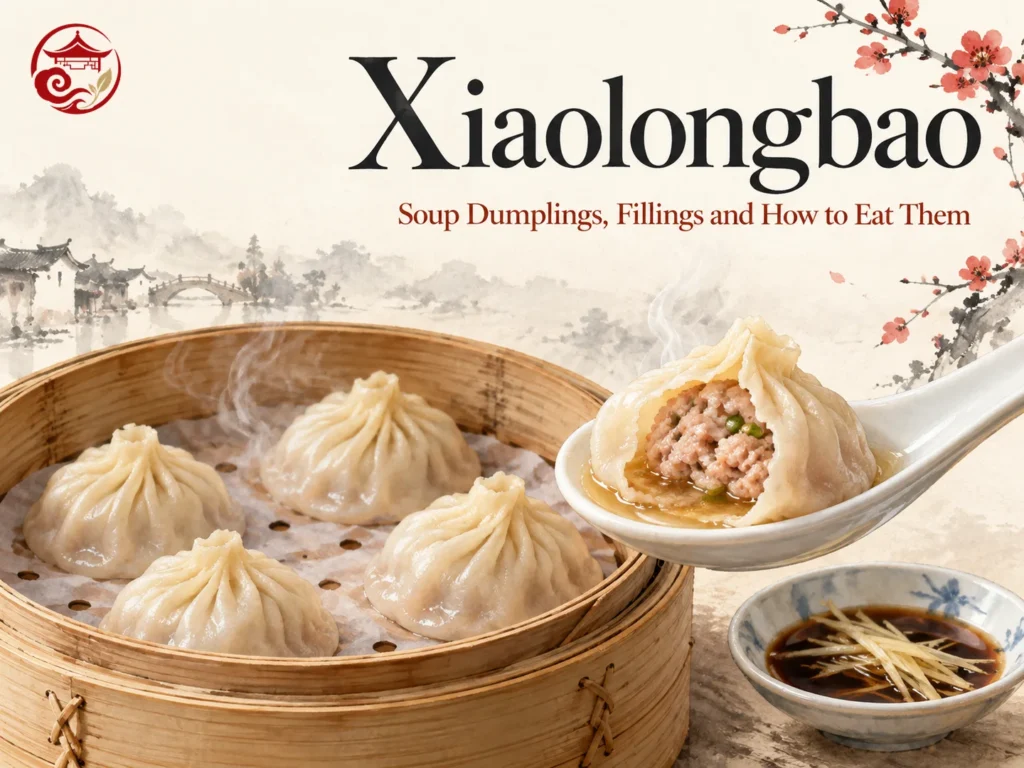

Quick Answer: What Is Xiaolongbao?
Xiaolongbao (小笼包, xiǎolóngbāo) are small steamed buns, named for their little steamer baskets. English menus often call the soup-filled versions “soup dumplings.”
- Wrapper: A thin wheat-flour skin encloses the filling, with pleats gathered at the top. Familiar soup-filled styles often use unleavened dough.
- Filling and soup: Seasoned meat and prepared meat jelly go inside together. Steaming melts the jelly into enclosed broth.
- Serving: They commonly arrive in their steaming basket. A spoon helps support the delicate wrapper and catch the soup.
This guide focuses on familiar Jiangnan soup-filled styles. Foods called xiaolongbao elsewhere can have different doughs and amounts of broth.[1]
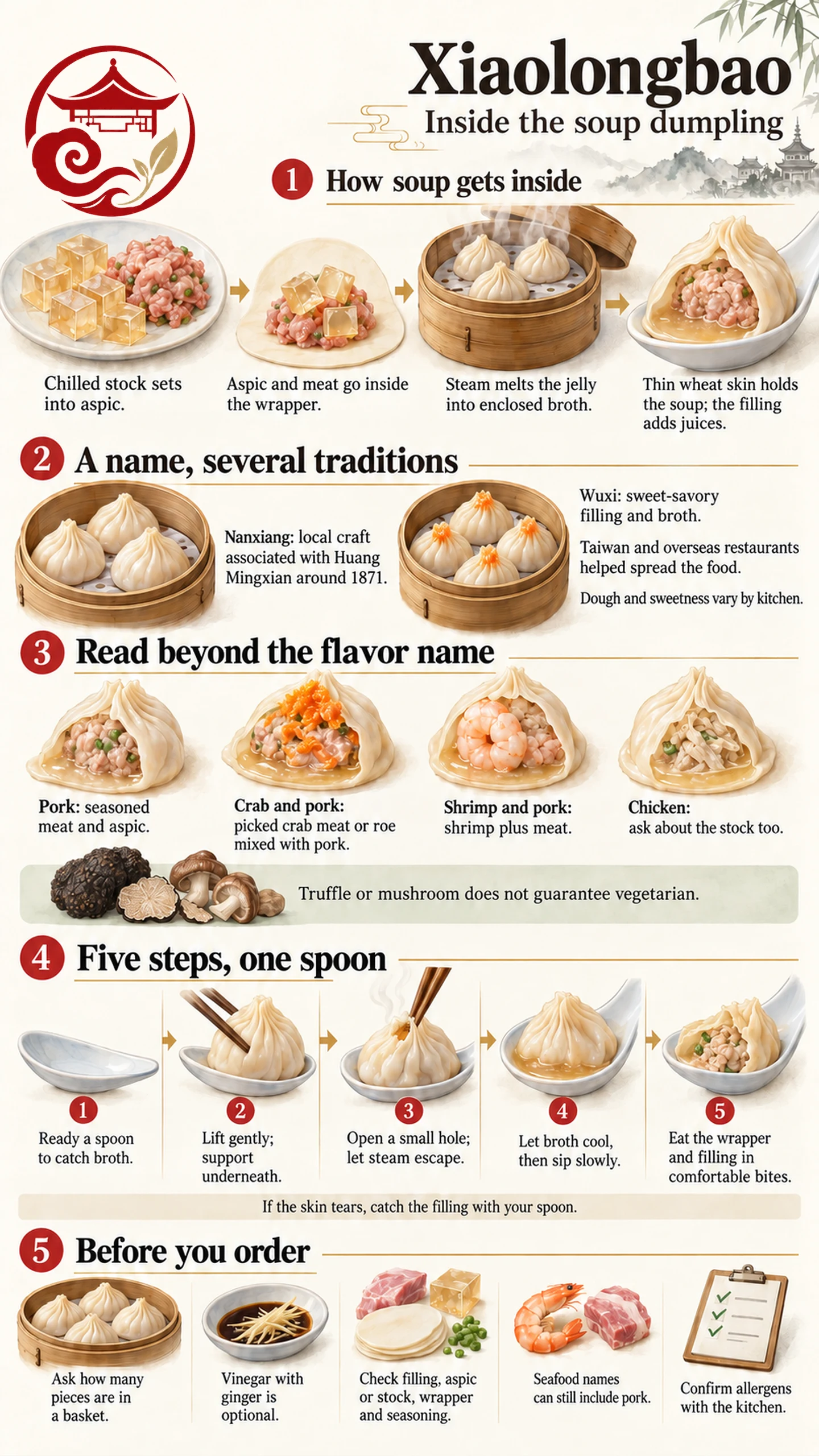
A small steamed dumpling arrives with a thin skin and a pocket of hot soup. How did the liquid get inside, and how do you eat it without spilling or burning your mouth? Understanding the filling, wrapper and serving method makes a first basket much easier to approach.
How the Soup Gets Inside Xiaolongbao
The soup is enclosed before the dumpling is cooked, but it goes in as a solid. Meat aspic, often called skin jelly or pidong (皮冻, pídòng), makes this possible.
Cooking collagen-rich ingredients such as pork skin and bones produces a stock that sets into a soft gel when chilled. The cook chops this jelly and mixes it with the seasoned meat filling. Solid pieces are much easier to wrap than spoonfuls of liquid.[1]
Inside the steamer, heat cooks the filling and melts the jelly. The sealed wrapper holds the resulting broth around the meat. The filling can also release juices, so “juicy meat” and “added aspic” describe related but different parts of the finished dumpling.[2]
The wrapper is therefore a container, rather than the source of the soup. In this familiar method, nobody injects liquid into the finished bun, and the broth is not outside steam that has seeped through the skin.
Aspic recipes vary. Some combine pork skin with chicken stock; others use different stocks or gelling ingredients. A chicken-flavored filling therefore does not, by itself, establish what the broth contains.[3]
Nanxiang Origins and Regional Styles
Nanxiang, now part of Shanghai’s Jiading district, is closely associated with the development of the small, thin-skinned soup bun. Its local craft history links Huang Mingxian with the change from larger meat buns to smaller parcels with generous filling around 1871. That date concerns the Nanxiang tradition; it does not establish when every Chinese soup-filled bun was invented.[3]
You may also see the regional name xiaolong mantou (小笼馒头, xiǎolóng mántou). Here, “mantou” can refer to a filled bun, unlike the unfilled steamed bread that the word often means elsewhere. This local vocabulary helps explain apparently different menu translations for the same family of foods.[3] Nanxiang belongs within the wider food traditions discussed in our Shanghai cuisine guide.
Wuxi has its own well-established version within Jiangsu cuisine. Its characteristic appeal is a sweet-savory filling and broth. However, sweetness does not establish a universal rule about bun size, skin thickness or dough: kitchens and periods differ. Local records describe changes from partly leavened to unleavened dough in one producer’s practice.[4][5]
The food also developed a substantial presence in Taiwan and reached overseas diners through restaurants expanding from there. A bowl or basket served overseas can still reflect a particular regional style. Read the description of its dough and filling rather than expecting every restaurant in one place to make it identically.[6]
Common Xiaolongbao Fillings
Start with the main filling, then check the broth separately. The table describes recognizable menu versions, rather than recipes every kitchen must follow. Crab powder is a misleading literal translation of xiefen (蟹粉, xièfěn): in this context it means picked crab meat and roe, rather than a dry powder.[7]
| Menu label | Ingredients you may find | Flavor and texture | What to check |
|---|---|---|---|
| Pork xiaolongbao | Seasoned minced pork with meat aspic | Savory meat filling surrounded by broth | What makes the aspic, and which seasonings are used? |
| Crab-and-pork xiaolongbao | Pork mixed with picked crab meat, roe or both, plus aspic | Rich crab flavor alongside the meat | Does a shorter “crab” label still include pork? |
| Shrimp-and-pork xiaolongbao | Shrimp combined with pork and soup jelly | Shrimp adds a firmer bite to the meat filling | Is pork mixed in, and what is the stock base? |
| Chicken xiaolongbao | Ground chicken with aromatics and a broth component | A poultry alternative to the pork version | Is the broth also chicken-based, and is any pork used? |
Pork, crab-and-pork and chicken versions appear on actual restaurant menus; shrimp-and-pork soup dumplings are another available variation. These names identify combinations, rather than a dependable way to infer all ingredients.[8][9]
Modern fillings broaden the range further. Truffle or mushroom can flavor a meat filling, so neither name guarantees vegetarian food. For a plant-based soup bun, check how both the filling and liquid center are made. Sweet versions with red bean, sesame or chocolate may share the pleated shape without reproducing the savory meat-aspic structure.[8] Our Chinese dumpling guide puts these buns beside other wrapper and filling styles.
How to Eat Xiaolongbao
Use a spoon and chopsticks to keep control of both the wrapper and the hot liquid. Take your time: the outside can feel manageable while the enclosed broth is still hot.
- Ready the spoon: Place a deep spoon beside the basket before lifting a dumpling. It should support the bun and catch any broth that escapes, rather than leaving the parcel dangling over the table.
- Lift gently and support: Grip near the gathered top with your chopsticks without squeezing the middle. Slide the spoon underneath as you move it from the basket. If the skin sticks to the liner, ease it free rather than pulling hard.
- Make a small opening: Rest the bun on the spoon and carefully open a little of the side. You can use your chopsticks to start the opening while keeping it away from your mouth. Let steam escape and the broth cool.
- Taste the broth slowly: Once it has cooled enough, try a small sip. Alternatively, let the liquid drain into the spoon and cool there before tasting. There is no fixed waiting time that makes every dumpling comfortable to eat.
- Eat the wrapper and filling: Finish the remaining bun in bites that suit you. You do not need to put it all into your mouth at once.[10][2]
If the wrapper tears, catch the soup and filling with the spoon and continue. A broken skin simply changes how you pick it up; it does not require abandoning the dumpling.
Ordering Xiaolongbao: Baskets, Dips and Dietary Checks
Three checks make ordering easier without requiring a detailed knowledge of the kitchen’s recipe.
- Basket and portion: Ask how many pieces come in an order and whether different fillings arrive in separate baskets. There is no nationwide basket count or fixed number one person should eat. For a shared meal, knowing the count makes it easier to divide a basket and compare fillings.
- Vinegar and ginger: Chinese aromatic or black vinegar with fine ginger shreds is a familiar accompaniment. You can taste the broth first and add a little dip to the remaining bun. The vinegar is optional, and there is no universal vinegar-to-ginger ratio.[2]
- Ingredients and preparation: Confirm four things: the meat filling, aspic or stock, wrapper, and seasoning or dipping sauce. Ask explicitly whether a seafood or chicken version contains pork. For Chinese vegetarian food, establish whether both the filling and broth meet your requirements, including any animal-derived gelatin.
Wheat is typical of the wrapper. Depending on the recipe, relevant allergens can also include crustacean shellfish, egg, soy and sesame; sauces and finishing ingredients count as well. If you have an allergy, ask staff to check with the kitchen and explain any need to avoid cross-contact.[11][12] Pork belongs in your ingredient checks when it matters to your diet, rather than being assumed absent from a seafood-named bun.
Menu wording is a starting point. Our guide to Chinese food names explains other labels that can help you ask more specific questions.
FAQs About Xiaolongbao
Are all soup dumplings xiaolongbao?
No. Tangbao (汤包, tāngbāo) is a broader soup-bun label. Other regional buns also enclose broth. Comparing soup dumplings and wontons also separates broth enclosed inside a bun from broth surrounding wontons in a bowl.
Is xiaolongbao the same as shengjianbao?
No. Shengjianbao (生煎包, shēngjiānbāo) have a pan-fried, crisp base, while the xiaolongbao described here are steamed. Dough and juiciness vary too; our xiaolongbao and shengjianbao comparison explains the differences.
Does xiaolongbao always contain pork?
No. Chicken and plant-based versions exist. However, a crab, shrimp or mushroom name does not rule out pork in the filling or aspic. Ask about the meat and broth separately rather than relying on the headline flavor.
Does xiaolongbao have to have 18 pleats?
No. Eighteen pleats is a production standard used by some kitchens, rather than a definition of all xiaolongbao. Other traditions use different fold counts. Pleats alone cannot establish a bun’s origin or guarantee its quality.[8][3]
Sources
[1] Judy / The Woks of Life. Soup Dumplings (Xiaolongbao)
[2] Shanghai Municipal Government. Xiaolongbao: A small dumpling with a big story
[3] Shanghai Municipal Administration of Culture and Tourism. 南翔小笼馒头制作工艺
[4] Wuxi Municipal Government Information Office. Wuxi small steamed stuffed buns (Wuxi xiaolongmantou)
[5] Wuxi Local Chronicles. 无锡小笼馒头
[6] Din Tai Fung. Worldwide Locations
[7] Ministry of Commerce, Time-Honored Brand Digital Museum. 王宝和:制作工艺
[8] Din Tai Fung. Menu
[9] MiLa. What Is Xiao Long Bao?
[10] Christopher St Cavish / SmartShanghai. How to: Eat Xiaolongbao Like a Scientist
[11] Hong Kong Centre for Food Safety. Food allergens
[12] U.S. Food and Drug Administration. Food Allergies: What You Need to Know