
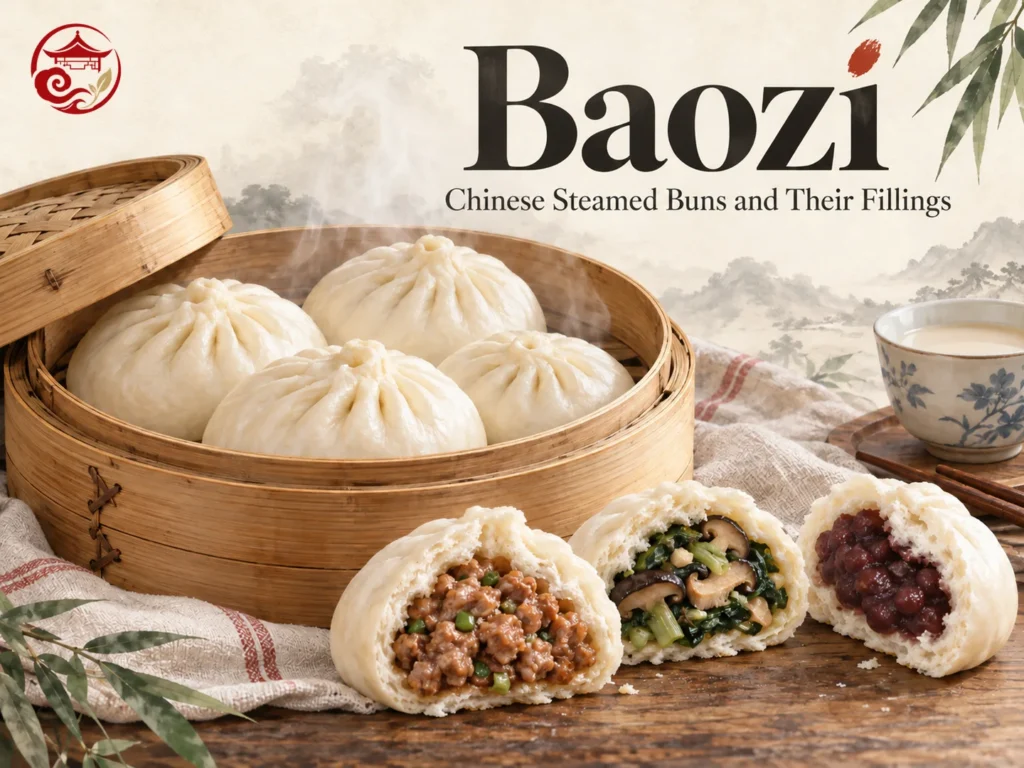

Quick Answer: What Is Baozi?
Baozi (包子, bāozi) are Chinese filled buns. The familiar steamed version has a soft, bread-like wrapper around a savory or sweet filling.
- Dough: Common versions use leavened wheat dough, which becomes fluffy when steamed.
- Fillings: Meat, vegetables, egg or sweet paste is enclosed inside the dough before cooking.
- Serving: Baozi can be breakfast, a simple meal or part of a selection of small dishes.
This guide focuses on enclosed, fluffy steamed buns. Foods with bao (包, bāo) in their names can use different doughs and cooking methods, so the name alone does not describe every version.[1]
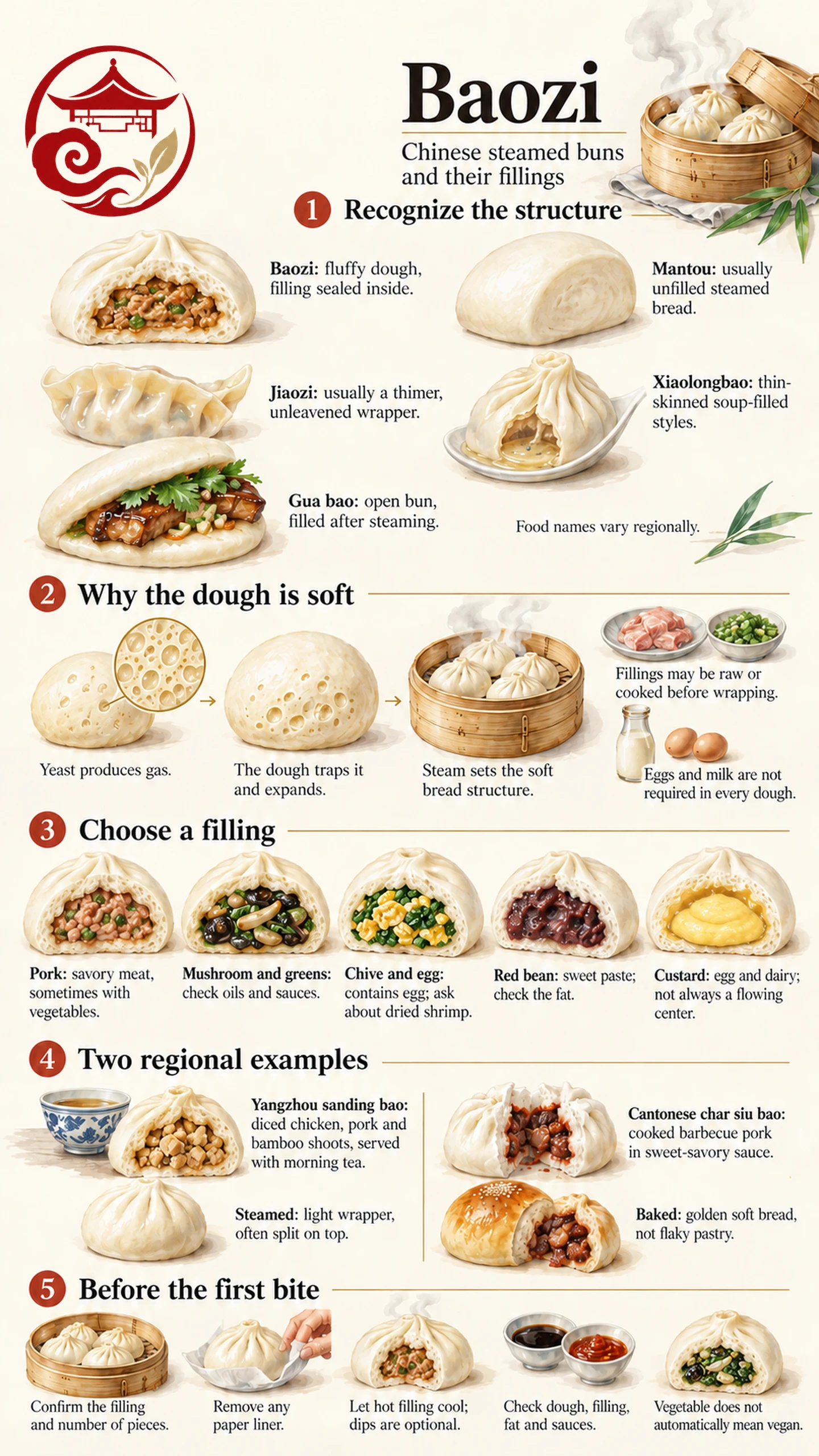
White steamed buns can look alike while hiding very different fillings. English menus also group several different structures under the same bun label. Knowing whether the filling is sealed inside, and what it contains, makes it easier to choose the bun you actually want.
Baozi, Mantou and Other Foods Called Bao
English “bun” and “dumpling” labels overlap. On a Chinese menu, the food’s name and structure are more useful than treating every filled parcel as the same thing. The pinyin below is Mandarin; familiar English menu spellings can reflect other Chinese languages.
| Food | Typical wrapper or structure | Where the filling goes |
|---|---|---|
| Baozi | Soft, leavened wheat dough in the style discussed here | Enclosed before steaming |
| Mantou (馒头, mántou) | Steamed bread, usually unfilled in modern Mandarin usage | Normally no enclosed filling |
| Jiaozi (饺子, jiǎozi) | Usually an unleavened wheat wrapper; often crescent-shaped | Sealed inside a thinner, less bread-like wrapper.[1] |
| Xiaolongbao (小笼包, xiǎolóngbāo) | Familiar Jiangnan soup-filled versions have thin skins, often unleavened | Meat and broth enclosed inside.[2] |
| Gua bao (割包, gēbāo in Mandarin) | An open, folded steamed bun | Cooked meat and accompaniments added after steaming |
The open sandwich form is an important distinction: ordering an English-menu “bao” does not always mean receiving a round, sealed bun.[3][4]
Regional speech also matters. In parts of Jiangnan, including Shanghai, “mantou” can name filled buns as well as plain bread.[5] Our mantou guide explains the usual modern distinction. For broader comparisons, see Chinese dumpling types and bao versus dumplings.
How Baozi Get Their Soft, Steamed Texture
The dough provides more than a thin container. It becomes a soft layer of bread around the filling. During fermentation, yeast produces carbon dioxide, which the dough’s gluten network traps. These pockets of gas help the dough expand.[6]
A common preparation sequence is to mix and knead the dough, let it rise, divide it into wrappers, add filling, and allow the shaped buns to rest before steaming. Recipes differ in how they organize those resting stages; a fixed number of proofs does not define all baozi.
Steam heats the dough until its structure sets and cooks the filling. The buns sit above the water rather than boiling in it. Bamboo baskets are familiar, but metal steamers can do the same job.[7]
The filling can take different routes too. Some recipes enclose raw seasoned meat; others cook a sauced filling first and let it cool before wrapping. Eggs, milk and baking powder are optional recipe ingredients, rather than requirements for every bun.[8][7] A smooth or pleated top cannot reliably tell you which filling is inside.
Common Baozi Fillings: Savory and Sweet
The filling usually gives you the most useful starting point when ordering. These five examples show common combinations, rather than a fixed national menu. The words “vegetable” and “sweet” describe the main filling, rather than guaranteeing everything used in the dough or seasoning.
| Name and Mandarin pinyin | Main ingredients | Flavor and texture | Ingredients to confirm |
|---|---|---|---|
| Pork buns (猪肉包, zhūròubāo) | Minced pork, sometimes with cabbage or scallion and ginger | Savory, juicy meat inside soft dough | The vegetable combination and any oyster sauce or added animal fat |
| Mushroom and greens buns (香菇青菜包, xiānggū qīngcài bāo) | Leafy greens and shiitake mushrooms; sometimes dried tofu | Savory vegetables with a mixture of tender and firmer pieces | Whether the oil, sauce or other additions include lard, oyster sauce or dried shrimp |
| Chive and egg buns (韭菜鸡蛋包, jiǔcài jīdàn bāo) | Chinese chives and egg; vermicelli appears in some versions | Fragrant and savory, with soft egg pieces | Egg is part of the named filling; ask about any dried shrimp |
| Red bean buns (豆沙包, dòushābāo) | Sweetened adzuki bean paste | Sweet, smooth or slightly textured | The fat used in the paste, including possible dairy or animal fat |
| Custard buns (奶黄包, nǎihuángbāo) | Egg, milk or other dairy ingredients, sugar and fat | Sweet, creamy filling | Egg and dairy ingredients; ordinary custard is not necessarily a flowing center |
These ingredient examples describe particular preparations; oils, sauces and additions vary by kitchen.[9][10][11][12]
Liusha bao (流沙包, liúshābāo), often described as flowing or molten custard buns, are a related variation; do not assume a regular custard bun will have the same liquid center.[13] Beef and lamb fillings are also available, but the meat and accompanying ingredients still need to be checked separately.
Regional Baozi Styles to Recognize
Yangzhou’s sanding bao (三丁包, sāndīngbāo) takes its name from three diced ingredients: chicken, pork and bamboo shoots. The contrast between tender meat and firmer bamboo gives the filling a different texture from a finely minced meat bun. It is associated with the city’s morning tea tradition and the wider cooking of Jiangsu cuisine. Although Yangzhou also serves crab soup buns, a three-diced bun is a different dish; a local origin does not make every bun there a soup dumpling.[14]
Char siu bao (叉烧包, chāshāobāo in Mandarin) belongs to a familiar Cantonese cuisine tradition. Diced cooked barbecue pork is mixed with a sweet-savory sauce. The steamed version has a light wrapper that often splits at the top, exposing some filling. It is a recognizable part of a dim sum meal.[15]
Baked versions commonly have a golden, sometimes glossy surface and soft bread dough. They are distinct from flaky barbecue-pork pastries. If an English menu simply says “barbecue pork bun,” check whether it means steamed or baked; our char siu bao guide covers both forms.[16]
Ordering and Eating Baozi
Baozi fit naturally into Chinese breakfast alongside soy milk or porridge. They can also be a portable lunch, a snack or part of a shared meal. Neither the time of day nor a particular drink defines how they must be eaten.
Four checks help turn a familiar-looking bun into a clear order:
- Filling: Ask whether it is savory or sweet, which meat it contains, and what accompanies that main ingredient. A short name may leave out vegetables, seafood or seasoning.
- Portion: Check whether the price is for one bun, a serving or a basket. Bun sizes and pieces per basket vary; there is no single portion that applies to every shop or appetite.
- Eating: Remove any paper liner from the base before eating. Take a small first bite and let hot filling cool. You can eat a seasoned bun on its own; vinegar or chili sauce is a preference, rather than a compulsory accompaniment.
- Dietary requirements: Ask about the dough, filling, cooking fat and sauces together. For Chinese vegetarian food, clarify whether you also avoid eggs and dairy. A vegetable name does not establish a vegan recipe.
Wheat, egg, milk, shellfish and soy may matter depending on the recipe. If you have an allergy, ask staff to confirm the ingredients and whether the kitchen can meet your requirements, including concerns about cross-contact.[17] Our Chinese food names guide can help with other unfamiliar menu labels.
FAQs About Baozi
Are baozi always steamed?
Steaming is central to the fluffy buns described here. Related named foods also include pan-fried and baked versions. Check the full menu name and cooking method, rather than assuming everything called “bao” arrives from a steamer.
Do baozi contain soup?
A juicy meat filling does not automatically make a bun a soup dumpling. Soup-filled xiaolongbao commonly use aspic that melts during steaming. The amount and form of liquid depend on the particular bun.
Are vegetable baozi vegan?
Not necessarily. Egg, dried shrimp, lard or oyster sauce may appear alongside vegetables, while the dough can contain dairy. Confirm the complete recipe rather than treating the main vegetable ingredient as a guarantee of a vegan bun.
Can baozi be frozen and reheated?
Yes, cooked baozi can be frozen and reheated. Uncooked buns still require cooking, rather than simple warming. For packaged products, follow the label: bun size, filling and whether they are already cooked affect the instructions.[7]
Sources
[1] Elaine / China Sichuan Food. An Introduction to Chinese Buns and Pancakes
[2] Shanghai Municipal Government. Xiaolongbao: A small dumpling with a big story
[3] Wei Guo / Red House Spice. Bao Buns, A Foolproof Recipe
[4] Taiwan Ministry of Education. 割包 — Revised Mandarin Chinese Dictionary
[5] Shanghai Municipal Government. Pan-fried pork buns
[6] King Arthur Baking. Yeast
[7] Judy / The Woks of Life. Steamed Pork Buns (Baozi)
[8] Wei Guo / Red House Spice. Steamed bao buns (baozi, 包子), a complete guide
[9] Judy / The Woks of Life. Steamed Vegetable Buns
[10] Elaine / China Sichuan Food. Vegetarian Steamed Buns (Baozi)
[11] Wei Guo / Red House Spice. Red Bean Buns (Dou Sha Bao, 豆沙包)
[12] Judy / The Woks of Life. Cantonese Steamed Custard Buns (Nai Wong Bao)
[13] Catherine Zhang. Salted Egg Custard Buns (Liu Sha Bao 流沙包)
[14] China Jiangsu Network. 扬州早茶上了北京卫视 三丁包蟹黄汤包等上演美食诱惑
[15] Wei Guo / Red House Spice. Char Siu Bao (BBQ Pork Buns, 叉烧包)
[16] Sarah / The Woks of Life. Chinese BBQ Pork Buns (Baked Char Siu Bao Recipe)
[17] Hong Kong Centre for Food Safety. Food allergens