

Quick Answer: What Should You Read by Wu Jingzi?
Wu Jingzi (吴敬梓, Wú Jìng Zǐ; 1701–1754) is best known for The Scholars (儒林外史, Rú Lín Wài Shǐ), a Qing-dynasty satirical novel about the world of educated people. Begin with its characters’ conduct: what they praise, what they want and how their manners change when status changes.
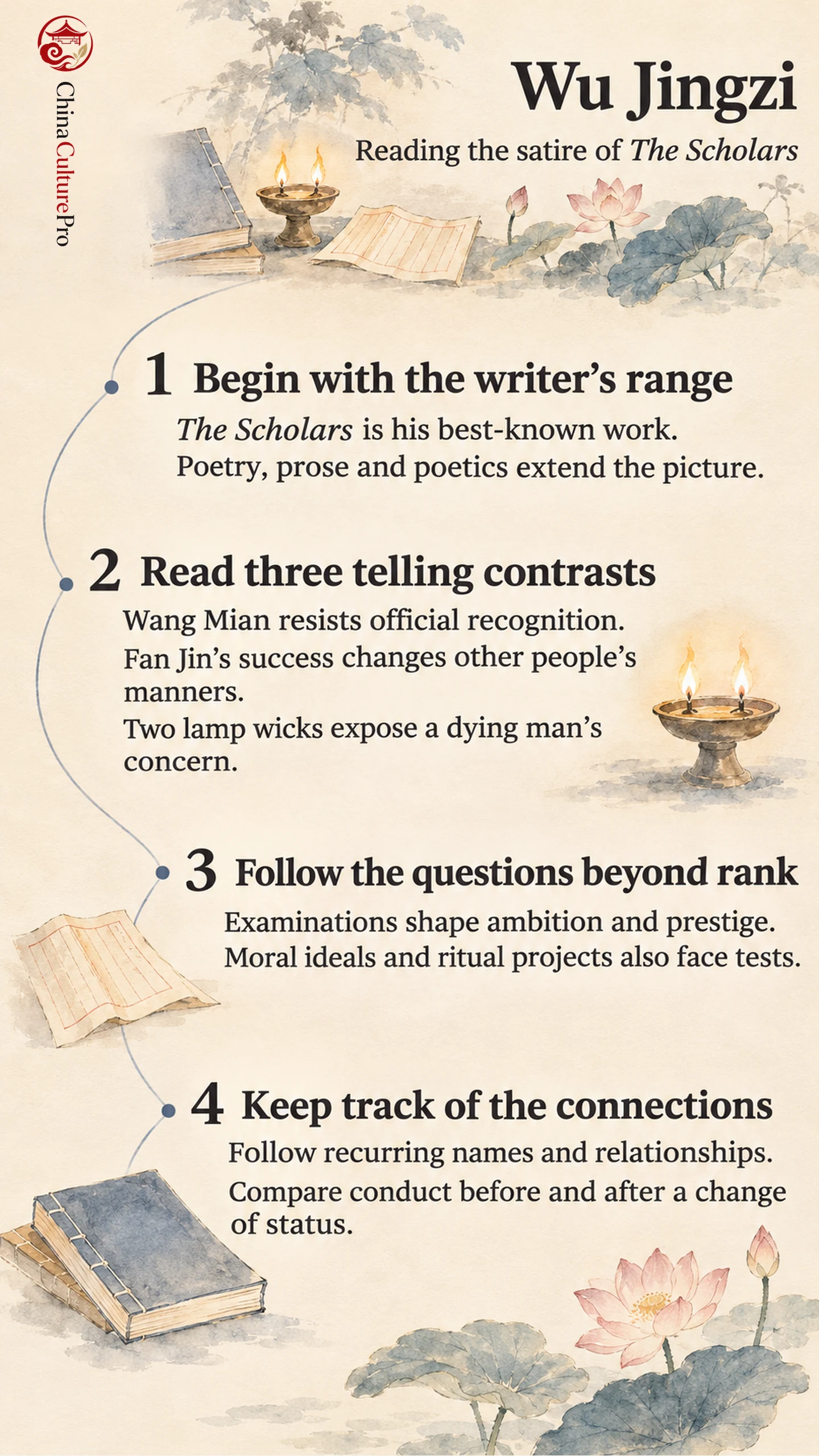
- For ambition: Read the scene in which a long-struggling candidate receives news of success.
- For independence: Compare the opening portrait of a painter who resists official recognition.
- For comic detail: Notice how a small household object can expose a consuming concern.
Examinations are central to this world, but the novel also asks what learning, integrity and social respect are worth beyond a successful career.
Wu’s satire often gives a character enough room to speak and act before the reader draws a judgment. An insult followed by extravagant praise can reveal more than a direct announcement that someone is a hypocrite.
Locate Wu Jingzi and His Main Writings
Wu came from Quanjiao in Anhui and later lived in Nanjing. He belonged to the Qing dynasty and had a lower examination qualification, but his studies did not lead to a successful official career. His family fortunes declined, and he wrote poetry and prose as well as his best-known novel. [1]
These titles show the range of his writing. The English renderings of the studio titles below are descriptive guides to their Chinese names.
| Work | Place in a reading plan |
|---|---|
| The Scholars | Begin here for the novel’s encounters with ambition, manners and moral judgment. [2] |
| Collection from the Wenmu Mountain Studio (文木山房集, Wén Mù Shān Fáng Jí) | A route into the author’s poetry and prose beyond the novel. [1] |
| Poetry Discussions from the Wenmu Mountain Studio (文木山房诗说, Wén Mù Shān Fáng Shī Shuō) | A title to seek when exploring his writing about poetry. [1] |
The novel uses a Ming setting while engaging with the educated world known to its Qing author. [1] Keep that distinction when using it to think about Chinese literary history.
Read Three Scenes of Refusal, Success and Possession
The novel’s Wang Mian (王冕, Wáng Miǎn) learns to paint lotus flowers, supports his mother and resists attempts to draw him into official patronage. At the end of the opening chapter, the narrator challenges the habit of giving him an official title when he never actually served. Read this fictional portrait as a test of the assumption that recognition by office completes a learned life. [4]
Fan Jin (范进, Fàn Jìn) provides a sharp contrast. Before his provincial examination success, his household lacks food and his father-in-law insults him. After the announcement, gifts and flattering connections appear; the same father-in-law praises his talents and looks. His excited collapse is followed by a conspicuous reversal in how others treat him. [5]
Compare the father-in-law’s language before and after the result. The news has altered Fan’s position; other people’s professed judgments alter with it. The scene makes snobbery visible through a rapid change of manners. [5]
Yan Jiansheng (严监生, Yán Jiàn Shēng) appears in a deathbed scene whose solution arrives at the start of Chapter 6. He holds up two fingers while those around him guess what remains unsettled. His wife identifies two lamp wicks burning together and removes one to save oil; he then dies. [6]
The delay gives the detail its force. Other people imagine larger unfinished concerns, but the explanation contracts the scene to a tiny expense. Watch how the narrative withholds that answer until the surrounding guesses have prepared the comic disproportion. [6]
Follow the Satire Beyond Examination Results
Examination writing, especially the eight-legged essay (八股文, bā gǔ wén), occupies a prominent place in this scholarly world. Success brings prestige and opportunities, encouraging people to measure learning by the qualifications it can secure. The imperial examinations guide explains the broader institution behind the satire. [2]
Yet the examination system does not explain every episode. The book also examines learned people’s social roles, ritual projects and attempts to live well. Attempts to renew learned life through ritual also encounter failure, so an attractive ideal is not automatically a successful remedy. [3]
This makes the novel more demanding than a simple opposition between bad office-seekers and good outsiders. Ask what a character claims to value, what their actions accomplish and how other people respond. The Confucianism guide supplies context for the moral vocabulary, while the novel tests conduct in particular situations. [3]
Its connected episodes let these questions move among different people. Keep an eye on recurring relationships and social habits rather than expecting one hero’s rise to organize the whole book. [2]
Read in English Without Losing the Connections
An established English route is The Scholars translated by Yang Hsien-yi and Gladys Yang. A Foreign Languages Press edition dated 1957 is recorded in the CiNii library catalogue. Check the translator credit when distinguishing this translation from other editions carrying the same English title. [7]
While reading, keep a short list of recurring names and relationships. Note whether someone is offering praise, asking for help, displaying a qualification or defending a principle. Then compare what happens when money or influence enters the encounter.
Return to an early passage after a later change in a character’s circumstances. Fan’s father-in-law, for example, becomes easier to assess when both his contempt and admiration remain in view. [5] The guide to Chinese classic books and translations offers further ways to compare an edition’s notes, names and scope.
FAQs About Wu Jingzi
Is Wu Jingzi’s main work The Scholars?
It is his best-known work. His surviving writings also include poetry, prose and discussions of poetry associated with the Wenmu Mountain Studio titles.
Is The Scholars only an attack on examinations?
No. Examination ambition is a major concern, alongside manners, moral claims, ritual and the search for a worthwhile learned life.
Does The Scholars follow one central hero?
Its connected episodes move through many figures. Read for recurring relationships and contrasting ways of behaving rather than a single protagonist’s continuous career.
Sources
[1] The Commercial Press. The Scholars: Annotated and Commented Edition
[2] Zhang Guofeng, Academy of Chinese Studies. The Scholars
[3] Liangyan Ge, University of Washington Press. The Scholars: Trudging Out of a Textual Swamp
[4] Wu Jingzi, via Wikisource. The Scholars, Chapter 1
[5] Wu Jingzi, via Wikisource. The Scholars, Chapter 3
[6] Wu Jingzi, via Wikisource. The Scholars, Chapter 6
[7] National Institute of Informatics, CiNii Books. The Scholars: Foreign Languages Press, 1957