


Quick Answer: What Was City Life Like in Tang Chang’an?
Tang Chang’an (長安, Cháng’ān), in the area of modern Xi’an, was a planned imperial capital with wide avenues, enclosed neighborhoods and designated markets. Its layout helped organize where people lived, traded and traveled. Gates and signals also helped govern when people could move between spaces.[1][2][5]
- Wards: A fang (坊, fāng) was an enclosed ward that could contain residences and other institutions.[1][2]
- Markets: The East Market (東市, Dōngshì) and West Market (西市, Xīshì) were major commercial centers.[3][5]
- Movement: Gate closures and curfew affected travel along the main streets at night.[2][5]
Commerce and daily life changed within that plan over the course of the Tang.[2][3]
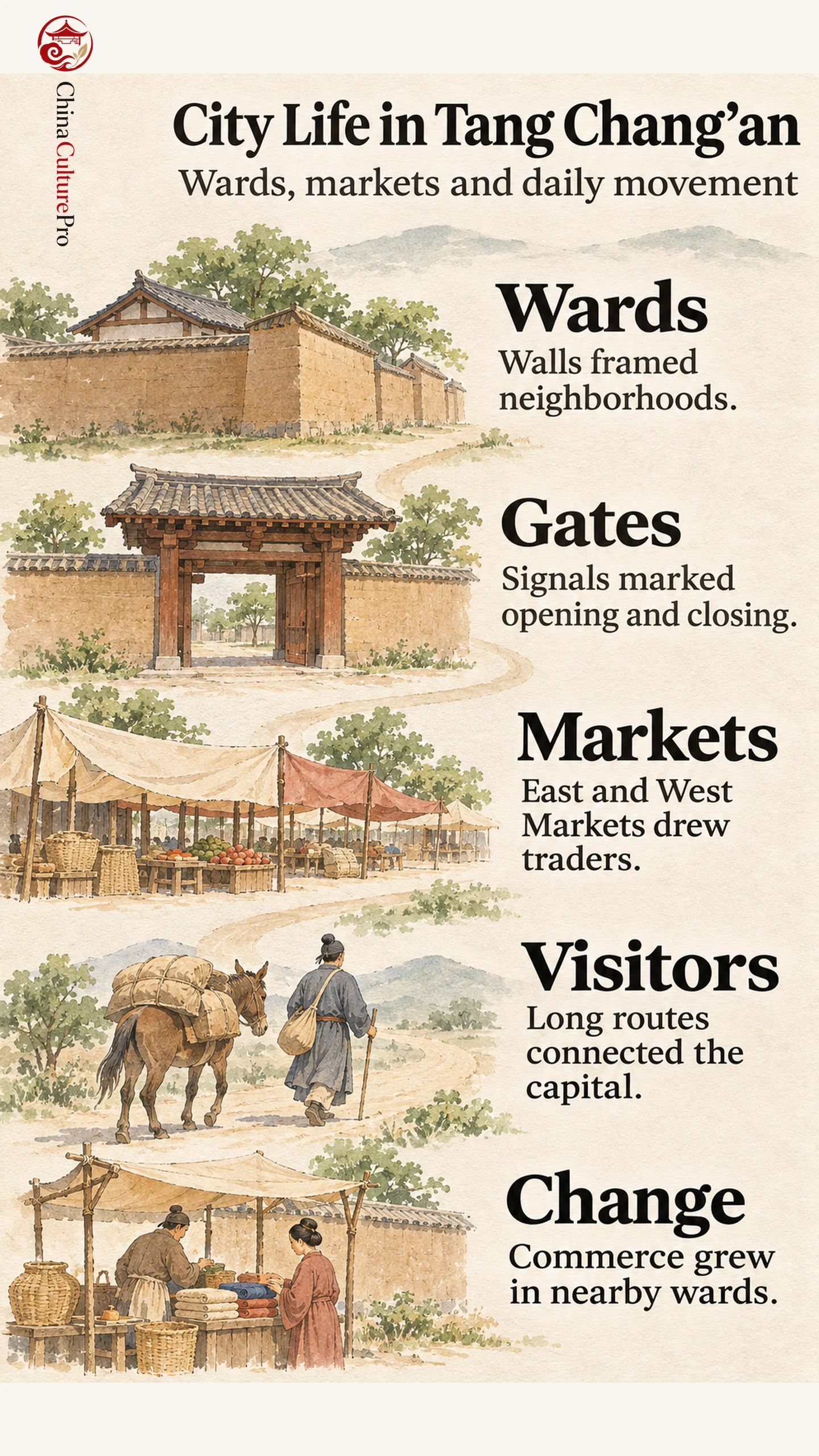
A resident who left home to shop had to cross spaces with different rules. The ward gate, the avenue and the market entrance each formed part of that trip. The city’s plan mattered because of the choices it shaped on the ground.[1][2][5]
How Wards Shaped a Day
The Sui–Tang capital was laid out with major avenues dividing it into blocks. Residences stood in wards, and urban institutions included monasteries and ritual spaces as well as palaces and government offices. An enclosed ward could contain more than houses. Gates connected activity inside it with the streets outside.[1][2]
At night, curfew rules restricted movement in the major streets outside the wards. Drums helped signal closing and reopening. A resident timing a return home had to take the closure of the ward gate into account. The written regulations tell us how authorities intended the system to work. Accounts of city life and activity outside the formal markets help show variation in practice.[2][3][5]
The East and West Markets
The designated East and West Markets were controlled commercial spaces with their own entrances and opening arrangements. The East Market served a district near elite residences, while the West Market became especially associated with long-distance trade. Both had many businesses, and an association with a particular clientele does not settle what every shop sold.[3][5]
The markets did not define the permanent limits of commerce. Research on Chang’an documents growth in commercial activity in wards near the East Market after the An Lushan Rebellion. The example shows how street and neighborhood economies could develop within a city still associated with enclosed wards and designated markets.[3]
Trade and People Beyond the Capital
Tang Chang’an drew merchants and visitors through long-distance networks. The Smithsonian discusses a ceramic head dated around 700–750 as representing a Sogdian or other Central Asian traveler. The figure shows how a traveler from Central Asia could be represented in Tang material culture. Its features and costume can be compared with other depictions, while its subject’s exact identity remains uncertain.[4]
The movement of travelers is one part of the city’s connections. The movement of goods is another. Later capital life in Song Kaifeng is documented through waterfront markets, shopfronts and written accounts. The contrast is clearest when each city is read through evidence specific to its period.[1][2][4]
FAQs About Tang Chang’an City Life
Was Chang’an the same place as modern Xi’an?
The Tang capital occupied a site in the area of modern Xi’an. Chang’an is the historical name used for the capital in the Tang period.[1][4]
What was the difference between a ward and a market?
A ward enclosed a neighborhood, often with residences and other buildings. The East and West Markets were designated commercial complexes with their own gates and schedules.[1][3][5]
Did commerce happen only inside the two markets?
The designated markets were important, and researchers also document later commercial growth in wards near the East Market.[3]
Sources
[1] Victor Cunrui Xiong. Sui-Tang Chang’an: A Study in the Urban History of Late Medieval China
[2] Christian de Pee. Urban Life and Intellectual Crisis in Middle-Period China, 800–1100 CE
[3] Yōhei Kakinuma. Study of markets and monetary circulation in medieval China
[4] Smithsonian National Museum of Asian Art. Head of a Tomb Figure of a Sogdian or Central Asian Traveler
[5] Shaanxi Provincial Archives. Chang’an wards and markets in the Tang