

Quick Answer: What Was City Life Like in Song Kaifeng?
Kaifeng’s commercial life followed streets, bridges and waterways through the capital. The Northern Song capital, also known as Bianjing (汴京, Biànjīng), supported river traffic, markets, shops and places to eat. Its street life is known in part through a painted handscroll and a later memoir of the capital.[1][2][3]
- Supply: The Bian River (汴河, Biànhé) connected the city to routes carrying goods.[1][2]
- Commerce: Street-facing businesses sold goods and food. Some markets operated late into the evening.[1][3][4]
- Evidence: An artist’s composition and a resident’s recollection capture different aspects of the city.[2][3][5]
Both sources describe the Northern Song city through selected scenes and places.[2][3][5]
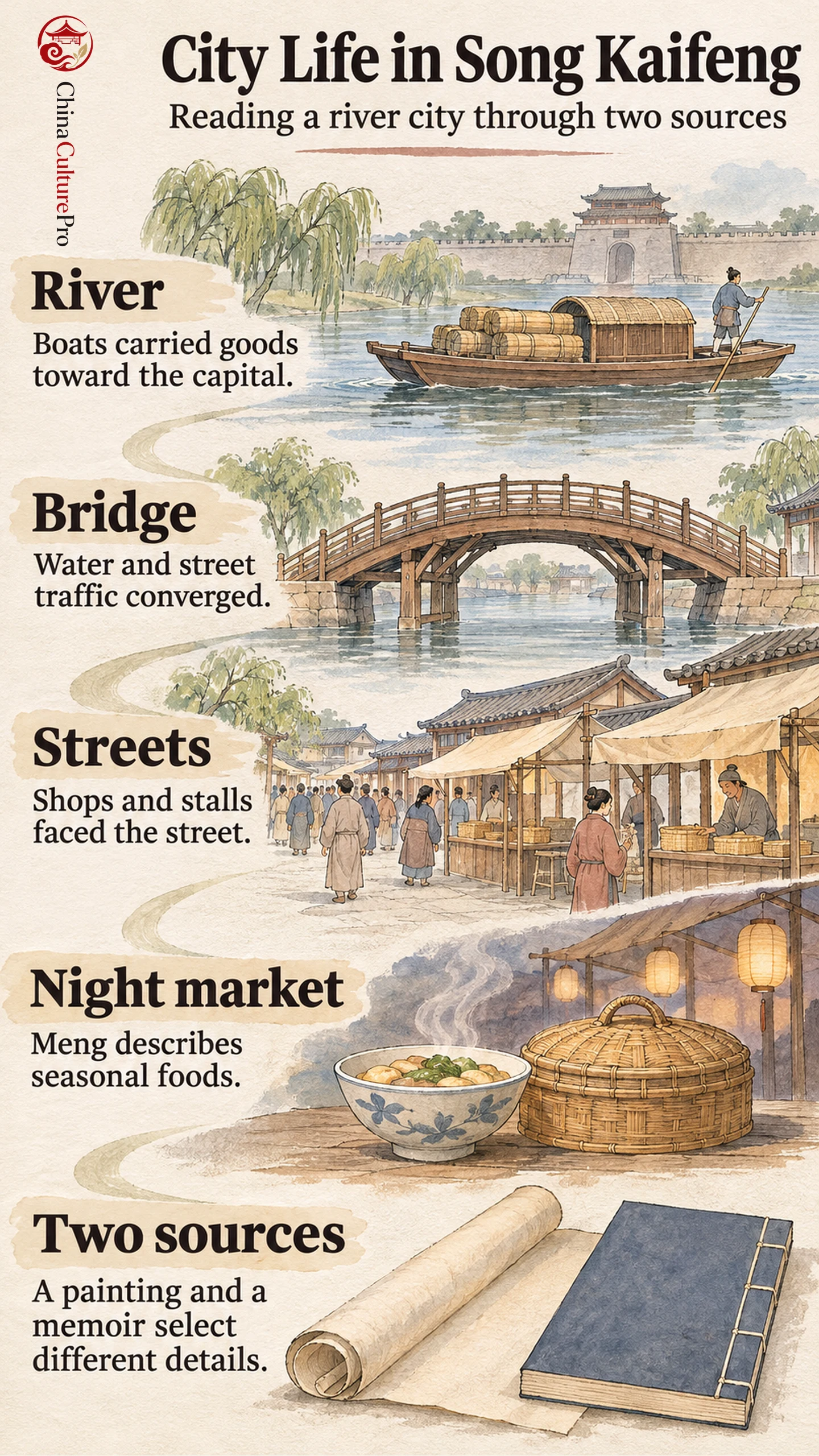
A boat crew preparing to pass under a bridge and food sellers trading late at night are two glimpses of the same capital. The boat appears in a painting. The food stalls come from an account written after the Northern Song had lost Kaifeng.[2][3][4]
River Traffic and the Rainbow Bridge
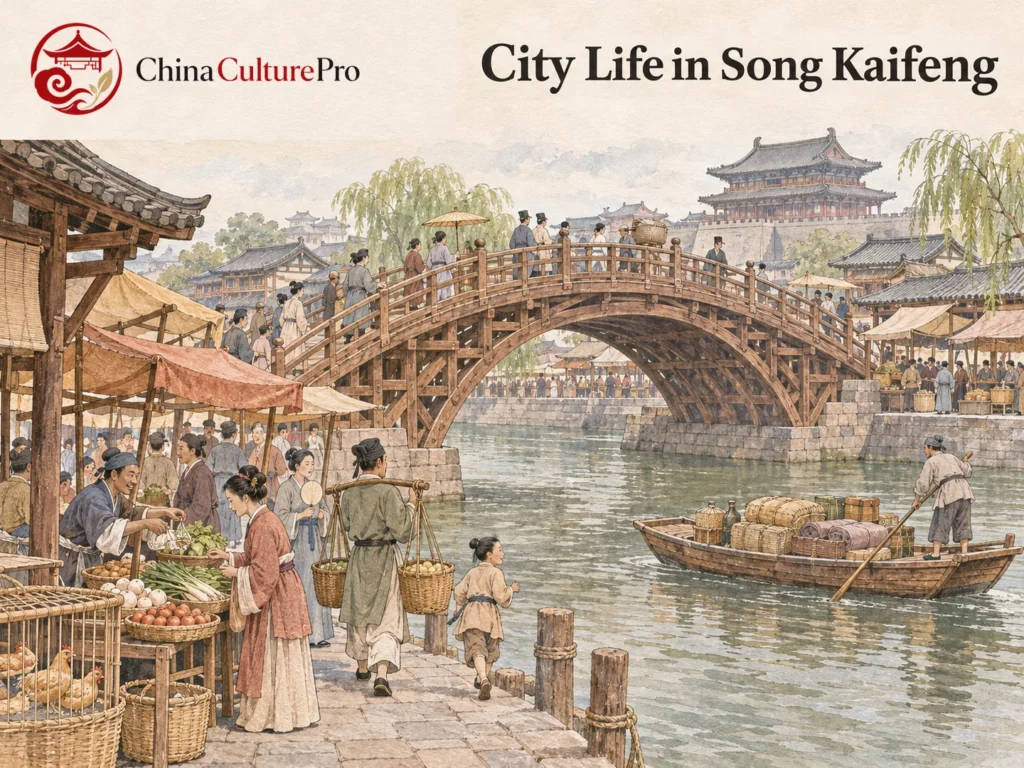
In Zhang Zeduan’s Qingming shanghe tu (清明上河圖, Qīngmíng Shànghé Tú), often called Along the River During the Qingming Festival, a wooden arch carries people and goods over the water. Beneath it, a cargo boat lowers its mast. The Palace Museum identifies the bridge in the scene as the Rainbow Bridge and interprets it as a meeting point for water and land traffic. The lowering mast makes the competing demands of river and street traffic visible in one scene.[2]
The river mattered to a capital that drew goods from beyond its walls. At crossings, boat crews, carriers and vendors shared a small space. The painting highlights the physical work of getting cargo through the city as well as the crowd gathered around it.[1][2]
Shops and Street Trade
Storefronts and stalls faced onto streets, so sellers could reach people already moving through the city. The Palace Museum distinguishes businesses with decorated entrances in the scroll from smaller operations under open shelters. Larger shops, temporary stalls, houses and traffic could all occupy the same stretch of street.[1][2]
These scenes help place the capital within a wider history of markets. A capital concentrated consumers and services on a larger scale than many towns. A scroll showing shops can reveal their placement and appearance, while research on Song paper money addresses the different question of how exchanges were paid for.[1][2]
What Meng Yuanlao Remembered
The Dongjing menghua lu (東京夢華錄, Dōngjīng Mènghuá Lù), by Meng Yuanlao, was written as a recollection of the Eastern Capital. A study dates its appearance to 1147. Meng discusses streets, markets, foods and seasonal practices from the city he remembered.[3]
The chapter on the Zhou Bridge night market describes food sold late in the evening. It lists chilled refreshments among summer offerings and roasted meats among winter ones. The market had a time and season as well as a location. This is evidence for a particular market in the account, with its own rhythm of evening trade.[4]
Reading the Scroll and the Memoir Together
The scroll arranges riverbanks, a wooden bridge and streets into a sequence that unfolds as the viewer opens it. Scholars disagree about how exactly the layout corresponds to physical places in Kaifeng. The memoir describes named locations and customs but draws on an author’s retrospective selection. Reading the two together gives the reader both a painter’s arrangement of urban activity and a resident’s memory of named streets and businesses.[2][3][5]
FAQs About Song Kaifeng City Life
Was Kaifeng the capital throughout the Song dynasty?
Kaifeng was the capital of the Northern Song. The Southern Song court was based at Hangzhou, another major city with an active commercial life.[1]
Did Kaifeng have night markets?
Meng Yuanlao describes evening food stalls near Zhou Bridge, with offerings that changed by season.[3][4]
Is the Qingming scroll a map of Kaifeng?
It is a handscroll with carefully composed city scenes. Scholars debate how closely its layout follows the actual city.[2][5]
Sources
[1] Columbia University, Asia for Educators. The Cities of the Song
[2] The Palace Museum. Zhang Zeduan’s Qingming Handscroll
[3] Igor Alimov, Kunstkamera. Dong Jing Meng Hua Lu as a Historical and Ethnographic Source
[4] Meng Yuanlao. Dongjing Menghua Lu, volume 2
[5] Yu Hui, The Palace Museum Journal. New Research on Zhang Zeduan’s Qingming Handscroll