


Quick Answer: What Do Zhengshi and Yeshi Mean?
In traditional Chinese historical writing, zhengshi (正史, zhèngshǐ) refers to recognized standard or dynastic histories. Yeshi (野史, yěshǐ) is a looser label for historical accounts written outside official auspices. The two labels help describe the standing and production of a work.[1][2][3]
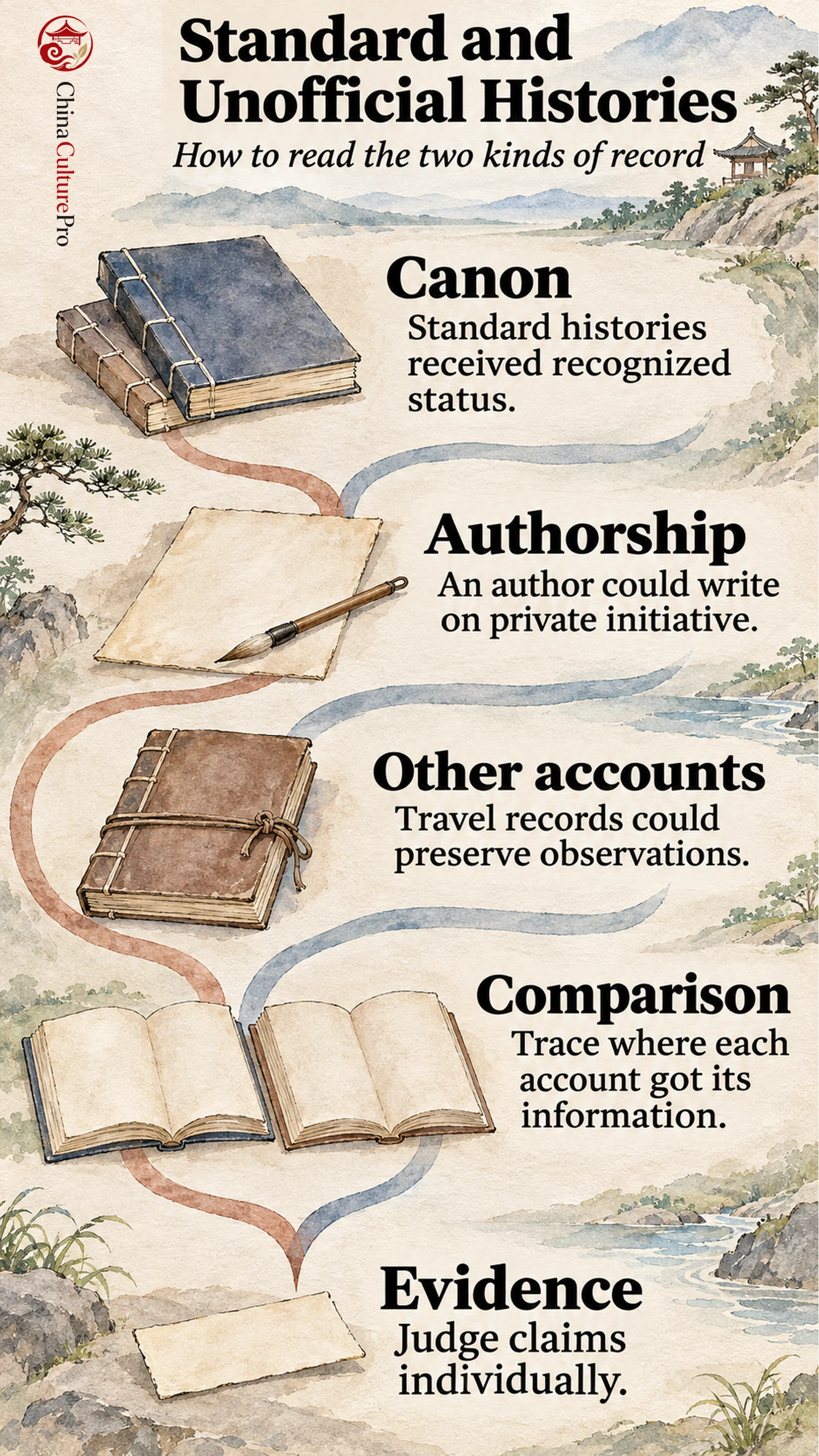
- Canon: Standard histories held a recognized place in the dynastic historical tradition.[1]
- Production: Unofficial accounts could include privately compiled histories, recollections and other records.[1][3]
- Verification: The usefulness of a claim depends on its sources, perspective and purpose.[1][3]
Official approval and historical reliability answer different questions about a text.[1][2][3]
Sima Qian held an official position, wrote a history as a private undertaking, and became the model for a canonical tradition. Those three facts can coexist. They show why readers should ask who wrote a book, who commissioned it and what status it acquired after publication.[1][2]
What Made a History Standard?
Sima Qian’s Shiji (史記, Shǐjì), or Records of the Grand Historian, gathered material about rulers, institutions and individual lives. The work later stood at the head of the Twenty-Four Histories (二十四史, Èrshísì Shǐ), which extend through the Ming. Its author’s official role gave him a vantage point on earlier records, while the project itself was undertaken on his own initiative.[1][2]
Many subsequent standard histories treated a particular dynasty. Compilers drew on records of government, biographies and other writing. Later recognition placed the works in a canon. For more on why annals and biographies can tell the same story from different angles, see the overview of Chinese historiography.[1][2]
What Unofficial Histories Can Preserve
Historical information circulated in works with different forms and purposes. A private compiler could assemble documents or report what they had heard. Accounts outside official auspices could record details that never entered a dynastic history, including the experiences of visitors and observers. The circumstances of writing affect how each detail should be read.[1][3]
Travel accounts by Joseon envoys offer a view of the Ming–Qing transition from outside the two Chinese courts. One comparative study treats these unofficial records of journeys to Ming or Qing capitals as a form of contemporary history. They can preserve what a traveler saw or heard in places that a court compiler might describe from administrative records. An envoy’s position also shapes what they were able to observe.[3]
How to Compare Two Accounts
Begin with the event and the date of each account. A work compiled afterward may use earlier records. An account written close to events may be based on rumor or a narrow vantage point. Mark which details each author claims to have seen and which come from other texts. The guide to Chinese historical chronology explains another part of that work, establishing dates across different systems.[1][3]
Find out whether the two accounts draw on separate evidence. Two versions of the same report count as one line of testimony. Agreement is informative when the routes by which information reached the writers can be traced. A disagreement may point to different dates, different purposes or a genuine conflict in the evidence.[1][3]
FAQs About Standard and Unofficial Histories
Is every standard history an official commission?
The Shiji is a major example of a privately undertaken work that acquired canonical standing. Later standard histories include works compiled under official auspices.[1][2]
Does yeshi mean legend?
The label covers a range of writing outside official auspices. An account may contain documentary material, observation or anecdotes. The nature of each claim depends on the text and its evidence.[1][3]
Why compare a standard history with other accounts?
Different works can preserve different witnesses, records and perspectives. Comparison can clarify which claims are corroborated and where uncertainty remains.[1][3]
Sources
[1] Johannes L. Kurz, Oxford Bibliographies. Traditional Historiography
[2] University of California, Berkeley, Institute of East Asian Studies. Preface to A Journal of My Misgivings
[3] Modern Asian Studies. The Transnational Historiography of a Dynastic Transition