


Quick Answer: How Does Chinese Historical Chronology Work?
Chinese historical chronology places events in the order they happened and relates dates in Chinese records to BCE and CE years. A record may date an event by its era name (年号, niánhào) and year number. [1][8]
- Period: A dynasty gives you a broad political setting. Other states may have ruled nearby at the same time. [5]
- Boundary: A table may date a dynasty from its proclamation or from the defeat of a rival court. [6]
- Exact date: A reign-year date usually needs the original month and day for a precise conversion. [8]
Treat early estimates and documented event dates as different kinds of evidence.
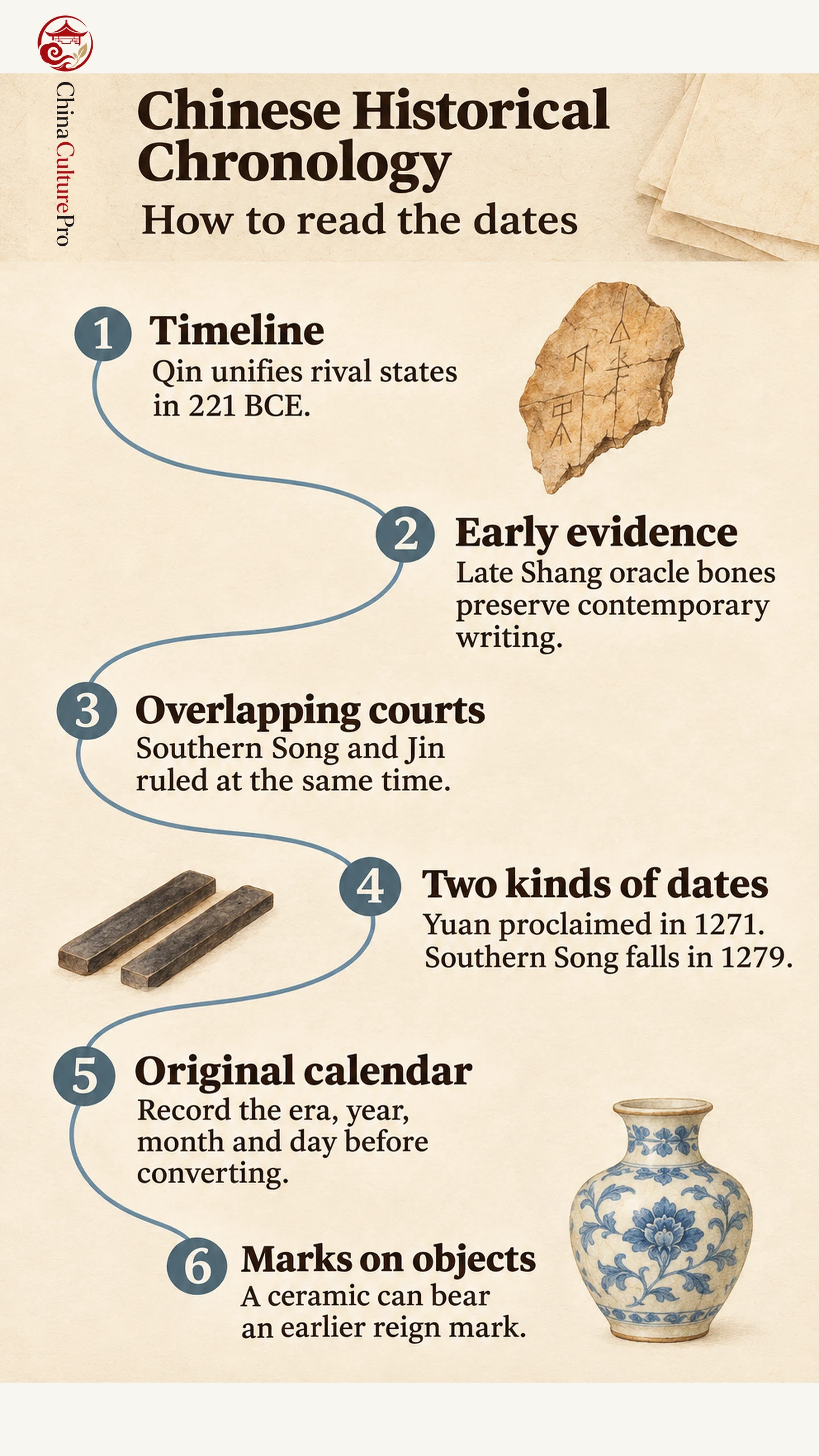
A label that dates the Yuan dynasty from 1279 can sit beside a textbook that starts it in 1271. One records a proclamation and the other marks the fall of a rival court. [6]
Chinese Dynasties and Historical Periods at a Glance
Use this table to place a name or event before looking up a precise date. The Yuan range starts with the proclamation. The Qing range starts with the capture of Beijing and ends with the formal abdication. Early dates are approximate, and adjacent rows can overlap. [1][2][6][7]
| Dynasty or period | Working dates | What the dates describe |
|---|---|---|
| Xia | Traditionally c. 2100–1600 BCE | Dates assigned to an early dynasty named in later texts. Its identification with Erlitou is debated. [1][4] |
| Shang | c. 1600–1046 BCE | Early Bronze Age dynasty whose later rulers are documented in oracle-bone inscriptions. [1][2][3] |
| Zhou | c. 1046–256 BCE | Western Zhou precedes Eastern Zhou. The Warring States period continues until Qin’s unification in 221 BCE. [1][2] |
| Qin | 221–206 BCE | Imperial Qin begins with the conquest of the rival states. The Qin state was older than the empire. [1][2] |
| Han | 206 BCE–220 CE | Western Han and Eastern Han, separated by the Xin dynasty and a brief interval of conflict. [1][2] |
| Three Kingdoms through Northern and Southern Dynasties | 220–589 CE | Several rival regimes, with a period of Western Jin reunification before further division. [1][2] |
| Sui and Tang | 581–618 and 618–907 | Sui was founded before it finished reunifying the north and south. Tang succeeded Sui. [1][2] |
| Five Dynasties and Ten Kingdoms | 907–960 for the Five Dynasties | Successive northern dynasties and coexisting regional kingdoms. Some regional kingdoms lasted beyond 960. [1][2] |
| Song | 960–1279 | Northern Song until 1127, followed by Southern Song. Song rulers shared the wider political landscape with other states. [1][5] |
| Yuan | 1271–1368 | Kublai proclaimed the dynasty in 1271. The Southern Song fell in 1279. [2][6] |
| Ming | 1368–1644 | The conventional span of the Ming dynasty as counted through the fall of Beijing. [1][2] |
| Qing | 1644–1912 in this table | Qing rule from Beijing and the end of the last imperial throne. The dynastic name predates 1644. [1][7][9] |
| Republic and People’s Republic | 1912 and 1949 as transition years | The Republic began in 1912. The People’s Republic was established in 1949. [1][7] |
Why Early Chinese Dates Are Often Approximate
A date attached to excavated buildings or pottery describes when the material was in use. A date attached to a dynasty also identifies a ruling house. At Erlitou, archaeologists can examine the layout, burials and bronze vessels without settling whether the settlement was the seat of the Xia named in later histories. The label “Xia, c. 2100–1600 BCE” belongs to a historical reconstruction. [1][4]
Late Shang oracle bones provide contemporary writing. Inscriptions about royal divination tie rulers to events and rituals, giving historians evidence unavailable in the same form for the Xia. Pinning that evidence to BCE years still requires comparing sources. Western Zhou bronze inscriptions and later accounts add clues, which carry different weight depending on when and why they were made. This distinction between contemporary evidence and later reconstruction also matters in Chinese historiography. [3][4]
Why Dynastic Dates Can Overlap or Disagree
In 1150 the Southern Song court ruled from Hangzhou while the Jurchen Jin ruled much of the north. The fall of the Northern Song capital at Kaifeng in 1127 ended one phase of Song rule. The Song ruling house continued in the south. That overlap matters when placing an object or person: the same year may belong to different dynasties in different cities. A guide to city life in Song Kaifeng follows the northern capital in more detail. [5]
For the Yuan, 1271 dates Kublai Khan’s proclamation and 1279 dates the defeat of the Southern Song. For the Qing, 1644 is the usual starting date for rule from Beijing, though Hong Taiji had already adopted the dynastic name. Many tables use 1911, the year the revolutionary uprising began, as their Qing endpoint. The abdication itself took place on February 12, 1912. When dates differ, compare the event behind each year before choosing a range. [1][2][6][7][9]
How to Convert a Chinese Historical Date
A reference to the third year of an era gives you a year in the original calendar. The Western date still depends on the month and day. A day written using the stem-branch cycle (干支, gānzhī) gives a repeating label, so it needs the surrounding date to identify an individual day. [8]
- Copy the polity, era name, numbered year, month and day as the source gives them. Keep any indication that a month was intercalary.
- Identify the dynasty and ruler. Check the place if two courts were active at once, since the name alone can be ambiguous.
- Look up the complete entry in a historical calendar converter. Check whether the result uses the Julian or Gregorian calendar if the document falls around a changeover.
- Record the converted date beside the original. When a field is missing, state the date range or the unresolved detail. [8]
A newspaper front page on February 13, 1912 also gives the 26th day of the 12th month of Xuantong year 3. Its story reports the previous day’s abdication. In a citation, February 13 belongs to the issue and February 12 belongs to the political event. The dual date helps you keep both pieces of evidence straight. [7]
What a Reign Mark Can Tell You About an Object
A reign mark (年款, niánkuǎn) on a ceramic can name the period in which it was made. Museums also identify pieces with retrospective marks. Some Kangxi-period porcelains carry the marks of earlier Ming emperors. In a catalogue, look for the distinction between “mark and period,” an attribution to the era named on the object, and a mark listed alongside a later manufacturing date. A peach-bloom vase catalogued as Kangxi mark and period illustrates the first case. [9][10]
FAQs About Chinese Historical Chronology
Is There a Year Zero Between BCE and CE?
No. In conventional historical numbering, 1 BCE is followed by 1 CE. For dates on the same month and day, subtract one from the sum of the BCE and CE year numbers to find the elapsed years.
Are the Two Jin Dynasties the Same?
Western and Eastern Jin (晉, Jìn) belong to the third through fifth centuries. Jurchen Jin (金, Jīn) was a different dynasty that coexisted with the Song. The Chinese characters distinguish the two names in a catalogue or index. [2][5]
When Should I Give Both the Original and Converted Date?
Give both when the wording of the source matters or when another reader needs to verify the conversion. A precise citation to a newspaper or an official record is a good example. For a broad timeline, the converted year and an explanation of the boundary usually suffice. [7][8]
Sources
[1] Columbia University. Timelines: China
[2] Oxford University Press. Timeline of Chinese Dynasties
[3] David N. Keightley. The Shang: China’s First Historical Dynasty
[4] Robert L. Thorp. Erlitou and the Search for the Xia
[5] The Metropolitan Museum of Art. China, 1000–1400 A.D.
[6] Smithsonian National Museum of Asian Art. Yuan Dynasty (1279–1368)
[7] National Museum of China. Special Edition on the Abdication of the Qing Emperor
[8] Academia Sinica. Two Thousand Years of Chinese–Western Calendar Conversion
[9] Asian Ceramics. Reign Marks on Chinese Ceramics
[10] The Metropolitan Museum of Art. Vase