

Quick Answer: Who Was the Guangxu Emperor?
The Guangxu Emperor (光绪帝, Guāngxù Dì; 1871–1908) reigned over the Qing dynasty from 1875 to 1908. He is best known for backing the reform movement of 1898, but his reign included childhood regency, a period of personal government and years with little independent authority.[1][3]
- Accession: Became emperor as a child within the Qing ruling family.
- Reform: Issued measures addressing education, government, economic activity and military training.
- Political defeat: Lost effective power in the court coup of September 1898.[1][3]
His reign dates describe his formal position; they do not mean he exercised the same power throughout those years.
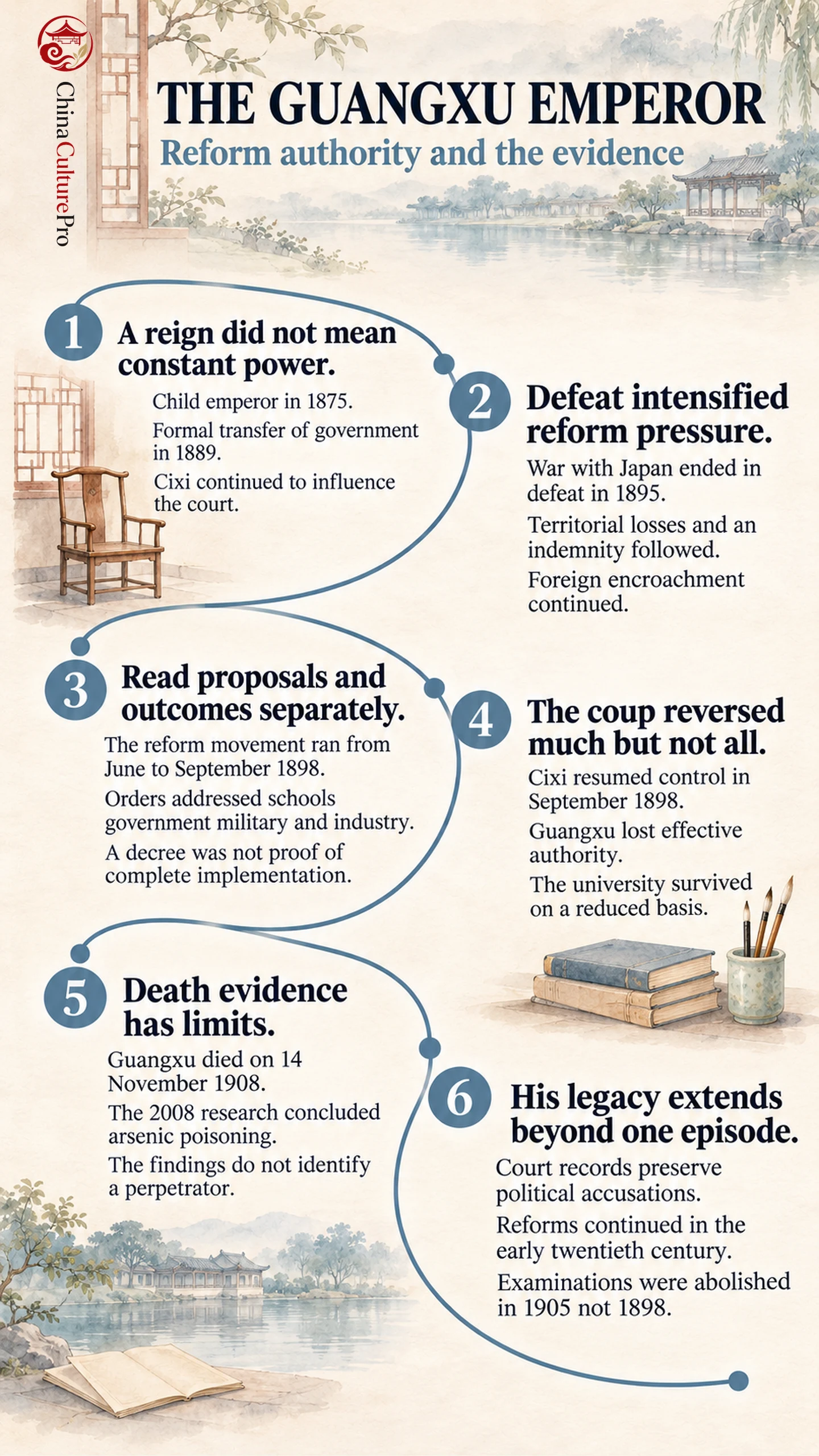
Guangxu’s life shows how an emperor could possess the throne yet struggle to direct the state. His biography becomes clearer when accession, reform decrees, court power and scientific evidence about his death are examined as different kinds of historical information.
Childhood Accession and Cixi’s Continuing Authority
His personal name was Zaitian (载湉, Zǎitián). Born in 1871, he was selected after the Tongzhi Emperor (同治帝, Tóngzhì Dì) died without a son. The succession placed him in the imperial line as an adopted son of the previous generation’s emperor, rather than as Tongzhi’s son.[1]
Cixi (慈禧, Cíxǐ) was his maternal aunt. Alongside the other empress dowager, Ci’an (慈安, Cí’ān), she initially governed during his minority. He entered the palace as a dependent child within this existing structure of authority.[1]
A ceremony marking personal rule took place in 1887, while Cixi’s formal transfer of government followed in 1889, around his marriage. Her withdrawal did not remove her influence over the court. The biography of Empress Dowager Cixi therefore remains closely connected to his own.[1][2]
War, Defeat and the Pressure for Reform
The war with Japan in 1894–1895 exposed grave weaknesses in the late Qing state. Defeat and the Treaty of Shimonoseki brought territorial losses, a large indemnity and further commercial concessions. These consequences intensified arguments about how the dynasty could survive.[3]
Foreign pressure continued after the treaty. By 1898, territorial leases and railway and mining interests made the danger of further encroachment immediate. Reform was not simply the emperor’s personal enthusiasm for foreign ideas: it addressed military, fiscal and institutional problems that officials were already debating.[3]
This context explains the urgency of 1898 without making either one ruler or one court faction solely responsible for all of China’s difficulties.
What the Hundred Days’ Reform Proposed
The Hundred Days’ Reform (戊戌变法, Wùxū Biànfǎ) ran from 11 June to 21 September 1898. The opening policy edict, Mingding Guoshi Zhao (明定国是诏, Míngdìng Guóshì Zhào), called for practical Western learning alongside the moral learning of the classics. It criticized inadequate training, funds and useful knowledge.[3][4]
Kang Youwei (康有为, Kāng Yǒuwéi) supplied influential arguments for institutional change. His January memorial pointed to foreign reform models and argued that inherited arrangements were unsuitable for present circumstances. It is evidence of an adviser’s program, rather than a transcript of the emperor’s private thoughts.[5]
| Area | Measures ordered or promoted |
|---|---|
| Education | Change examination writing, expand schools and establish a university in the capital. |
| Military affairs | Introduce modern drill and improve training. |
| Administration | Merge offices and widen channels for policy suggestions. |
| Economic activity | Promote commerce, agriculture, industry, railways and mining. |
The Imperial University of Peking (京师大学堂, Jīngshī Dàxuétáng), predecessor of Peking University, offers a concrete institutional example. Guangxu approved its charter in July 1898. Approving the charter did not mean that its entire program was implemented. The wider reform movement likewise did not establish a functioning constitutional monarchy.[3][4][6]
The Coup and the Limits of Imperial Power
On 21 September, Cixi resumed control and the emperor lost effective authority. Reform supporters were arrested; six were executed, while Kang escaped. Offices were restored and several measures reversed. The court’s own annals preserve both reform orders and the subsequent condemnations of their supporters.[3]
The contrast reveals a practical limit of imperial sovereignty. An emperor could issue edicts, but sustaining them required officials, personnel and political support. Formal command did not automatically secure control of the machinery needed to carry it out.
Reversal was extensive, but not total. The university survived the coup and opened later in 1898 on a reduced basis. Its smaller initial operation shows how one initiative continued despite a major political reversal.[6]
Confinement, Death and the Arsenic Investigation
Guangxu was confined under court supervision, associated especially with Yingtai (瀛台, Yíngtái) in the western imperial gardens. This did not mean he remained continuously in one room: during the Boxer crisis of 1900, he accompanied Cixi’s flight to Xi’an. He retained the imperial title without recovering independent government.[2]
He died on 14 November 1908, one day before Cixi. Puyi (溥仪, Pǔyí) succeeded him. The closeness of the deaths encouraged suspicion, but chronology alone cannot identify a killer.[3][7]
A research team reporting in 2008 examined preserved hair, clothing and other remains, using chemical analysis and comparisons with environmental samples. It concluded that Guangxu died from arsenic-trioxide poisoning. The report interpreted high arsenic on hair as contamination from the poisoned body after death, not as a straightforward record of chronic exposure.[7]
The findings address the cause of death. They do not, by themselves, establish who administered the poison or who ordered it. A named culprit requires a different chain of historical evidence.
Sources and Historical Legacy
The Draft History of Qing (清史稿, Qīngshǐgǎo) supplies a chronological record, but its annals preserve the language of court decisions, including accusations against reformers. Those accusations should be read as political statements, not automatically accepted as impartial verdicts.[1][3]
Guangxu’s reform effort failed to secure lasting control of the court. Nevertheless, educational and administrative change continued under the Qing government in the early twentieth century. The civil service examinations were abolished in 1905, rather than in the Hundred Days of 1898.[8]
His legacy combines a serious attempt at change with limited governing capacity. Distinguishing history from later storytelling means comparing policy documents, institutional outcomes and forensic findings without turning them into a single palace drama.
FAQs About the Guangxu Emperor
Was Guangxu the emperor’s personal name?
No. Guangxu was his reign title. His personal name was Zaitian; using the reign title is the conventional way to identify this Qing emperor.[1]
Was Guangxu China’s last emperor?
No. He died in 1908 and was succeeded by Puyi, the dynasty’s final emperor.[3][8]
Did the arsenic study identify who killed Guangxu?
No. The team concluded that he died of arsenic-trioxide poisoning. Identifying the person who administered or ordered it is a separate historical question.[7]
Sources
[1] Draft History of Qing compilers. Draft History of Qing, Chapter 23: Dezong, Part One
[2] The Palace Museum. The Guangxu Emperor
[3] Draft History of Qing compilers. Draft History of Qing, Chapter 24: Dezong, Part Two
[4] Qing imperial government. Edict Determining National Policy, 11 June 1898
[5] Kang Youwei, translated in Sources of Chinese Tradition; Columbia University Asia for Educators. Excerpts from Comprehensive Consideration of the Whole Situation
[6] Peking University. The Imperial University and Peking University in the Early Republic, 1898–1916
[7] Zhong Liman and research collaborators. Research Report on the Cause of the Guangxu Emperor’s Death
[8] Columbia University, Asia for Educators. Living in the Chinese Cosmos: Nineteenth-Century Encroachment