


Quick Answer: What Was the Tea and Horse Trade System?
Tea and horse trade (茶馬貿易, chámǎ màoyì) refers here to government-organized exchange that used tea to acquire horses. The Song bought tea in Sichuan and used it to procure animals from suppliers on the frontier. The Ming later regulated related exchanges through dedicated offices.[1][2][3][4]
- Tea: An official purchasing system could bring together tea from producers for trade.[1]
- Horses: The court sought horses for state needs, including cavalry.[1][2][3]
- Offices: Ming chamasi (茶馬司, chámǎsī) supervised exchanges at frontier markets.[2][3]
These arrangements were one part of a larger trading world that also included merchants and routes carrying other goods.[2][3]
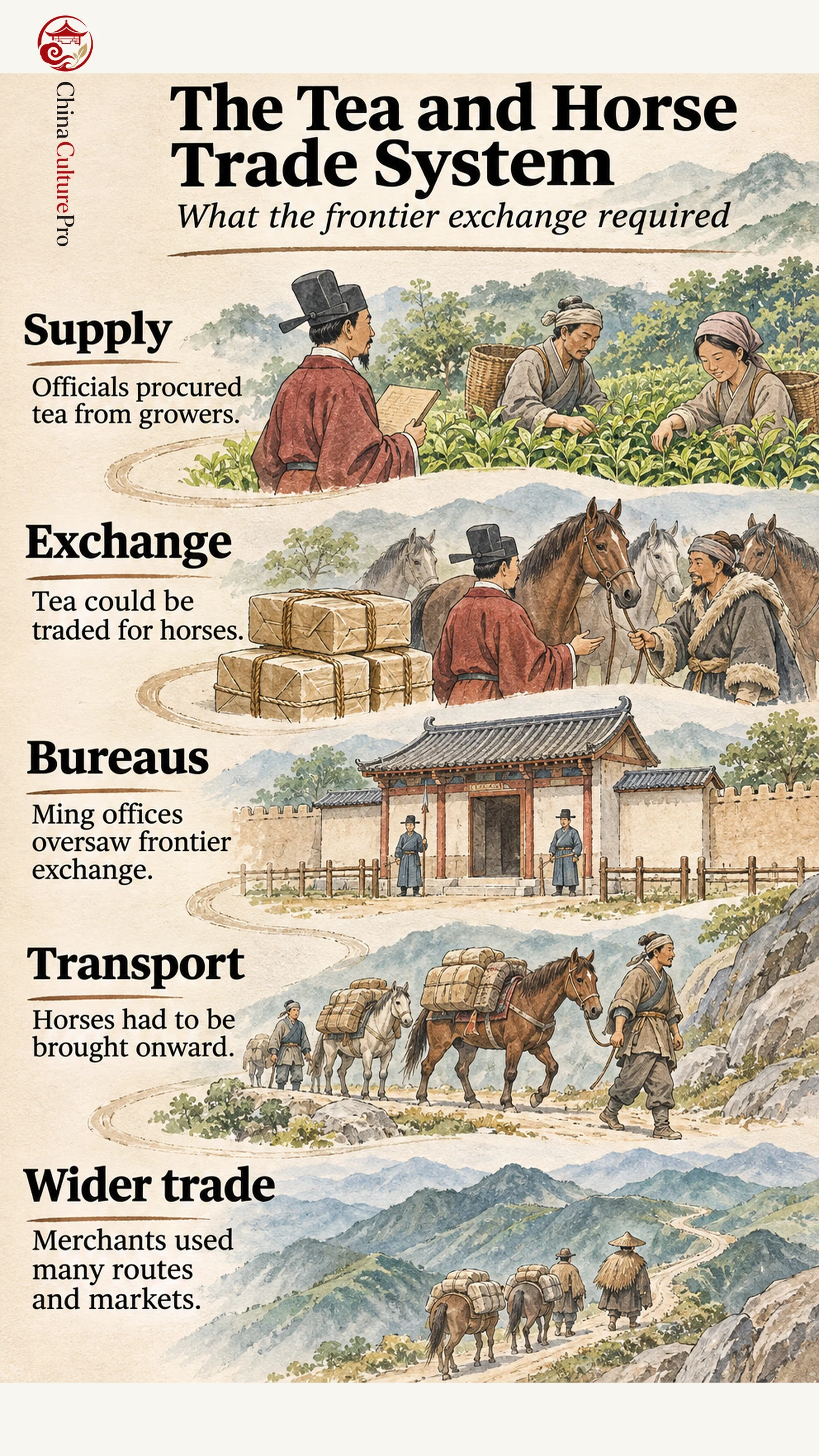
Tea in a producing district and horses at a frontier market were separated by distance and administration. An official trade system had to bring the two together, then get the purchased animals to where the state needed them.[1][2]
How the Song Procured Tea and Horses
During the New Policies associated with Wang Anshi, the Northern Song established a Tea Market Agency to buy Sichuan tea. The agency acquired Sichuan tea for exchange with suppliers in Tibetan frontier regions. Tea procurement linked policy at court to a growing industry, while horse procurement depended on exchange with communities beyond the interior producing districts.[1]
The state also had to handle what happened after purchase. Paul Jakov Smith describes long journeys with live animals over rugged terrain. Staff and transport were part of the cost. A tally of horses acquired and a tally of horses delivered therefore tell different stories about whether a procurement system worked.[1]
How the Ming Organized Frontier Markets
The Ming used horse trade offices on the frontiers of Shaanxi and Sichuan. These offices regulated exchanges in which Tibetan and other suppliers could trade horses for tea. The Ming established a tea-horse bureau at Hezhou in 1374, an example of the offices it set up along the northwestern frontier. Other offices served their own districts and partners. This was a related policy in a different administrative and political setting from the Song agency.[2][3][4]
The market was useful to officials because it brought exchange to specified places. Control over tea supply gave them a tool for managing trade. Participation still depended on whether people brought animals to market and wanted what was offered in exchange.[1][2][3]
Trade Offices, Routes and Tribute
A bureau was an institution that regulated exchange at a location. A trading route describes how people and goods moved between locations. Tea was one commodity within a much larger network of frontier exchange. The term Tea Horse Road can refer to broader networks, while the official system describes particular rules, officials and transactions.[1][2][3]
The Ming also received horses in diplomatic or tributary settings. Research distinguishes trade in designated border markets from formal tribute missions, even when some of the same goods or political aims were involved. The distinction matters when reading a record of imperial tribute gifts. For the commodity beyond official horse procurement, see tea trade in Chinese history.[2][3]
FAQs About the Tea and Horse Trade
Why did Song officials use tea to acquire horses?
Sichuan provided a source of tea that officials could purchase, and frontier suppliers could exchange horses for it. The Song sought those horses for state purposes including cavalry.[1]
Did the Song and Ming use the same office?
The Song developed a Sichuan tea procurement agency. The Ming organized frontier exchanges through tea-horse bureaus in its own administrative setting.[1][2][3][4]
Was every tea shipment part of horse procurement?
Tea moved through a wider commercial network. The government system covered particular procurement and exchange arrangements.[1][2][3]
Sources
[1] Paul Jakov Smith, Harvard University Asia Center. Taxing Heaven’s Storehouse
[2] Revue d’Études Tibétaines. The Ming, Tibetan and Mongol Interactions
[3] Springer. The Structure and Transformation of the Ming Tribute Trade System
[4] Ray Huang, Cambridge University Press. Fiscal Organization and General Practices