


Quick Answer: What Were Imperial Tribute Gifts?
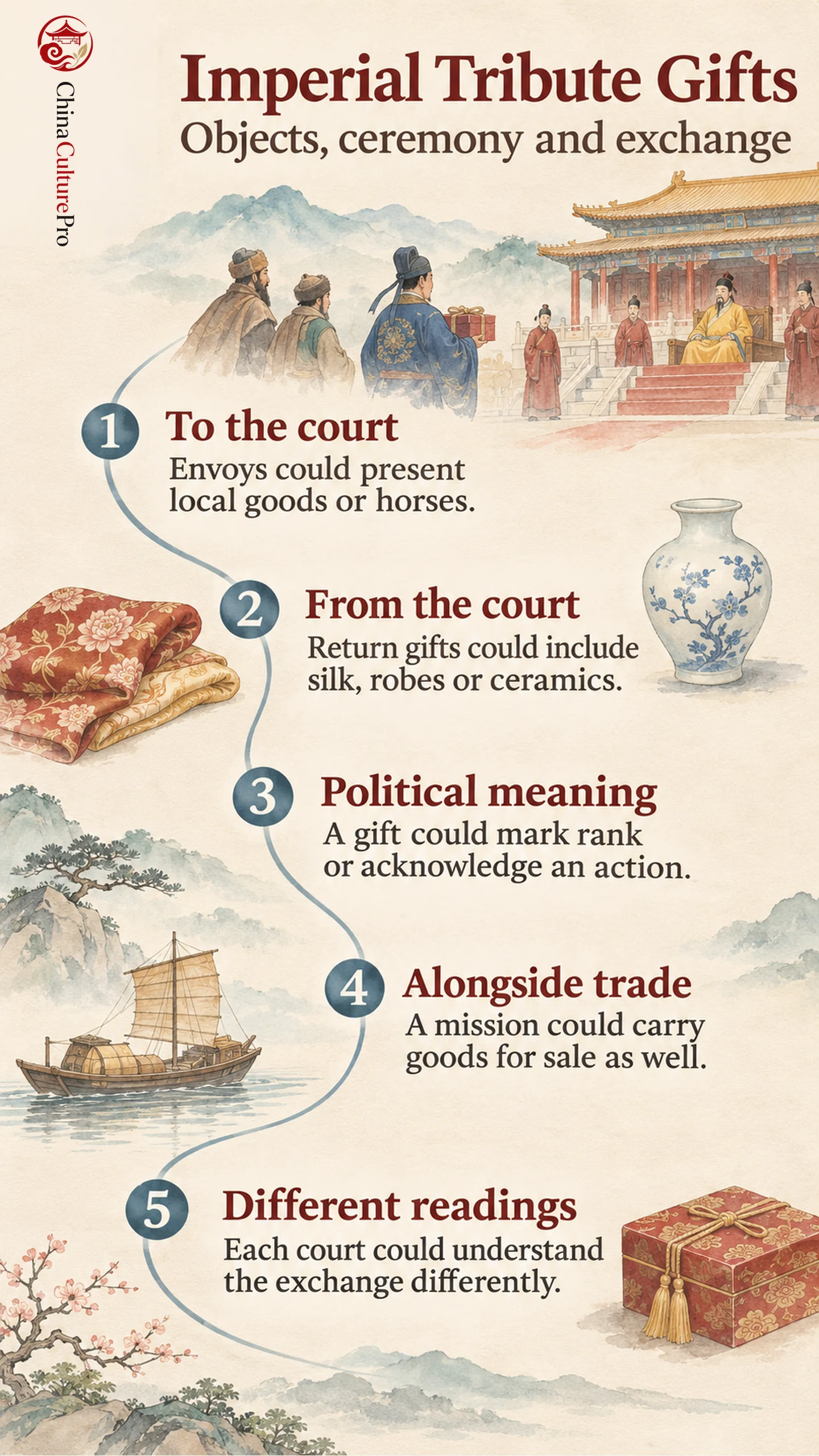
Imperial tribute gifts were goods that visiting delegations presented to a Chinese emperor within a diplomatic relationship. Presenting tribute (進貢, jìngòng) could include formal greetings, gifts and other business. The court could send back its own gifts to envoys or to the rulers they represented.[1][2]
- Gifts to the court: Local products, textiles, horses or other goods could be presented, depending on the relationship.[1][2]
- Gifts from the court: Rulers and envoys might receive textiles, robes, books or objects chosen for a particular occasion.[1][2]
- Other exchange: Trade could take place alongside a mission, with its own transactions and rules.[1][3]
The court’s language of tribute expressed its view of the relationship. A delegation or ruler might understand the exchange in different terms.[1][4]
A gift list can tell us what changed hands. A court order may tell us why a ruler received a length of silk. A cargo account can show which objects were intended for sale. The same material appears in records of quite different exchanges.[1][2][3]
What Envoys Brought to the Ming Court
Delegations could bring goods associated with the regions they represented. Horses mattered in some of the Ming court’s relations with Central Asian rulers. The court could also accept goods primarily for the ceremony, where the act of presenting them mattered more to officials than their market price. At imperial court audiences, presenting the objects could become part of the public ceremony.[1]
The terms could also be negotiated. Early Ming demands on Korea included gold and silver. After repeated Korean appeals, those particular deliveries were canceled in 1429. Those appeals changed the list of required objects. The episode helps explain why a list from one year cannot stand for the entire relationship.[1]
What the Emperor Sent Back
Objects moving out from the court could carry different messages. In 1407, according to Ming records discussed by historian Felix Kuhn, the court sent silver and silk to the ruler of Champa after he supplied troops for an expedition. The gift acknowledged a particular action.[1]
Robes could also convey status. The cut, decoration and intended wearer linked a gift to an understanding of rank, which is why the history of imperial regalia matters to diplomatic gifts. A robe recorded in a gift list could communicate a status that a comparable amount of silver could not.[1]
In the Qing, missions from Joseon could take home ceramics, textiles and objects such as a ruyi (如意, rúyì), a ceremonial scepter. Yoonjung Seo’s study also describes engravings in European style transmitted through diplomatic channels in the late eighteenth century. Their presence shows how a gift from the Qing court could bring a work shaped by several artistic traditions into a Korean collection.[2]
Gifts and Trade on the Same Journey
A delegation could bring goods for formal presentation and also take part in commerce. Ming dealings with Ryukyu (琉球, Liúqiú) involved maritime journeys in which an official mission and commercial exchange could be closely connected. Ships connected the Ryukyu Kingdom to ports in Fujian and to other Asian markets. A ceremonial presentation at court was one part of a trip that could also move goods through a wider trade network.[1][3]
The distinction helps when reading a cargo list or accounts of Chinese maritime customs. A visit could make trading possible under particular rules. A sale still had its own parties and terms, and other trade could take place outside the official mission channels.[3]
When the Two Sides Understood a Gift Differently
In 1793 the British Macartney embassy brought gifts from George III to the Qianlong emperor (乾隆, Qiánlóng), including a telescope, a planetarium and Wedgwood pottery. The court could understand the presentation through the language of tribute. The British delegation approached it as part of a diplomatic mission with its own aims, including a request for a permanent mission in Beijing.[4]
The Qing gave objects including silk, porcelain and tea in return. The exchange went ahead even though the emperor refused the request for a permanent British mission. Accepting an object and accepting a diplomatic proposal were separate actions.[4]
FAQs About Imperial Tribute Gifts
Were tribute gifts a tax?
A court could demand certain goods from particular diplomatic counterparts. The gifts described here belonged to diplomatic missions, while taxes were levies within the state’s fiscal administration.[1]
Did tribute missions also trade?
They could. Ryukyu’s maritime networks show how trade could accompany official visits. Goods formally presented at court had a different role from merchandise.[1][3]
What kinds of gifts did the emperor send in return?
It depended on the visit. Examples include silk, silver, robes, ceramics and illustrated works, selected for recipients and occasions.[1][2][4]
Sources
[1] Felix Kuhn, Journal of Chinese History. Much More Than Tribute: The Foreign Policy Instruments of the Ming Empire
[2] Yoonjung Seo, Korean Bulletin of Art History. Art and Material Culture of Qing Dynasty and Its Transmission to Joseon through Diplomatic Channels
[3] Harriet Zurndorfer, Cambridge University Press. Oceans of History, Seas of Change
[4] Royal Collection Trust. The Macartney Embassy: Gifts Exchanged between George III and the Qianlong Emperor