


Quick Answer: What Were Imperial Examination Quotas?
Imperial examinations (科舉, kējǔ) in China could limit or allocate the places available at a particular stage. A quota might specify the number of successful candidates in a province or the share drawn from a large region. The rules varied by dynasty and examination level.[1][2][3]
- Local access: A cap on lower-level admissions affected who could proceed to further examinations.[2][3]
- Regional shares: The Ming assigned metropolitan places to northern, southern and central groups in one later arrangement.[1][4]
- Results: The quota determined available places. The number of candidates and their performance also mattered to the result.[1][2]
A quota, a pass rate and a final rank describe different things. To understand a figure, identify which stage and which group it covers.[1][2][5]
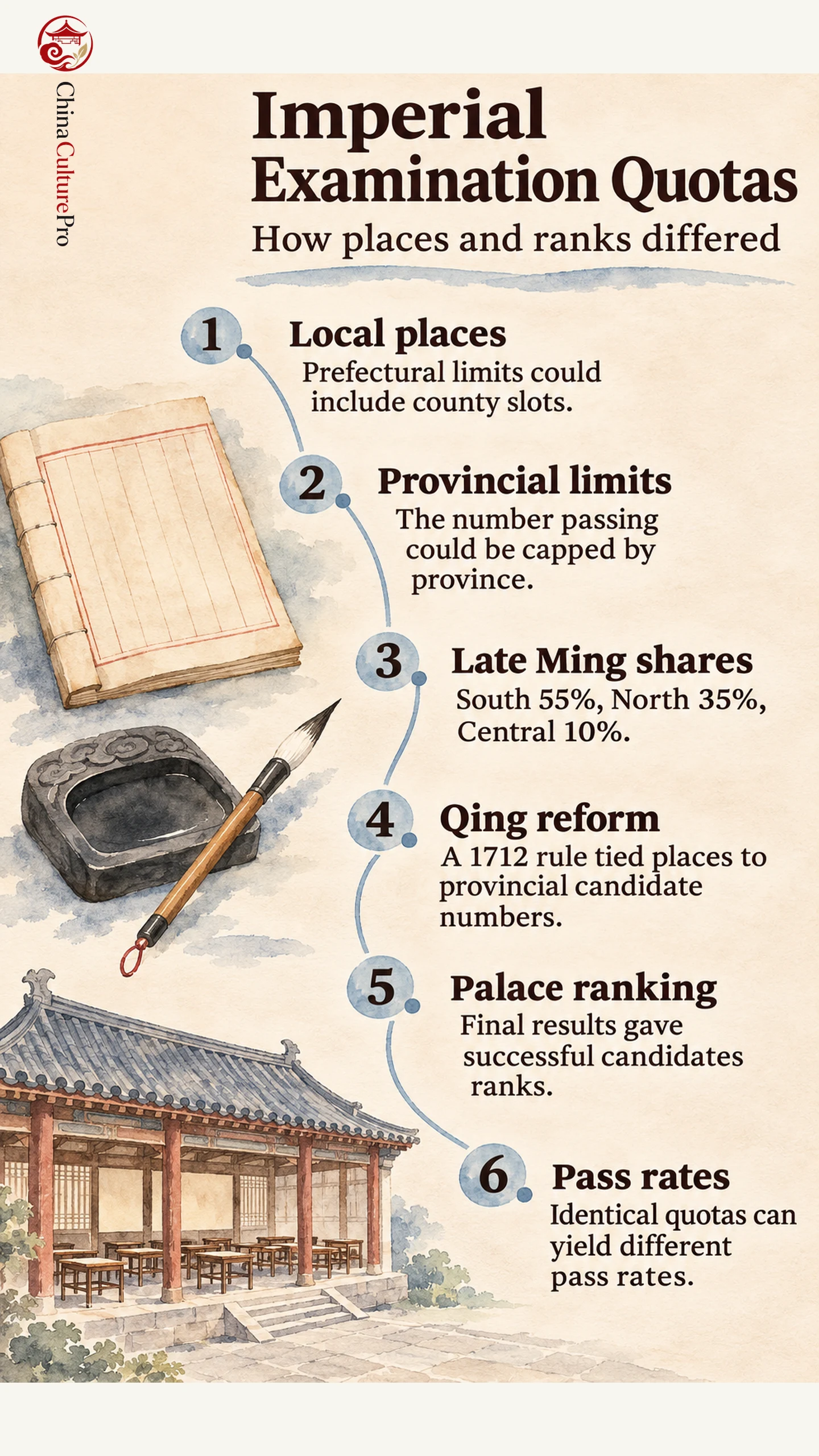
A provincial limit could determine how many candidates advanced to the capital. At the metropolitan examination (會試, huìshì), a separate allocation could divide the available places among broad regions. A candidate could encounter both kinds of rule on the way to a final rank.[1][2]
Where Quotas Entered the Examination Sequence
The civil examination system selected candidates in stages. In Qing records, a prefectural limit could include slots set aside by county and a smaller set shared among counties. A provincial examination (鄉試, xiāngshì) could cap the number of successful candidates for the province. Each lower-level limit affected the pool eligible to compete later.[2][3]
The metropolitan examination brought qualified candidates together. Its regional allocations were a separate policy from the quotas controlling earlier admissions. The subsequent palace examination (殿試, diànshì) produced final ranks recorded in lists. A rank is a position in a result, whereas a quota is a rule governing the number or share of places.[1][2][5]
Why the Ming Divided Metropolitan Places by Region
In 1397 the initial list of successful metropolitan candidates came entirely from the south, according to the account discussed by historian Benjamin Elman. The result provoked a dispute at court. The dispute came before a durable system of fixed shares. In the fifteenth century the court adopted formal regional arrangements and eventually grouped candidates into southern, northern and central divisions.[1]
The late Ming formula that Elman traces after 1489 assigned 55 percent to the southern group, 35 percent to the northern group and 10 percent to the central group. The figures refer to shares of metropolitan places in that arrangement. The total number selected in a sitting could change. A sitting that selected fewer people could retain the same division. The formula described the shares rather than prescribing a fixed total for every sitting.[1][4]
What Changed Under the Qing
The Qing continued to use limits at more than one level. Prefectural admission and the provincial examination could each have an allocation. Xue and Zhang describe a 1712 reform that tied the number of jinshi (進士, jìnshì), or highest civil examination degree holders, to the number of examinees from each province. That basis differed from the Ming formula, which assigned shares to larger regions. Qing rules for lower levels still mattered because those exams helped determine who reached the capital in the first place.[1][2]
Those rules affected representation, while examination anonymity addressed whether graders could recognize individual candidates. The two could operate in the same system because they addressed different parts of selection.[2][3]
How to Read a Historical Quota Figure
Imagine two provinces each allowed to pass twenty candidates. If the first has a hundred candidates and the second has two hundred, filling those places would yield a pass rate of 20 percent in the first province and 10 percent in the second. Both provinces would have the same number of successful candidates.
That example explains why a register of successful candidates cannot by itself show how hard it was to pass. A reader needs the number of people eligible or examined, the level of examination and the allocation rule used for that sitting. It also matters whether the record describes places available or candidates actually selected.[1][2][4]
FAQs About Imperial Examination Quotas
Were quotas always set by province?
Different arrangements applied at different stages. Qing records include county and prefectural allocations, while the Ming used broad regional groups for some metropolitan quotas.[1][2]
Was 55:35:10 the normal division for all dynasties?
It was a later Ming allocation for the southern, northern and central divisions of the metropolitan examination. Other periods and examination levels used different rules.[1][2][4]
Could a quota tell you someone’s final rank?
It gives a number or share of available places. A ranked list gives the position of a successful candidate within the final results.[1][5]
Sources
[1] Benjamin A. Elman, Academia Sinica publication. Ming and Qing civil examination structures and quotas
[2] Melanie Meng Xue and Boxiao Zhang, STEG working paper. The Short- and Long-Run Effects of Affirmative Action
[3] Cambridge University Press. The Political Economy of China’s Imperial Examination System
[4] Acta Geographica Sinica. Historical geography of successful candidates and regional quotas
[5] UNESCO Memory of the World. Golden Lists of the Qing Dynasty Imperial Examination