


Quick Answer: What Was the Palace Examination?
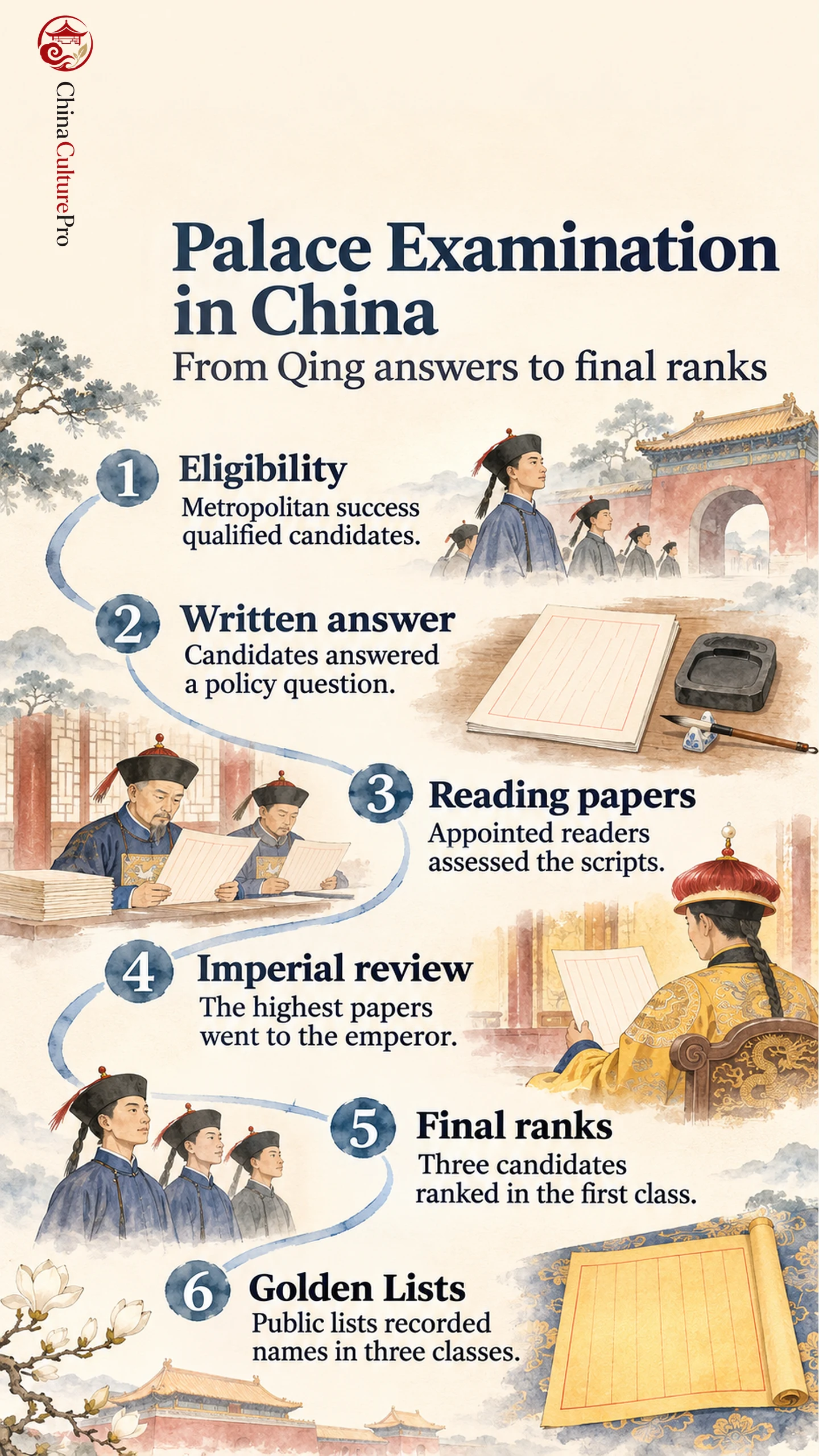
The palace examination (殿試, diànshì) was the final level of China’s civil service examinations in dynasties including the Ming and Qing. Candidates who qualified at the metropolitan examination (會試, huìshì) could sit it. The Qing process used written answers, designated readers and ranking under the emperor’s authority.[1][2][5]
- Question: In the Qing procedure, candidates wrote a response to a policy question.[1]
- Reading: Officials examined the papers and recommended the highest-ranked answers for imperial review.[1]
- Result: Successful candidates received jinshi (進士, jìnshì) status and were placed in three classes.[1][2]
The emperor presided over the examination, while appointed officials handled much of the reading and administration.[1][2]
A surviving Qing answer paper might be marked third in the second class. That position differs from third in the first class, whose holder had a special title. The final lists preserve both kinds of information, class and position within it.[1][2][3]
Who Reached the Palace Examination?
The palace stage came after qualification in the metropolitan examination, which in turn depended on earlier success in the civil examination system. The palace stage ranked a group that had already cleared those earlier selections. The record of a metropolitan result establishes eligibility, while a palace result establishes class and rank.[1][2]
The venue changed over the Qing. The Palace Museum dates the adoption of the Hall of Preserving Harmony (保和殿, Bǎohé Diàn) as the regular site to 1789. An earlier document can describe a different location while still referring to the same examination level.[1][2]
What Candidates Wrote and Who Read It
In the Qing procedure, candidates answered a question on government policy in a single written session. Officials often drafted a question for imperial approval. Staff collected the originals and sealed identifying information. Appointed readers assessed the papers and discussed their order. In the later procedure described by the Palace Museum, they submitted the ten highest papers for the emperor’s review.[1]
Sealing could cover identifying details on an original. Unlike the procedure used for the Qing provincial and metropolitan stages, the palace papers could remain in the writer’s own hand. The difference helps explain why examination anonymity involved different procedures at different stages.[1][3][4]
Three Classes and the Top Three Ranks
Qing results divided successful candidates into three classes. The first class had three names. Its members received individual titles that marked their order within that class.[1][2]
| Title | Rank in the first class |
|---|---|
| Zhuangyuan (狀元, zhuàngyuán) | First |
| Bangyan (榜眼, bǎngyǎn) | Second |
| Tanhua (探花, tànhuā) | Third |
A candidate could also rank within the second or third class. Academia Sinica preserves a paper by Niu Yuankai (牛元愷, Niú Yuánkǎi), dated 1860, that the museum identifies as third within the second class. That rank is different from third place within the first class. The Palace Museum records appointments at the Hanlin Academy for the three candidates in the Qing first class.[1][3]
What the Golden Lists Recorded
The Qing court made its results public on yellow documents called Golden Lists (金榜, jīnbǎng). UNESCO’s collection description distinguishes a smaller form for the emperor from a larger public one. The large public list was posted outside the Chang’an Gates in Beijing. It bore the imperial seal and set out names by class in Manchu and Chinese.[2]
A reader working with a list can learn the name, class and rank recorded for a candidate. A surviving answer paper offers different information, such as handwriting or material details. The two kinds of document tell us about the same process from different points in it.[1][2][3]
FAQs About the Palace Examination
Was the palace examination the same as the metropolitan examination?
They were successive stages. Metropolitan success qualified candidates to sit the palace stage, where they could receive a final class and rank.[1][2]
Did the emperor read every answer?
The Qing appointed readers assessed the scripts and considered the results. They presented the top papers for the emperor to review and rank.[1]
Was every jinshi a zhuangyuan?
The zhuangyuan was first in the first class. Successful candidates in the other positions and classes were also recorded in the final results.[1][2]
Sources
[1] The Palace Museum. The Qing palace examination
[2] UNESCO Memory of the World. Golden Lists of the Qing Dynasty Imperial Examination
[3] Academia Sinica, Museum of the Institute of History and Philology. Palace Examination Paper by Niu Yuankai, Third in the Second Category
[4] Academia Sinica, Museum of the Institute of History and Philology. Qing examination papers, seals and copies
[5] The Palace Museum. Palace examination