

Quick Answer: How Were Imperial Exams Made Anonymous?
Examination anonymity in imperial China could involve two separate protections. Name sealing (彌封, mífēng) covered identifying details on a submitted paper. Clerical transcription (謄錄, ténglù) gave the grader a copy in another hand. The Song made these procedures an important part of civil examinations, and later dynasties used related methods.[1][2]
- Identity: Staff covered the candidate’s name and other details before the paper reached the reader.[1][2]
- Handwriting: A copy could conceal the candidate’s distinctive script.[1][2]
- Verification: Qing staff compared a copied answer with its original before forwarding it for assessment.[2]
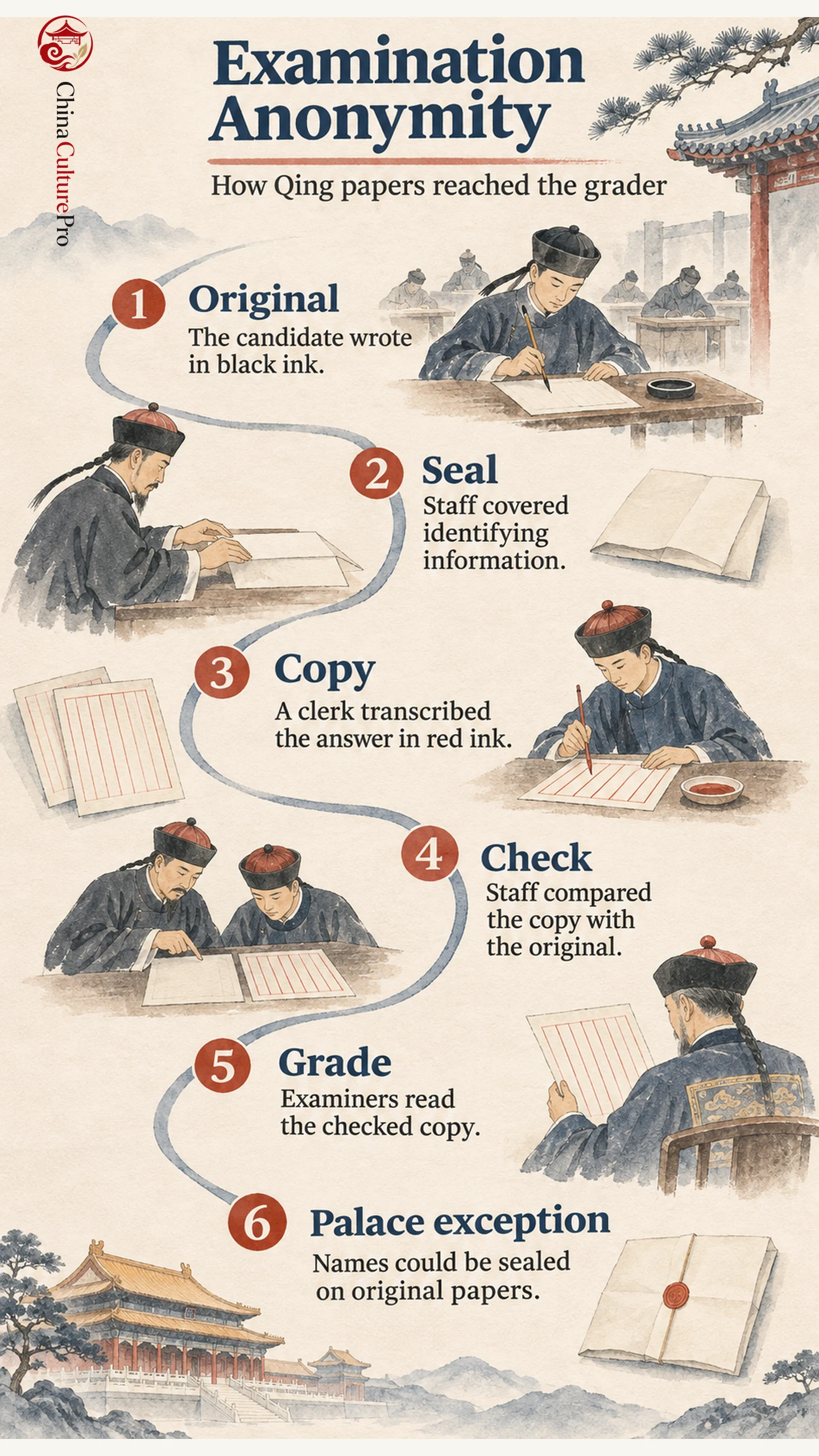
The procedures depended on the exam and its period. Qing palace examination papers could be sealed while remaining in the candidate’s own hand.[2][5]
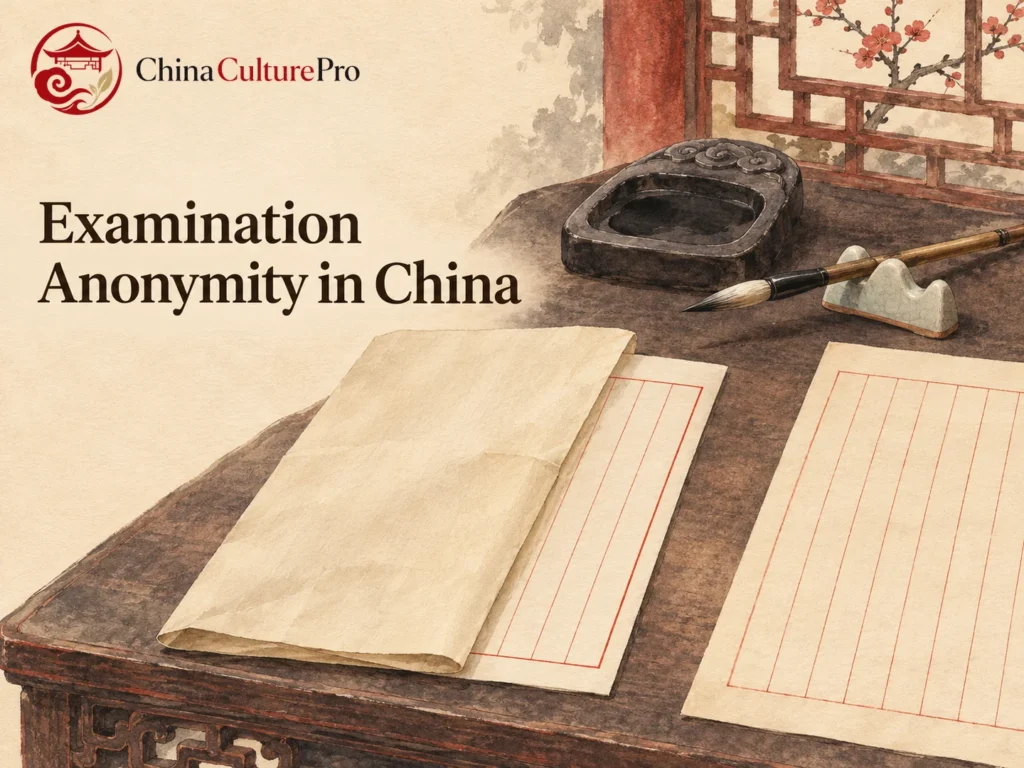
A Qing examination paper can show red ruling on a sheet filled out in black ink, seals on a folded cover or officials’ stamps on a separate copy. Each feature belongs to a different part of the paper’s journey.[2][4]
Why the Song Separated a Candidate From the Answer
In the Tang, candidates could circulate examples of their writing to examiners before sitting the examination. An evaluator might consider a writer’s reputation or conduct along with the work. Song procedures made the submitted answer a more separate object of assessment by hiding the name and having the writing transcribed.[1]
The two protections addressed different routes to recognition. A sealed cover kept the examiner from simply reading the name. A copy made the candidate’s hand less visible. This second measure mattered in examinations that required extensive handwritten answers. The later eight-legged essay governed what a candidate wrote. Copying governed what the reader received.[1][2]
How a Qing Examination Script Reached the Reader
The Qing provincial and metropolitan examinations provide a clear documented example of how officials divided the work. The candidate wrote a black-ink paper (墨卷, mòjuàn). Identifying details on the cover could include place of origin. After collection, a sealer covered the identifying section and looked for signs such as a folded corner or a pinhole. A distinctive mark could help an accomplice pick out a paper even after the name was concealed.[2][3]
A clerk then copied the answer in red ink to create a vermilion copy (硃卷, zhūjuàn). Other staff compared it against the original. The checked copy went on to the examiners, while the original still tied the response to the candidate. The division of work meant the people who handled identification and copying had separate responsibilities from those who judged the answer.[2][4]
A late Qing copy at the National Museum of China bears marks for roles including sealing, transcription and comparison. The cover also records the province. The system restricted the information a grader received while preserving enough paperwork for officials to track a script and assign the result to its writer.[2][4]
How to Read Black Ink and Red Lines on a Surviving Paper
The original metropolitan answer paper of Zhao Hao (趙灝, Zhào Hào), preserved at Academia Sinica, has a space for drafting and a later section ruled in vermilion. The candidate transferred the draft into the ruled area in black ink. The red borders were part of the paper. The distinct vermilion examination copy was a second document, made by a clerk after the original was handed in.[2][3]
The distinction also helps explain why museum collections preserve separate originals and transcripts. On Zhao’s paper the layout preserves the candidate’s working process, while the red-ink Guangxu copy preserves marks made as officials moved it through the grading process.[2][3]
What Anonymity Could and Could Not Change
At the Qing palace examination, evidence for name sealing survives on original scripts. The paper could retain the candidate’s handwriting. Designated officials read and assessed papers before the final ranking under imperial authority. The same notion of a hidden name could therefore operate with different paper handling across stages of the civil examination system.[2][5][6]
The system reduced opportunities for direct recognition during grading. It also created new points where a clerk’s error or an attempt at collusion could matter. Checking copies and watching for marks were responses to those risks. Imperial examination quotas addressed a different issue, the allocation of places, outside the act of concealing a writer’s identity.[1][2]
FAQs About Examination Anonymity
When did name sealing and copying become regular practices?
Song civil examinations established strict anonymity procedures using both protections. Later dynasties carried them forward in different forms.[1][2]
Were drafts sent to the examiners?
In the documented Qing provincial and metropolitan procedure, staff sealed identifying information and the rough work. Examiners received the checked transcript of the finished answer.[2][3]
How could officials connect a graded answer to its writer?
The identifying information was still recorded on the sealed original. Keeping the copy associated with that original let officials identify the writer after the answer had been assessed.[2][3][4]
Sources
[1] Cambridge University Press. The Political Economy of China’s Imperial Examination System
[2] Academia Sinica, Museum of the Institute of History and Philology. Qing examination seals, red-ink copies and anti-cheating measures
[3] Academia Sinica, Museum of the Institute of History and Philology. Black Ink Version of the Third Section Metropolitan Examination Paper by Zhao Hao
[4] National Museum of China. Vermilion metropolitan examination paper from the Guangxu reign
[5] Academia Sinica, Museum of the Institute of History and Philology. Palace Examination Paper by Chen Benzhong
[6] The Palace Museum. The Qing palace examination