

Quick Answer: What Was the Hanlin Academy?
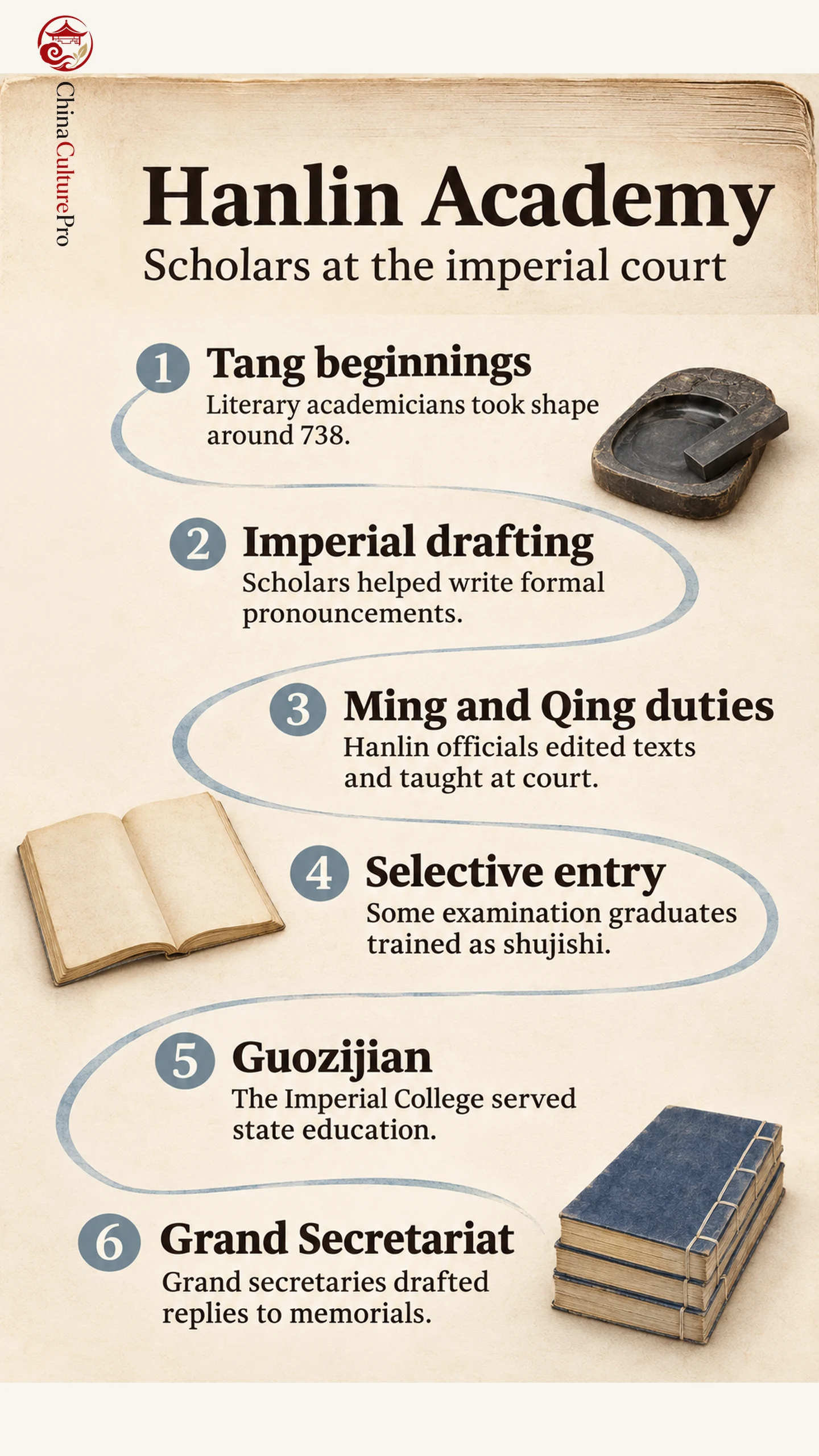
The Hanlin Academy (翰林院, Hànlín Yuàn) was an imperial institution whose scholars served the Chinese court through writing, editing and teaching. Its literary branch took shape under the Tang dynasty. Its duties and routes of appointment changed over time. [1][2][7][8]
- Drafting: Tang academicians helped compose imperial pronouncements.
- Editing: Hanlin scholars worked on histories and other court-sponsored texts.
- Training: Ming and Qing courts selected some advanced examination graduates for further instruction and appointments. [1][3][7]
A Hanlin appointment identified a court role. Its holder could later take a post with wider political responsibility.
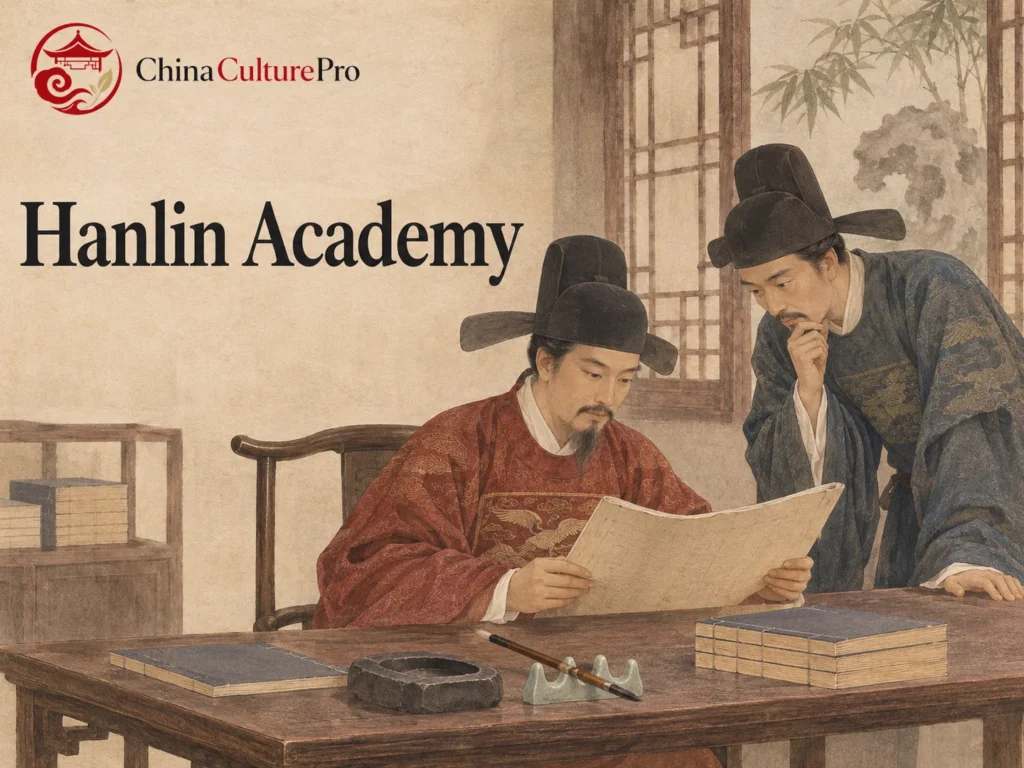
A scholar asked to write in the emperor’s voice needed more than an examination degree. A draft had to fit the occasion, express the court’s decision and be ready for review. Under later dynasties, preparing a history or teaching a prince drew on the same court’s pool of literary officials. [1][7][8]
How the Hanlin Academy Took Shape Under the Tang
The Tang court developed an inner group of literary specialists during the reign of Emperor Xuanzong. Around 738, the formation of a group of Hanlin academicians gave the emperor additional help drafting formal orders. The existing Secretariat still handled documents. Hanlin drafting grew beside that work and gave the ruler access to writers within the palace. [1][8]
Early appointments could be duties held by officials who already had posts elsewhere. A scholar’s place among the academicians therefore tells you about his access to the ruler and the work he was called to do. You may need another title in his biography to identify the office in which he formally held rank. [1]
The word Hanlin can also appear in titles connected to other palace services. A catalogue reference to a court painter or artisan does not by itself place that person among the literary officials who drafted edicts. The full title and the dynasty supply the distinction. [1]
What Hanlin Officials Did in the Ming and Qing
In 1367, the emerging Ming court set up a Hanlin office at what is now Nanjing, a year before the conventional start of the dynasty. Its staff included literary officials who read or lectured at court and officials with titles for compiling, editing or reviewing texts. The ranks changed as the institution developed. That variety helps explain why someone described as “in the Hanlin” might have been preparing a history while a colleague held duties closer to the ruler. [2]
In the Qing, Hanlin officials could help compile histories and books, tutor imperial sons or serve as examiners. The balance of influence changed as other palace offices took on sensitive business. Individual scholars could still advise the ruler through a different appointment. After the 1679 earthquake, for example, the Kangxi emperor asked Hanlin scholar Zhang Ying, who served in the Southern Study, about conditions outside the palace. Zhang urged the burial of victims who had no family to take care of them. Court-sponsored history often required officials to edit existing materials rather than simply record events as they happened. The article on Chinese historiography follows that broader process. [1][7]
How Examination Graduates Entered the Hanlin Academy
The jinshi (進士, jìnshì) degree gave successful candidates access to routes into government. Under the Qing, the three graduates in the first class of the palace examination qualified for direct appointments. The first-place graduate could become a compiler and the next two could become editors. Another route was selection as a shujishi (庶吉士, shùjíshì), a graduate admitted for further training. Which candidates were selected and how regularly selection took place varied, especially in the Ming. For the degree itself, see the palace examination. [3][7]
In 1404, the Ming court set up a training hall for selected graduates associated with the Hanlin Academy. At the end of the usual three-year period an assessment could lead to retention in a Hanlin editing post or assignment elsewhere. Admission to training and appointment to the permanent staff were separate decisions. [3]
A Qing archival document from the 60th year of the Qianlong era, 1795, records different trainees assigned to study Manchu or Chinese and names officials proposed as instructors. It shows what selection could lead to: assigned study under officials already employed by the court. [4]
Hanlin Academy, Guozijian and Grand Secretariat Compared
The name Guozijian (國子監, Guózǐjiàn) refers to the Imperial College. The Grand Secretariat (內閣, Nèigé) handled a different kind of court writing. In the Ming, a grand secretary could prepare a proposed reply (票擬, piàonǐ) to a memorial for the emperor to consider. A scholar could move from literary service into a senior advisory post, so the institutions could share personnel without having identical responsibilities. [5][6][7]
| Institution | Central role | What the name tells you in a biography |
|---|---|---|
| Hanlin Academy | Literary and editorial service for the throne. [1][2] | Look for a specific title in drafting, reading, lecturing or compiling. |
| Guozijian | State institution for advanced instruction and educational administration. [5] | Check whether the person was a student or held an administrative or teaching office. |
| Grand Secretariat | Review and drafting of responses to government submissions in the Ming. [6] | The person worked with business submitted to the emperor. |
A fuller account of the Guozijian explains state education. The history of the Grand Secretariat follows the circulation of memorials and draft replies.
FAQs About the Hanlin Academy
Was the Hanlin Academy a University?
It was primarily a court institution. Some branches trained selected graduates, but the academy’s members also drafted official texts, edited books and taught at court. The Guozijian more directly served the state’s educational system. [1][3][5]
Did Every Jinshi Become a Hanlin Official?
Only some graduates received direct appointments or were selected for further training. The examination degree, a place in training and retention in a Hanlin office were different milestones. [3][7]
Could a Hanlin Academician Decide Imperial Policy?
Academicians could advise or put a court decision into words. Their influence depended on the assignment and their access to the ruler. Drafting for the throne did not carry the same authority as approving what went out in the emperor’s name. [1][6][8]
Sources
[1] Charles O. Hucker. A Dictionary of Official Titles in Imperial China
[2] The Palace Museum. Hanlin Academy
[3] The Palace Museum. Shujishi
[4] Institute of History and Philology, Academia Sinica. Hanlin Academy Record on Selecting Shujishi From New Jinshi
[5] Beijing Municipal Government. Guozijian and Temple of Confucius
[6] The Palace Museum. Drafting Proposed Replies
[7] Academy of Chinese Studies. The Hanlin Academy in the Qing Dynasty
[8] Xie Chen. The Social and Political Life of Calligraphy at the Tang Courts