

Quick Answer: Who Is Su Tong and Where Should You Start?
Su Tong (苏童, Sū Tóng) is a contemporary Chinese fiction writer known for unsettling stories of families, desire and power. Choose an entry point by the kind of story you want to read.
- A short introduction: Start with Wives and Concubines (妻妾成群, Qī Qiè Chéng Qún), known in English as Raise the Red Lantern.
- A longer family-and-status story: Choose The Boat to Redemption (河岸, Hé Àn).
- A mythic journey: Choose Binu and the Great Wall (碧奴, Bì Nú).
English book titles, collection titles and film titles sometimes overlap, so check the work and translator before choosing an edition.
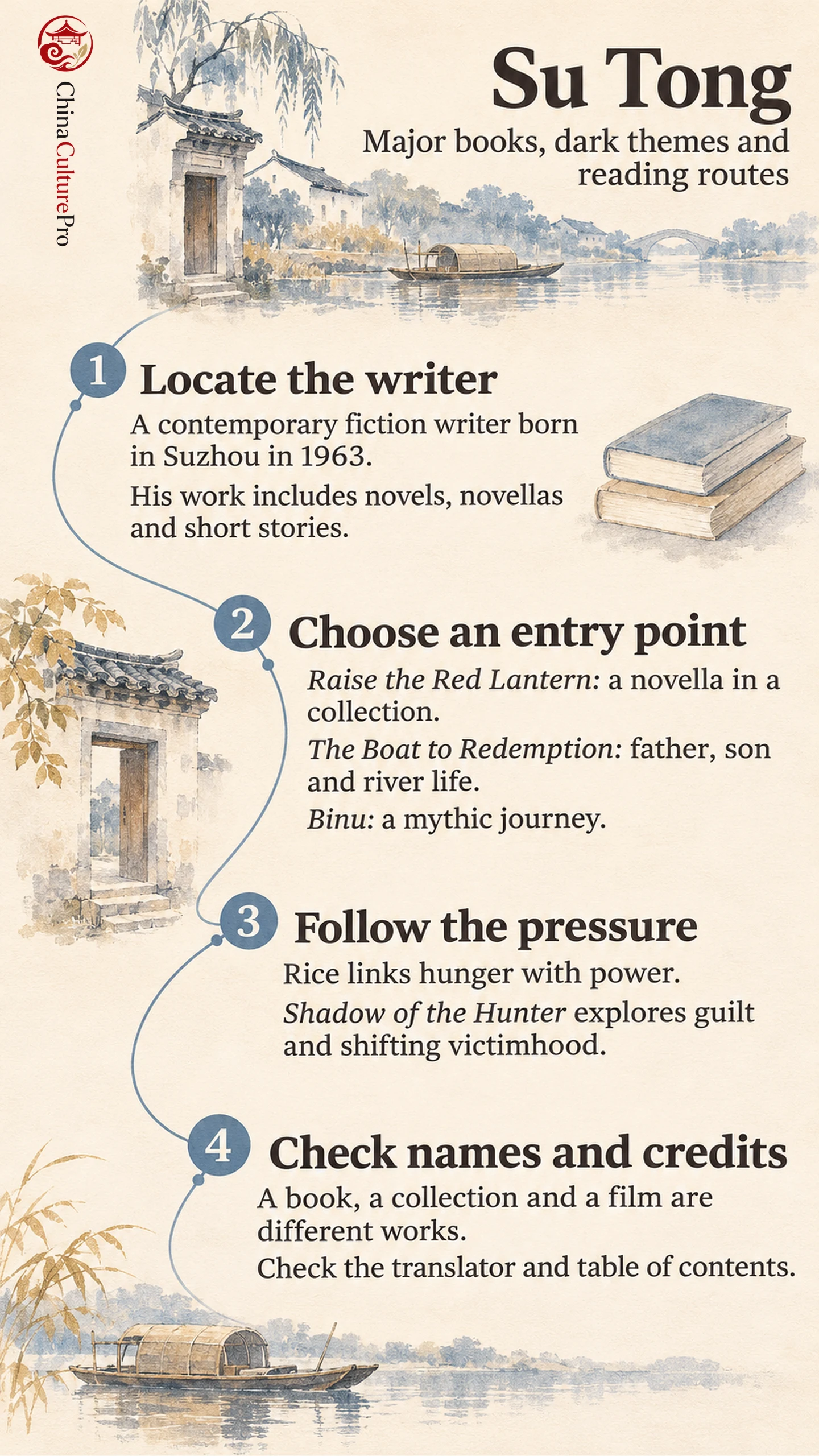
Raise the Red Lantern offers one route into Su Tong’s writing. His translated fiction also moves through a grain-shop family, a riverboat community, a troubled urban street and a world shaped by myth.
Place Su Tong in Contemporary Chinese Fiction
Born in Suzhou in 1963, the writer uses Su Tong as the pen name of Tong Zhonggui (童忠贵, Tóng Zhōng Guì). [1]
His place in modern and contemporary Chinese literature includes an association with the avant-garde. That context helps explain why a familiar household or town need not produce a reassuringly conventional story. [2]
Two awards identify different parts of his career: The Boat to Redemption won the 2009 Man Asian Literary Prize, while the work commonly called Yellow Bird or Yellowbird Story won a Mao Dun Literature Prize in 2015. [1]
Use those distinctions as orientation rather than a reading order. A prize tells you about a book’s reception; it does not tell you whether you want a compact household tragedy, an extended river narrative or a myth retelling today.
Within the broader Chinese-literature tradition, approach Su Tong first as a storyteller. Keep the individual narrator, setting and pressure on the characters in view before trying to make a whole society fit one plot.
Choose among Five English-Language Entry Points
These five works offer different scales and settings. The English publication name is especially important when a literal translation of the Chinese title would suggest another book.
| English reading title | Original title or form | Translator | A useful reason to choose it |
|---|---|---|---|
| Raise the Red Lantern | Wives and Concubines, a novella within a three-novella English collection | Michael S. Duke | A concentrated story of a young woman entering a wealthy household. [3] |
| Rice (米, Mǐ) | A novel | Howard Goldblatt | An outsider’s arrival links material hunger with desire, family power and brutality. [4] |
| The Boat to Redemption | A novel | Howard Goldblatt | A father and teenage son move into a barge community after the father loses political standing. [5] |
| Shadow of the Hunter (黄雀记, Huáng Què Jì) | A novel also discussed under Yellowbird Story | James Trapp | Three entangled lives raise questions of violence, guilt and shifting victimhood. [6] |
| Binu and the Great Wall | A myth retelling | Howard Goldblatt | A woman searches for her husband after he is taken to labor on the Great Wall. [7] |
For a first encounter, the novella gives you a bounded setting and a smaller cast. Choose the river novel when you want a longer relationship between an adolescent’s perspective, his father and a surrounding community. Those are different reading experiences, not successive levels of difficulty.
If you prefer a legendary frame, take the mythic route instead. Su Tong’s version belongs beside the Meng Jiangnü tradition, while remaining a particular modern author’s imaginative treatment.
Read Hunger, Family Power and Unstable Status
In Rice, the newcomer Five Dragons enters a city family after experiencing hunger. Food becomes connected with possession, sexuality and violence. Read the recurring material object as part of relationships: who lacks it, who controls it and what someone is prepared to do to obtain power. [4]
The novella in Raise the Red Lantern offers a different enclosed world. A young woman enters a wealthy man’s household and faces loneliness and cruelty. A useful question is how dependence limits a person’s choices even when several people appear to compete for influence. [3]
The Boat to Redemption shifts attention toward inherited standing. Secretary Ku’s claimed revolutionary ancestry is discredited, and he takes his son Dongliang into life on the water. Follow how a public label affects intimate relationships, rather than reading the river only as attractive scenery. [5]
In Shadow of the Hunter, violence ties three lives together over time. The uncertainty about who is hunter and who is hunted makes responsibility a productive reading question. Keep track of what each person does, rather than treating the title as a simple division between good and bad characters. [6]
Binu makes social rules strange through fantasy. In the published opening, communities restrict crying and explain children’s origins through unequal stories about boys and girls. Ask how an apparently fantastic custom makes obedience and unequal value visible. This is interpretation of a fictional world, not evidence that the described rules were historical practice. [7]
These stories include coercion and violence; Rice is particularly harsh. Choose by subject matter as well as length; the shorter work also depicts coercion and cruelty.
Keep Fiction, Film and Translation Distinct
Raise the Red Lantern can refer to a film, an English collection and the novella associated with that film. The collection contains three novellas; reading its title alone does not establish that the entire volume was adapted. [3]
The connection with Chinese cinema is important, but it should not replace the text. Su Tong said that he did not write the screenplay for Zhang Yimou’s adaptation. An author and one of the directors adapting Chinese fiction therefore perform different creative jobs. [8]
Translation also involves concrete decisions. In his interview, Su Tong described drawing a flat-bottomed southern boat and faxing it to Howard Goldblatt while the river novel was being translated. An object that seems straightforward to one reader can require careful clarification in another language. [8]
Check the translator’s credit and the table of contents when comparing editions. Distinguish a Chinese work’s title from an English publishing title, and a reissue’s date from the original work’s date. You can then compare interpretations without accidentally comparing different books.
FAQs About Su Tong
Which Su Tong book is a useful first read?
The novella associated with Raise the Red Lantern is a compact starting point. Choose The Boat to Redemption if you prefer a longer father-and-son narrative.
Is Raise the Red Lantern a novel or a film?
It is a film title and an English publishing title associated with a novella. Raise the Red Lantern: Three Novellas is a collection, not one full-length novel.
Is Shadow of the Hunter the same work as Yellowbird Story?
Yes. These English names refer to the Chinese novel Huangque Ji, published in James Trapp’s translation as Shadow of the Hunter.
Who translates Su Tong into English?
Translators include Michael S. Duke, Howard Goldblatt and James Trapp. Check the individual book: the same translator did not translate every work.
Sources
[1] Sinoist Books. Su Tong
[2] Nanjing Literature Center. Su Tong
[3] OCLC WorldCat. Raise the Red Lantern: Three Novellas
[4] William Morrow, via Google Books. Rice
[5] Penguin Books. The Boat to Redemption
[6] Sinoist Books. Shadow of the Hunter
[7] Grove Atlantic. Binu and the Great Wall: The Myth of Meng
[8] Peony Literary Agency. Su Tong: Interview “I am first and foremost a novelist”