


Quick Answer: What Are Chinese Begonia Cakes?
Chinese begonia cakes, or haitang gao (海棠糕, hǎitánggāo), are small, filled cakes cooked from batter in special molds. Familiar sweet versions have a flour-based exterior, red bean paste inside and a browned sugar surface. They belong to the Chinese snack and dessert repertoire of the lower Yangtze region.[1][2]
- Form: A molded cake with a compact filling.
- Texture: A crisp outer surface around a softer interior.
- Name: A flower-inspired appearance, rather than a required flower ingredient.
Recipes and molds differ, so the name does not guarantee one flour mixture or set of toppings.[1][5]
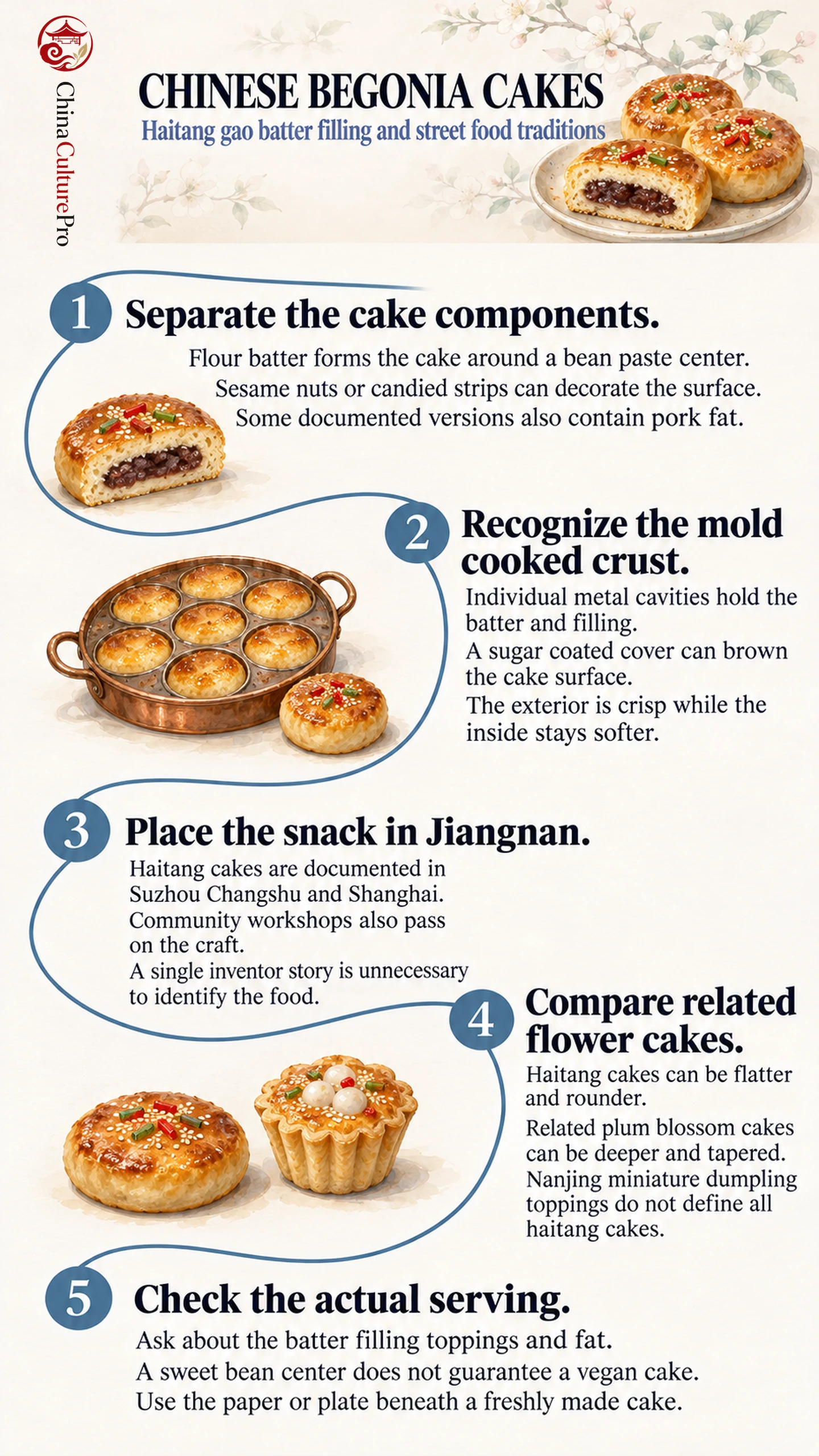
A browned top, soft cake and sweet bean center give haitang gao several textures in one bite. The name can obscure what matters on a menu: the batter, the filling and the toppings each do a different job.
Flour Batter, Bean Paste and Surface Toppings
Wheat flour appears in documented haitang gao batters. In one Changshu preparation, it is mixed with water and a sweet starter. This makes a pourable batter, distinct from a dough wrapper folded around a filling. Gao therefore does not identify a single grain.[1][2]
The red bean paste forms a separate center. Sesame, nuts, candied kumquat slices and red-and-green candied strips are among recorded surface additions. That Changshu version also includes sugared pork fat.[2]
How the Mold Creates a Crisp Exterior
A heated metal pan holds the batter in individual cavities while the exterior sets around the filling. In a documented copper-pan method, the cakes are inverted against a sugar-coated metal cover. Heating browns the surface sugar, adding a crisp, sweet top to the softer cake underneath.[2]
The mold controls the outline and depth. Contact with the hot mold develops a crisp exterior around a softer interior.[1][3]
Jiangnan Street Snacks and Living Craft
Haitang gao are documented in Jiangsu food traditions, including Changshu and Suzhou, and in Shanghai snack culture. The shared Jiangnan setting is more useful for recognizing the snack than an unverified inventor story.[1][2]
The craft is also taught beyond the stall. A Suzhou community workshop brought a pastry maker together with children and parents to demonstrate the molds and preparation. The workshop passed on practical skills through a familiar local snack.[3]
Begonia Cakes and Plum Blossom Cakes
Plum blossom cakes, or meihua gao (梅花糕, méihuāgāo), are close relatives. A firsthand comparison describes flatter, rounder Suzhou haitang cakes and deeper, tapered plum blossom cakes. Both use batter, bean paste and decorated tops; the outlines reflect different molds.[5]
Nanjing plum blossom cakes are also documented with miniature glutinous rice dumplings, raisins and other additions piled on top. Those toppings do not define every haitang cake. Local names overlap; check the menu name alongside the shape.[4]
How to Choose and Eat Haitang Gao
Ask about the filling, batter and toppings separately. For vegetarian or vegan ordering, confirm the fat used as well as any animal ingredients in the paste.[2]
These cakes are commonly eaten freshly made. Keep the paper or small plate beneath the cake as you bite into its crisp shell and soft filling. A freshly cooked center may be much hotter than the surface suggests.[5]
FAQs About Chinese Begonia Cakes
Do begonia cakes contain begonia flowers?
Not as a defining ingredient. The name refers to the flower-like appearance.
Are haitang gao made only from rice flour?
No. Wheat-flour batter is well documented. Check the actual recipe.
Are begonia cakes the same as plum blossom cakes?
They are closely related, but names, molds and toppings can differ locally.
Are red bean begonia cakes automatically vegan?
No. A documented sweet version includes pork fat; check the full preparation.
Sources
[1] Jack Zhou and Sophie Wang, original filmed chef profile, SHINE via Shanghai Government. Shanghai Eats: Sweet and Fragrant Haitang Cake
[2] Wang Zhenhao, Changshu local gazetteer, China Local Conditions. Haitang Cake: Xiangqiao Song Family Tradition
[3] Wang Ke and Sheng Yiping, original community workshop reporting, Gusu Evening News. Traditional Suzhou Snacks and Haitang Cake Return to Guanqian
[4] Ma Xueren and Liu Zhenggang, Nanjing local gazetteer research. Nanjing Snacks: Cakes and Pastries
[5] Yu Bin, original first-person food essay, Xinmin Evening News. Plum Blossom Cake