
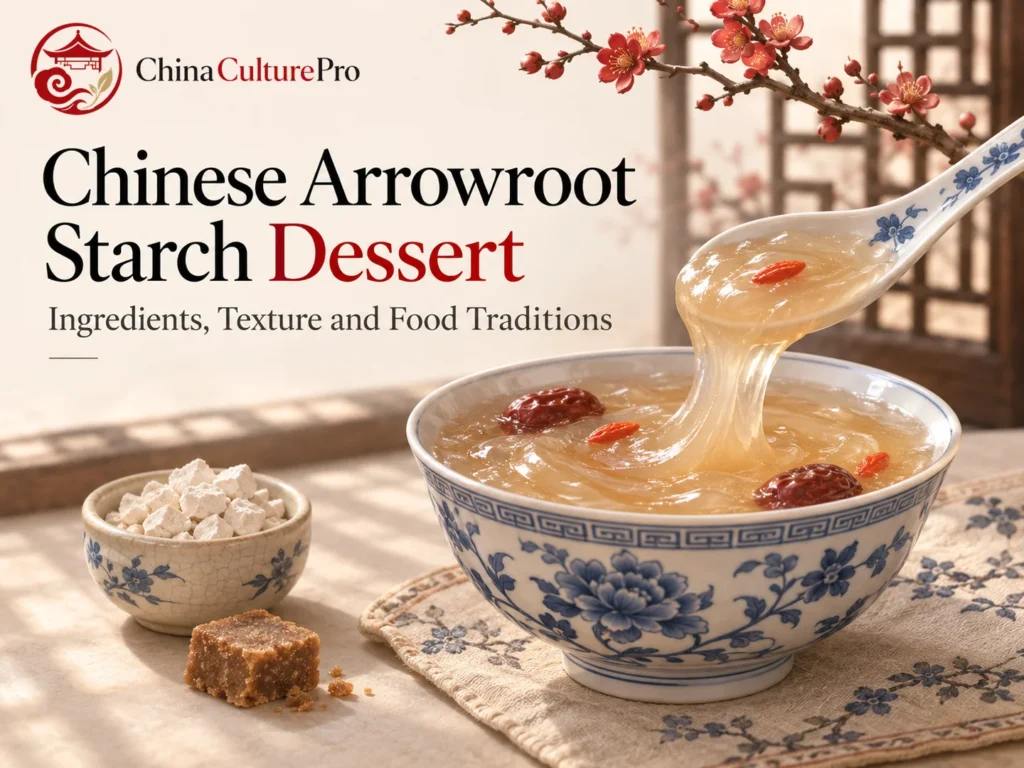

Quick Answer: What Is Chinese Arrowroot Starch Dessert?
Chinese arrowroot starch dessert can refer to sweet preparations of ge fen (葛粉, géfěn), also called ge gen fen (葛根粉, gégēnfěn): starch extracted from kudzu roots. It becomes a smooth, thickened base when prepared with water and heat, then takes its sweetness from added ingredients.[4][5]
- Base: Kudzu starch supplies body, not a filling of chopped root.
- Texture: A soft, spoonable paste or a firmer set preparation.
- Flavor: Sugar, honey, fruit or other additions shape the finished dessert.
“Arrowroot” is an ambiguous English plant name. Check the actual ingredient before treating two powders as the same food.[1][2]

A pale starch powder can become a glossy dessert with no visible grain. Chinese kudzu sweets make that transformation the main attraction. Understanding the plant name, thickening process and additions helps explain these dishes within the broader world of Chinese desserts.
Arrowroot, Kudzu and the Meaning of Ge Fen
Kudzu belongs to the Pueraria group, while the English name arrowroot is also used for Maranta arundinacea and other plants. Check for kudzu or Pueraria on the ingredient label; “arrowroot” alone does not settle the identity.[1][2]
In a documented Chinese production method, roots are processed with water, the starch settles, and the resulting material is dried. It may remain in pale granules rather than being ground into a fine powder. The dry granules still need preparation.[4]
Why the Starch Becomes a Smooth Dessert
Heat and water change the starch’s structure through gelatinization, producing the body associated with a thickened dessert. Unlike dissolved sugar, swollen starch gives the liquid body.[3]
Native starch and pre-gelatinized products behave differently. Industrial pre-processing can improve cold-water swelling, so an instant mix should not be assumed to behave like untreated starch. Follow the specific package’s preparation directions instead of borrowing instructions from a different powder.[3]
A slightly brownish powder can produce a semi-transparent paste. Color and clarity alone do not establish the starch’s plant source or purity.[4]
Sweeteners, Fruit and Contrasting Textures
Plain kudzu paste can be sweetened with white sugar, brown sugar or honey. Optional additions include red dates, goji berries, raisins or fruit pieces.[4]
A contemporary Hong Kong sweet-soup preparation combines kudzu starch with chopped water chestnuts, red dates, goji berries and slab sugar. Here, the starch supplies a smooth background while the water chestnut pieces provide crunch. The water chestnut ingredient and the thickening starch perform separate jobs.[5]
Spoonable Desserts and Set Starch Sheets
The sweet-soup example can be served warm or chilled. It belongs alongside Chinese sweet soups, rather than requiring the consistency of a sliceable jelly. Its soft consistency suits eating with a spoon.[5]
Kudzu starch also appears as steamed sheets that are cooled and cut into pieces. A producer documents sweet, salty and spicy ways of dressing those sheets. Sweetness comes from the dressing rather than the starch.[6]
How to Read a Starch Dessert Label
Look first for the named starch, then distinguish a plain ingredient from a sweetened mix. Check whether sugar or toppings are included, whether the product is instant, and whether the menu describes a spoonable soup or pieces of set starch.
For vegetarian or vegan requirements, check the complete dish, including honey or dairy additions. A plant-derived base does not identify every topping. Lotus root starch dessert is a useful comparison in form, but uses a different named plant ingredient.
FAQs About Chinese Arrowroot Starch Dessert
Is Chinese ge fen the same as supermarket arrowroot powder?
Not necessarily. English arrowroot can name different plants; check whether the packet actually contains kudzu starch.
Is ge fen dessert the same as lotus root starch dessert?
No. Similar-looking starch desserts can use different botanical ingredients.
Can kudzu starch desserts be eaten chilled?
Yes. Documented sweet-soup preparations allow both warm and chilled serving.
Does plain kudzu starch make every dessert vegan?
No. Sweeteners and toppings still need checking, including honey or dairy.
Sources
[1] Royal Botanic Gardens, Kew, Plants of the World Online. Pueraria montana var. lobata
[2] Royal Botanic Gardens, Kew, Medicinal Plant Names Services. Non-Scientific Name: Arrowroot
[3] Xin Guo and colleagues, original research. Effects of Pre-Gelatinization Methods on Structure and Physicochemical Properties of Kudzu Starch
[4] Greenman Food, original cooperative product record. Wild Kudzu Root Powder: Cooperative Production
[5] Ada Lam, Yuen Tung Sugar, original recipe. Red Date Water Chestnut Soup Recipe
[6] Eryuefeng Foods, original producer preparation. Kudzu Starch Sheets