


Quick Answer: What Is Mi San Dao?
Mi san dao (蜜三刀, mìsāndāo), sometimes translated as Chinese honey cakes, are small fried wheat pastries finished with syrup. Their familiar form is a sesame-speckled rectangle with three shallow cuts across the top. They are syrup pastries, not baked honey sponge cakes.[2][3]
- Base: Wheat dough, often arranged as a thin lower layer and a thicker upper layer.
- Finish: Sweet syrup coats the outside and enters the fried pastry.
- Bite: A delicate fried surface with a softer, syrup-rich interior.
“Honey” is not a complete ingredient declaration: some recipes use maltose syrup without bee honey, while others include honey.[1][4]
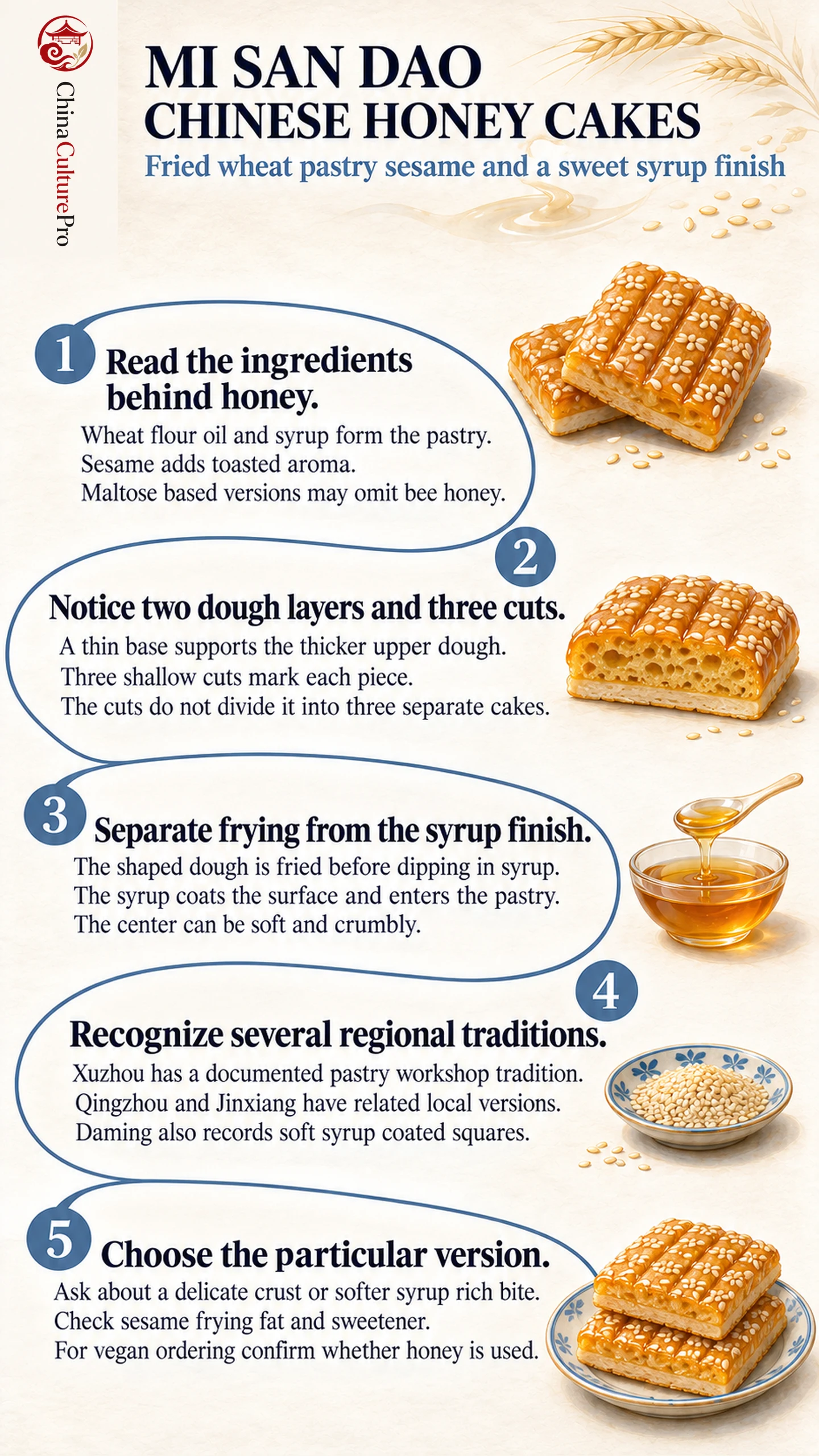
A glossy sesame-covered square may look solid until the first bite reveals its sweet, syrup-rich interior. Mi san dao depends on the relationship between fried dough and syrup. The cuts, thin base and regional variations explain more than its honey-cake translation.
Wheat Dough, Sesame and the Meaning of Honey
Wheat flour forms the pastry body. Oil and syrup are mixed into the dough in documented preparations, while sesame supplies toasted aroma and small seeds against the softer interior. Sesame may be worked into the lower dough as well as sprinkled on top.[4][5]
The sweet finish commonly includes maltose and sugar. One home preparation makes its syrup from maltose, white sugar and water; a Jinxiang version lists honey among its ingredients. See Chinese maltose for the related sweetener.[1][4]
Two Dough Layers and Three Surface Cuts
In a documented two-dough construction, the thin base is a flour, water and oil dough. The upper portion also contains maltose syrup. The sheets are joined, portioned and scored, leaving a lower layer beneath the cuts rather than dividing each cake into separate pieces.[2][4]
A Jinxiang description compares the resulting top to four small lobes. The underside remains a relatively thin sheet beneath the scored top.[1][3]
Frying, Syrup and the Finished Texture
Frying cooks and expands the shaped dough before it meets the finishing syrup. The golden pieces are then dipped or soaked so sweetness is carried into the pastry as well as coating it. A workshop account from Lingbi, Anhui, documents this same fry-then-syrup sequence.[3][5]
The finished result can combine a delicate exterior with a soft, crumbly center. Some descriptions emphasize a glossy, well-syruped surface; others emphasize a tender bite after cooling.[1][2][3]
Regional Pastry Traditions in Jiangsu and Beyond
These pastries belong to several local traditions, including Xuzhou in Jiangsu and Qingzhou and Jinxiang in Shandong.[1][2][6]
| Place | Documented connection |
|---|---|
| Xuzhou, Jiangsu | Mi san dao appear among the local traditional pastry assortment made by a recognized heritage workshop. |
| Qingzhou, Shandong | A craftsperson describes the two doughs and syrup finish; pastries are bought during festivals. |
| Jinxiang, Shandong | Hongsandao (红三刀, hóngsāndāo) include sesame oil, honey and osmanthus. |
| Daming, Hebei | A local food video documents fried, syrup-coated squares with a soft, crumbly cooled texture. |
These regional pastries belong to the wider family of Chinese traditional sweets.[1][3]
How to Choose and Eat Mi San Dao
Enjoy a small piece as a sweet snack, checking whether the version is delicately crisp, softer or especially syrup-rich. Sesame, the frying fat and the sweetener are useful details to ask about. For vegetarian or vegan ordering, confirm the fat and whether bee honey is used.[1][4]
FAQs About Chinese Honey Cakes
Does mi san dao always contain honey?
No. Some recipes list maltose and sugar without honey; others include bee honey.
Are mi san dao baked?
The documented preparations here fry the dough, then finish it in syrup.
Why are they called three-cut cakes?
Three shallow cuts are made in each pastry; the cake is not divided into three separate portions.
Are mi san dao always crunchy?
No. A fried surface can surround a soft or crumbly, syrup-rich interior.
Sources
[1] Jinxiang County Government via Jining Municipal Government. 蜜制红三刀: Jinxiang Honeyed Three-Cut Pastries
[2] Tian Ruye and Zhang Xikun, original Qilu Evening News craftsperson interview. Qingzhou Mi San Dao: Interview and Workshop Photographs
[3] Daming County Local Gazetteer Compilation Research Center, original video via The Paper. 特色美食蜜三刀: Daming, Hebei
[4] Jun Zhi, original recipe and process photographs, Xiachufang. 蜜三刀: Original Two-Dough Home Preparation
[5] Suzhou Municipal Government, Lingbi pastry workshop reporting. 灵璧游集糕点: Workshop Process Account
[6] Xuzhou Municipal Government Office via Jiangsu Provincial Government. First Provincial Intangible Heritage Workshops: Xuzhou