

Quick Answer: What Is Tang Er Duo?
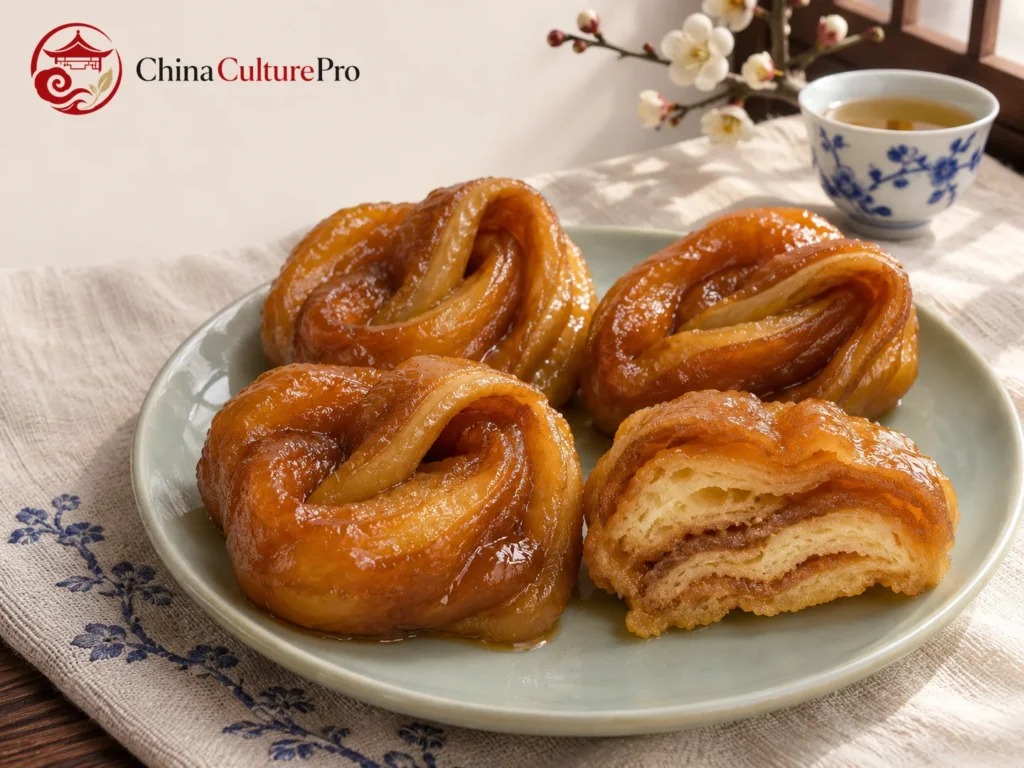
Tang Er Duo(糖耳朵,táng ěrduo)is a Beijing sweet made from shaped dough, fried and then soaked in syrup. Its name means “sugar ears,” referring to the finished outline rather than an animal ingredient.[1][2]
- Dough: Leavened dough and a separate sweet dough form layers.
- Shape: Cutting and folding create the ear-like outline.
- Finish: Syrup is added after frying.
- Texture: The finished sweet is glossy, moist and yielding.
It is also called mi mahua(蜜麻花,mì máhuā). The name does not make it identical to every twisted fried-dough snack.
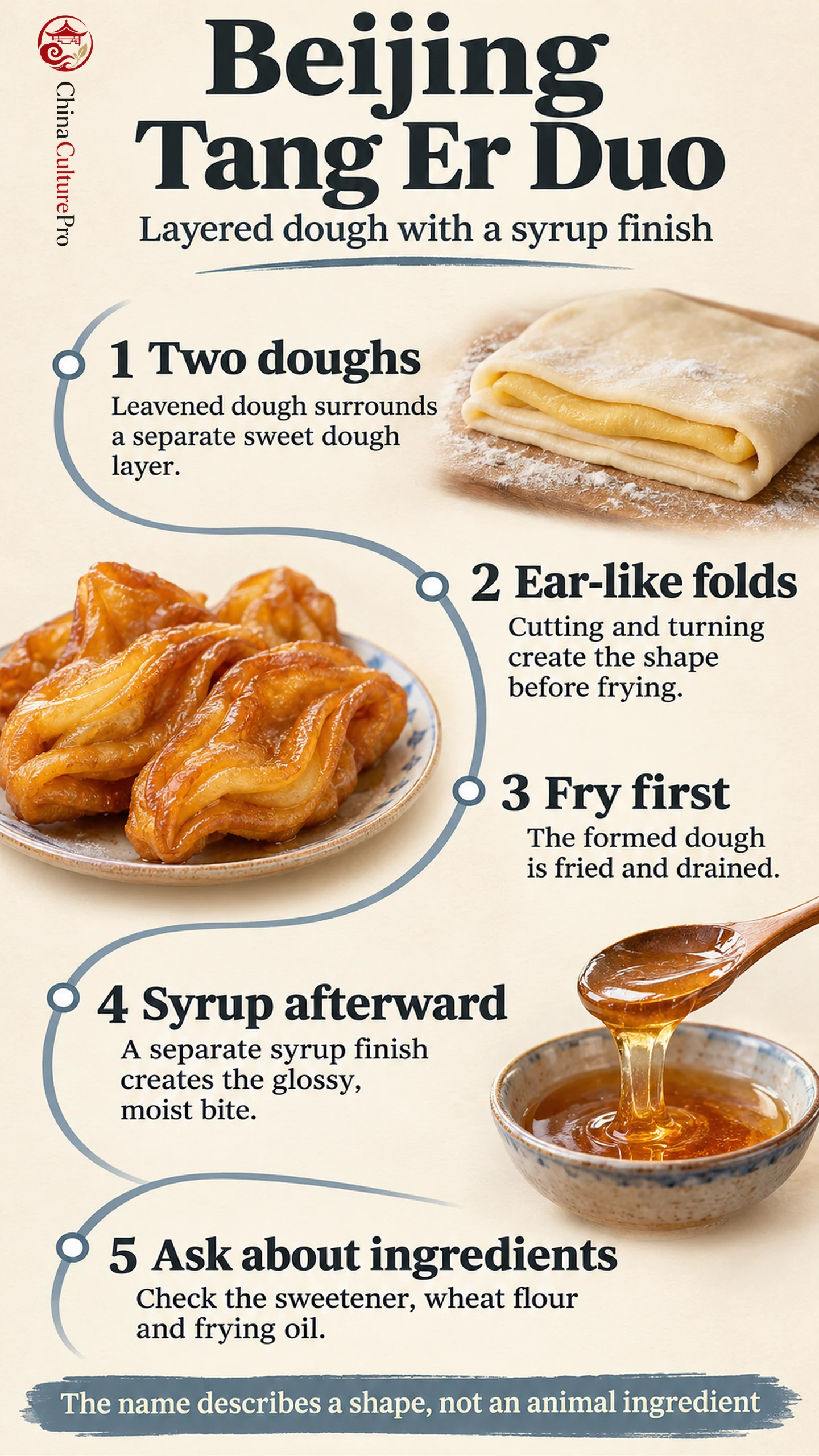
The folds explain the shape; the syrup explains why a fried sweet can still feel soft rather than dry and brittle.
Layered Dough and a Separate Syrup Finish
The layered structure begins before the piece enters the oil. A documented method places a sweet dough sheet between two sheets of leavened dough. The darker sweet layer becomes visible within the folded piece.[3]
The sweet dough itself can differ. One local method describes brown sugar worked into dough, while a home recipe uses maltose with flour. Those choices should not be mistaken for the syrup added later.[1][3]
The finishing syrup is another component. Published versions use maltose syrup after frying, and one ingredient list also includes honey. “Honey twist” is therefore an imperfect shortcut if you need to know whether bee honey is actually present.[1][4]
How the Ear Shape Is Formed and Finished
A home preparation shows the broad shaping and finishing sequence:[4]
- Prepare the leavened dough and sweet dough separately.
- Roll them into sheets and sandwich the sweet layer between the other sheets.
- Cut portions and make a slit in each folded piece.
- Turn part of the dough through the opening to form the ear-like folds.
- Fry the shaped pieces, drain and immerse them in the finishing syrup.
- Remove and let the finished sweets cool.
The shape is made from dough before frying. Syrup does not glue together separate baked biscuits to create an ear, nor is the coating simply dry sugar dusted onto a finished twist.[3][4]
Texture and Similar Sweet Snacks
| Component or comparison | What distinguishes it | Texture clue |
|---|---|---|
| Tang er duo dough | Layered and folded into an ear-like form | A formed, substantial bite |
| Syrup finish | Applied after frying | A glossy, moist surface |
| Dry-sugar fried snacks | Coated with a dry sugar mixture instead | A different sweet exterior |
A local food report emphasizes a soft, moist texture for tang er duo. The fact that it is fried does not mean the intended finish is the same snap as a dry wafer or peanut brittle.[2]
The same report compares it with other sweets that are rolled in a mixture of cooked flour and sugar instead of being syrup-soaked. That finishing difference is more useful than grouping everything together simply because it is sweet and fried.[2]
Beijing Snack Culture and Spring Customs
Tang er duo appears in the city’s familiar repertoire of street snacks and old-style snack-shop foods.[2]
Spring outings are one documented setting. A Beijing reporter’s shop visit before the Hanshi, or Cold Food, observance records customers buying tang er duo and other seasonal snacks to take on outings. This describes a local practice, not a rule that everyone must eat it on one day.[5]
Choosing and Eating Tang Er Duo
Ask about the syrup and frying oil if those ingredients matter. A local recipe lists peanut oil, while another uses a different vegetable oil. Neither the shape nor the syrupy surface identifies the oil used.[1][4]
Wheat flour is part of the dough in the documented methods. If avoiding honey or animal ingredients, check the actual sweetener and complete recipe rather than relying on an English translation of the name.[1][3]
For contrasting Beijing sweets, ai wo wo has a cooked-rice shell, while tang huo shao is a different, baked sweet. A snack selection can therefore offer several structures, not just several names for the same dough.
FAQs About Tang Er Duo
Does Tang Er Duo Contain Animal Ears?
No. The name refers to the shape of the dough sweet, not an animal body part.[1]
Does the Syrup Always Contain Honey?
Not necessarily. Maltose syrup appears in published methods, while some ingredient lists also include honey. Ask the maker.[1][4]
Is Tang Er Duo Supposed to Be Dry and Crisp?
The familiar syrup-finished version is described as moist and soft. It is not the same finish as a dry sugar-coated twist.[2]
Sources
[1] Beijing Tourism. Tang Er Duo
[2] Guo Tie / The Beijing News. Tang Er Duo: Ear-Shaped Syrup Sweets
[3] Kiss Zhannu. Tang Er Duo: A Home Preparation
[4] Yang Xiaoshao. Beijing Tang Er Duo: Shaping and Syrup Finishing
[5] Li Jia / Beijing Youth Daily. Spring Outings and Beijing’s Cold Food Snacks