
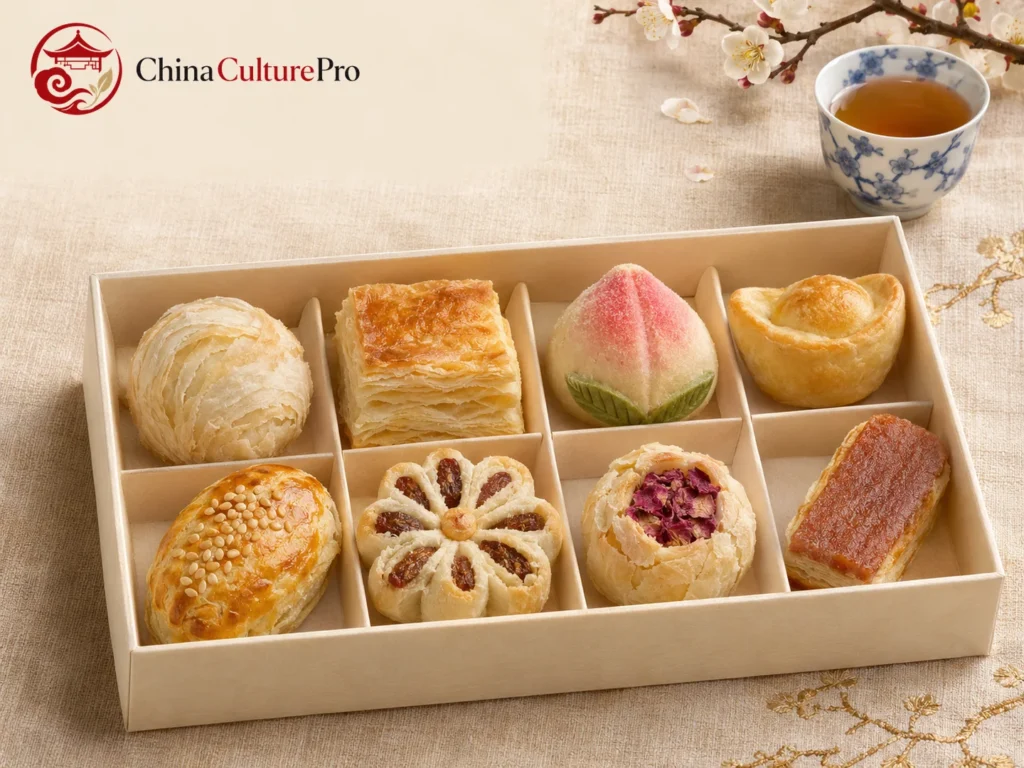

Quick Answer: What Are Beijing Jing Ba Jian Pastries?
Jing Ba Jian(京八件,jīngbājiàn)is a Beijing pastry assortment organized around eight kinds with different shapes and flavors. It names a collection, not one single cake or filling.[1]
- Variety: The selection brings several pastry forms together.
- Crust: Flaky and other pastry styles can appear.
- Filling: Sweet, floral, fruit, seed and savory flavors vary by set.
- Custom: The boxed assortment is associated with visits and gifts.
Eight kinds do not guarantee that every retail box contains exactly eight individual pieces or the same eight recipes.
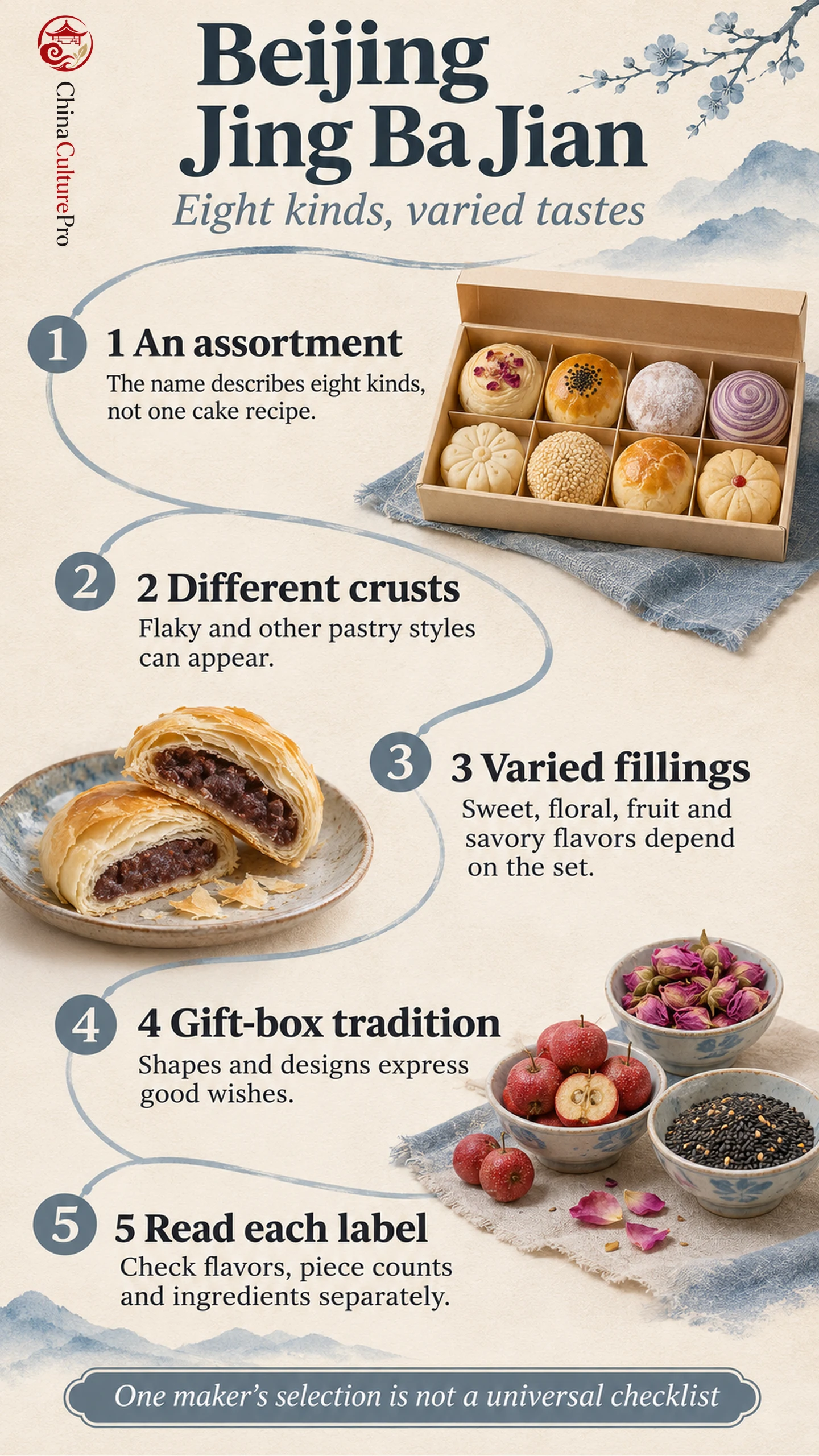
Reading the selection key is more useful than recognizing the box: similar-looking pastries can have different crusts and centers.
An Assortment, Not One Fixed Pastry
The organizing idea is variety. A local account describes different shapes and tastes arranged in a pastry box, while also noting that the contents have changed over time and can vary between shops.[1]
A manufacturer’s own example includes lotus paste, hawthorn, rose and a savory sesame pastry alongside pieces named for auspicious characters. That is evidence for one real assortment, not a universal checklist that every maker must reproduce.[2]
The number of kinds and the number of pieces are separate questions. A box can repeat a kind; a product’s packing list is the reliable place to check the actual count. Nor does the assortment name reveal the weight or size of each pastry.
Crusts, Fillings and Auspicious Shapes
| Feature | Examples in documented sets | What to ask |
|---|---|---|
| Crust family | Flaky pastry and other dough styles | Which pieces have a layered or firmer shell? |
| Filling flavor | Lotus, hawthorn, rose or savory sesame | Which center belongs to each shape? |
| Symbolic form | Peach, ingot and auspicious-character designs | Is there a printed selection key? |
Local descriptions distinguish larger flaky assortments, smaller milk-crust pieces and a more elaborate wine-crust family. Such names describe particular pastry groupings; size alone does not tell you the ingredients of an unlabelled piece.[1]
Fillings can contrast sharply. Hawthorn contributes a tart-sweet fruit flavor, rose brings floral aroma, lotus paste provides a smooth center and savory sesame changes the sweet-salty balance. Compare Beijing rose pastries for the floral branch rather than treating every piece as rose-filled.[2]
How Flaky Pieces Are Made
A reported view of a Beijing pastry workshop records the broad sequence behind layered pieces:[5]
- Prepare the dough components.
- Enclose the shortening dough to create the layered pastry structure.
- Prepare the chosen filling separately.
- Enclose the filling and shape the individual pieces.
- Bake the formed pastries.
This describes one pastry family, not a recipe for the entire box. A local craft record also describes shortcrust-style and fried techniques within Beijing’s wider pastry repertoire. Different pieces can reach the same gift box through different processes.[3]
Gift Boxes and the Continuation of Craft
A Beijing account describes buying boxed pastries when visiting relatives and friends during holidays. Shapes and auspicious designs make the gift visually varied, while the selection of fillings gives recipients different tastes to share.[4]
Contemporary reporting also records efforts to restore older assortments and continue hand skills through teaching. A specific maker’s craft has received local heritage recognition. That recognition concerns a documented tradition of making, not an automatic status attached to every box with the same name.[4][5]
This fits a broader theme in Chinese food culture: a shared food can carry social meaning through presentation and giving as well as flavor. The assortment does not need a single unverified court-origin story to explain its place as a gift.
Choosing and Sharing a Box
Check the selection key before dividing the pastries. Confirm which pieces are sweet or savory, whether floral flavors are present and how many of each kind the box contains. Names can refer to shapes or wishes as well as fillings; the Chinese food names guide helps explain that distinction.[2]
For ingredient restrictions, check each kind separately. A local record lists flour, oil, fruit, beans and nuts across the repertoire; the assortment name cannot substitute for individual labels. A milk-crust or wine-crust description also deserves a direct ingredient question.[1][3]
These pastries differ from soft cooked-rice sweets such as ai wo wo. Choose by the actual crust and center rather than assuming every Beijing sweet has the same texture.
FAQs About Jing Ba Jian
Does Jing Ba Jian Mean Exactly Eight Pieces?
It refers to an assortment of eight kinds. Check the actual packing list for individual piece counts.
Are All Eight Pastries Sweet?
Not necessarily. Documented selections include savory sesame as well as sweet and floral options.[2]
Does Every Box Have the Same Fillings?
No. Local accounts describe changing selections, and individual manufacturers publish their own contents.[1][2]
Sources
[1] Beijing Tourism. Jing Ba Jian and Beijing’s Pastry Gift Boxes
[2] Daoxiangcun Group. Jing Ba Jian Product Selection
[3] Beijing Tourism. Dongcheng Food and Pastry Craft
[4] Beijing Daily. New Year Pastry Gifts and Handcraft
[5] Pan Junqiang / People’s Daily. Traditional Pastry Skills and Contemporary Food Culture