

Quick Answer: What Are Chinese Red Bean Desserts?
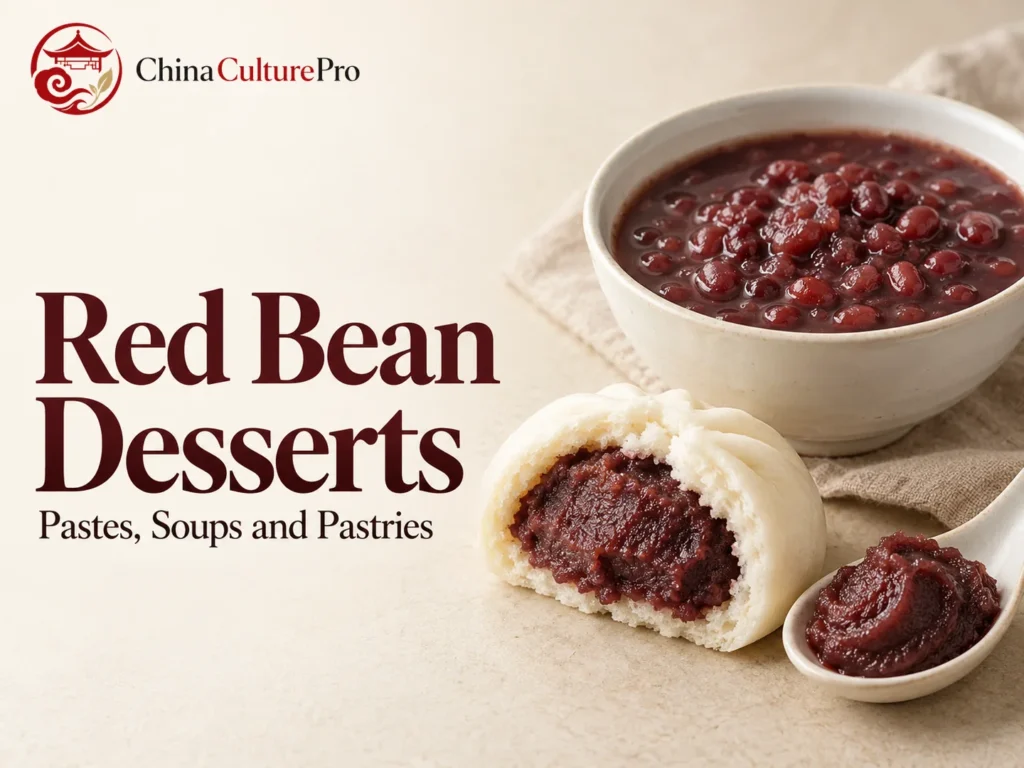
Chinese red bean desserts use sweetened red beans in several forms, especially adzuki beans cooked into pastes, soups or toppings. Hongdousha(红豆沙,hóngdòushā)can describe red bean paste, while on some Cantonese dessert menus it refers to a sweet soup.
- Paste: a smooth or textured filling for buns, rice sweets and pastries.
- Soup: soft beans and sweet liquid, sometimes partly broken down into a thick bowl.
- Topping: cooked sweet beans added to another dessert rather than enclosed inside it.
The bean is a shared ingredient, not a guarantee of one texture, sweetness level or dietary formulation. [1]

A spoonful of smooth red bean filling, a warm bowl of bean soup and a pastry with a dark center can taste recognizably related while eating very differently. Within traditional Chinese desserts, it helps to identify the bean preparation first, then the wrapper, liquid or topping around it.
Red Beans, Sweetness and the Meaning of Dou Sha
Adzuki beans are a familiar base for sweet red bean preparations. They are smaller than the large red kidney beans many English-speaking shoppers know from savory dishes. On a package labeled “red beans,” check the bean variety and any existing seasoning. Canned beans in a savory sauce are not the same ingredient as a prepared sweet pastry filling.
Sugar is normally added to create the dessert flavor. The cooked bean itself contributes an earthy, gently nutty character; the finished sweetness depends on the formulation. Red bean is therefore not a synonym for “sugar-free,” and its naturally reddish color does not tell you how much sweetener a product contains.
Dousha(豆沙,dòushā)means bean paste more broadly. It does not necessarily identify red beans without additional context. Red bean pastes are also used elsewhere in East Asia, with Japanese anko being a familiar example. Shared beans and similar appearances do not make every country’s or baker’s formulation identical. [1]
Smooth Paste, Coarse Paste and Pastry Fillings
Smoothness and moisture are two separate choices. A paste can be finely processed yet quite soft, or retain pieces of bean while being firm enough to portion. Smooth preparations may involve sieving out skins; coarser ones retain more bean texture. Neither is inherently more authentic or better for every sweet. [1]
A homestyle paste for buns or rice cakes can be made by cooking softened beans with sugar and reducing the liquid. The beans are mashed as the mixture thickens. By contrast, a filling intended for a particular mooncake may need a smoother, more oil-rich texture that holds its shape differently. A soft spoonable paste is not automatically interchangeable with that baking filling. [2]
Think about the task the paste performs. Inside a small bun, it should remain contained while the bread provides a soft surround. In a molded pastry, moisture and consistency affect shaping. As a topping, a looser mixture can be useful because it is not required to support a wrapper.
For purchased paste, read both the ingredients and its intended use. A smooth paste may still be too moist or too firm for a particular mooncake, fried sweet or steamed bun. Follow the specific pastry recipe when cooking rather than choosing only by color or the word “premium.”
Red Bean Soup and Cold Dessert Toppings
Cantonese red bean soup belongs to the broader tong sui sweet-soup tradition. Its liquid is part of the dessert, unlike a concentrated filling enclosed in pastry. The beans may remain partly intact or break down into a thick, softly grainy bowl. Hong Kong dessert shops also offer additions such as glutinous rice balls or ice cream. [3]
Dried tangerine peel, chenpi(陈皮,chénpí), is a familiar aromatic in one traditional preparation. Its citrus character adds a different dimension to the sweet beans. Thickness and seasoning vary; the presence of peel does not define every red bean soup. A plain bean-and-sugar preparation and a bowl with citrus aroma can both belong to this family. [4]
Cold uses provide another setting. Red bean ice appears among the familiar drinks of Hong Kong cafe culture. [5] Sweet beans can also be spooned over shaved ice or other desserts. [2] Here, the beans are a visible topping or component rather than a hidden filling.
When ordering, separate the bean preparation from the additions. A red bean base does not tell you whether the finished bowl includes milk, ice cream, coconut products, rice balls or other ingredients. Ask which components are included and whether the soup is served hot or chilled.
Buns, Rice Sweets and Pastries to Recognize
The surrounding dough changes the dessert as much as the bean filling does. A steamed wheat bun is soft and bread-like; a rice-flour sweet can be chewy; a fried sesame shell adds crispness. These differences remain even when a similar red bean paste appears inside. [2][6]
| Dessert format | Surrounding component | Role of red bean |
|---|---|---|
| Steamed sweet bun | Wheat-based bun dough | An enclosed sweet center within soft bread. |
| Filled rice cake | Rice or glutinous-rice preparation, depending on the dish | A contrasting layer or center within a denser, sometimes chewy sweet. |
| Sesame ball | Fried, sesame-coated glutinous-rice dough | One possible filling beneath a crisp exterior and chewy shell. |
| Mooncake | A style-specific pastry or skin | A filling whose consistency must suit that particular mooncake. |
| Shaved-ice topping | Ice and other optional components | Visible sweet beans or paste added to the bowl rather than wrapped inside. |
The sesame ball guide explains the fried shell in more detail. For other textures, compare Chinese rice cakes and mooncakes. These categories include many fillings; the presence of red bean does not define every example.
Buns and other bakery sweets can be everyday purchases. Mooncakes have a Mid-Autumn association, while their filling can be red bean or another ingredient. The occasion belongs to the complete dish and local custom. [7]
Choosing and Storing Red Bean Desserts
Begin with the texture you want: smooth filling, visible bean pieces, a spoonable soup or a crisp pastry around a soft center. Then check the sweetness and additions. A large drink with dairy, a modest plain soup and a dense pastry are different choices even if all three are labeled red bean.
For vegetarian needs, ask about fats in the paste and dough, plus egg, dairy and any animal-based additions. A bean-and-sugar filling can be plant-based while its surrounding pastry is not. The Chinese vegetarian food guide gives a wider ingredient framework.
Wheat wrappers, egg washes, milk, sesame or peanuts can introduce allergens, and shared equipment creates another point to check. A rice-based wrapper or a red bean center alone cannot establish that the complete dessert meets a particular dietary restriction. [8]
Unopened commercial paste, opened paste, homemade filling and a finished dessert require different handling. Follow the actual label, and use the recipe’s storage guidance for homemade preparations. Avoid transferring the shelf life of a sealed commercial pouch to a fresh bowl of soup or a bakery pastry. [2]
FAQs About Chinese Red Bean Desserts
Are red beans the same as kidney beans?
Adzuki and kidney beans are different beans. Adzuki are commonly used for these sweets; check the variety and seasoning of products labeled “red beans.”
Is Chinese red bean paste the same as anko?
They share the use of sweetened adzuki beans, but anko is a Japanese term. Chinese and Japanese preparations can differ in texture, moisture and intended use.
Are red bean desserts vegan?
Some are. Confirm fats, wrappers, dairy, egg and toppings; a plant-based bean filling does not establish that the whole dessert is vegan.
Are red bean desserts gluten-free?
Not automatically. Buns and many pastries use wheat, while sauces, other components and cross-contact also need checking in rice-based versions.
Sources
[1] Namiko Hirasawa Chen, Just One Cookbook. Anko: Red Bean Paste
[2] Maggie Zhu, Omnivore’s Cookbook. Red Bean Paste
[3] Hong Kong Tourism Board. Traditional Hong Kong Desserts
[4] Ellen L., The Hong Kong Cookery. Red Bean Dessert Soup
[5] Hong Kong Tourism Board. Taste Hong Kong: Eastern
[6] Bill Leung, The Woks of Life. Sesame Balls
[7] Macao Museum. Traditional Chinese Bakery
[8] U.S. FDA. Food Allergies: What You Need to Know