

Quick Answer: What Happened at the Battle of Guiling?
The Battle of Guiling (桂陵之战, Guìlíng zhī zhàn) was a victory for Qi (齐, Qí) over Wei (魏, Wèi), usually dated to 353 BCE. Wei had attacked Zhao (赵, Zhào) and besieged its capital, Handan (邯郸, Hándān). Qi intervened and put pressure on Wei elsewhere, and defeated a Wei force at Guiling. [1][2][3][4]
- The problem: Attacking Wei directly at Handan would mean meeting a concentrated force.
- The response: Qi threatened interests Wei could not readily leave exposed.
- The result: Qi won at Guiling, but the return of Handan came later. [1][3][4]
The sources support the Qi victory. The exact route and the commander’s fate are harder to establish. [1][2][5][6]
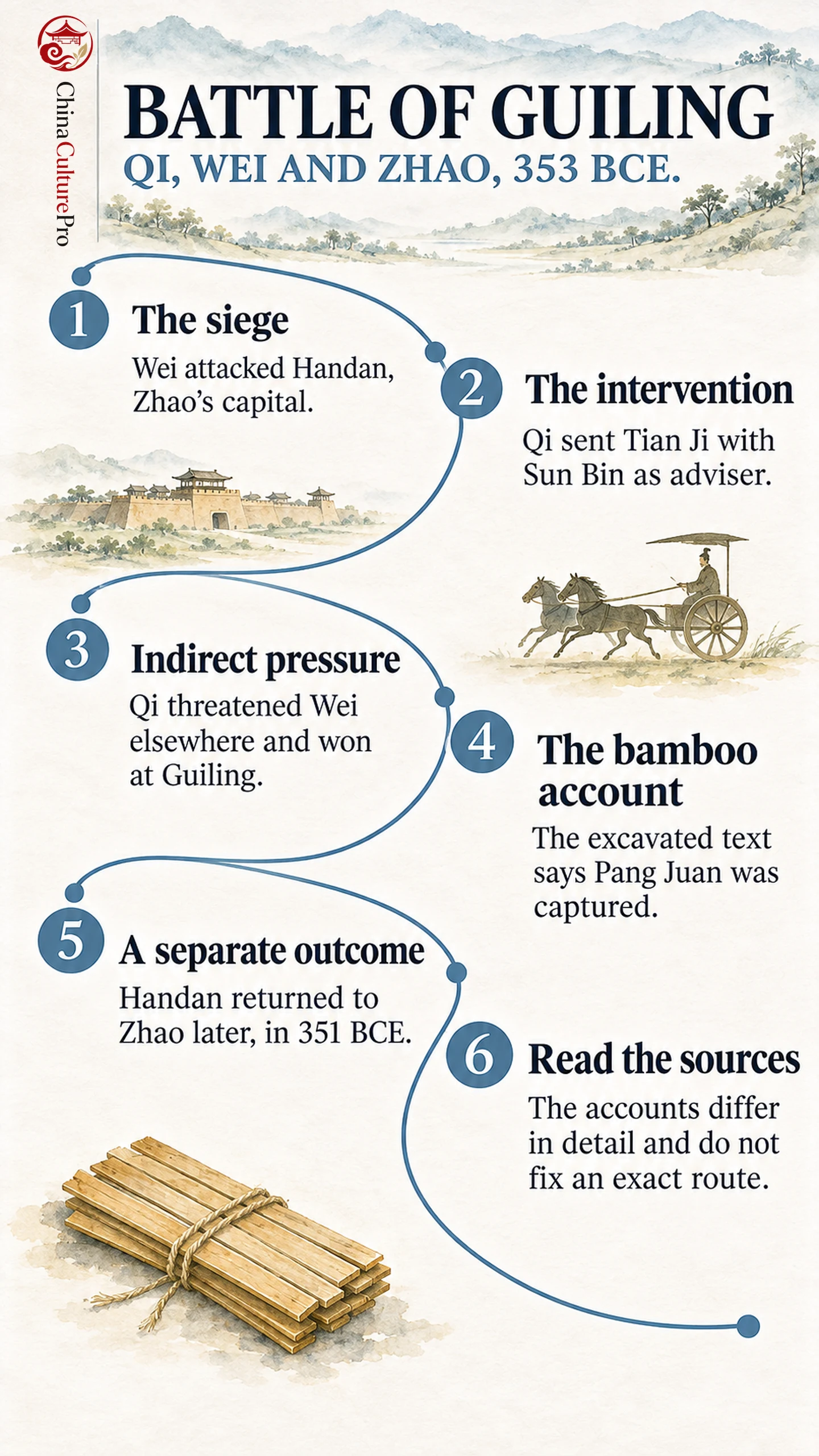
A relief campaign can change an enemy’s priorities without starting at the place under siege. That is the insight readers remember from Guiling. To see what the victory achieved, follow the army’s movement separately from the fate of the city.
Why Qi Intervened in the Siege of Handan
Wei’s siege of Handan is usually placed in 354 BCE, before the battle at Guiling the following year. Zhao appealed for help, and Qi sent an army led by Tian Ji (田忌, Tián Jì), with Sun Bin (孙膑, Sūn Bìn) advising him. The campaign took place during the Warring States period, when a threat to one capital could draw neighboring powers into a war. [1][3][4][5]
Qi’s choice was where to intervene. Relieving a siege by moving straight to the city could put a new army against Wei’s existing concentration. A move into territory that Wei needed to protect offered a way to make Wei shift its own forces. That is the choice the received biography uses to explain Sun Bin’s advice. [1]
How the Indirect Attack Worked
The Records of the Grand Historian (史记, Shǐjì) has Sun Bin advise Tian Ji to avoid a direct collision and threaten the less protected part of Wei. He proposed moving toward Daliang (大梁, Dàliáng), the Wei capital. The narrative says the Wei army then left the Handan area and met the Qi force at Guiling. [1]
The logic is captured by the expression “besiege Wei to rescue Zhao” (围魏救赵, wéi Wèi jiù Zhào). A force outside Handan threatened something Wei valued at home, creating a reason for its troops to move. The point of the phrase is the change in the opponent’s priorities. It does not show that Qi stormed Daliang or that Zhao recovered its capital that day. [1][3][5]
What the Bamboo Slips Add to the Historical Account
The Yinqueshan (银雀山, Yínquèshān) manuscript of Sun Bin’s Art of War (孙膑兵法, Sūn Bìn Bīngfǎ) preserves a fragmentary account of the campaign. It describes an operation at Pingling (平陵, Pínglíng) that made Qi appear less threatening, then a move toward Wei’s capital area with a light force. In the bamboo text, Pang Juan (庞涓, Páng Juān) leaves his baggage behind, moves quickly and is captured at Guiling. [2]
The slips were excavated from a Han tomb in 1972. The same discovery contained material associated with the military work traditionally attributed to Sun Wu as well as the text attributed to Sun Bin. That makes the excavated evidence especially important for separating the two bodies of writing. The tomb date does not make the slips an eyewitness record of Guiling. They preserve a version transmitted from an earlier period. [2][7]
Sima Qian’s chapter on the strategists does not say that Pang Juan was captured at Guiling. It places his death at Maling (马陵, Mǎlíng), in a later battle. A reader can ask whether the accounts could be reconciled, but neither passage gives a secure narrative of Pang Juan’s release. The reported capture in one source and death in the later battle in the other should retain their individual attributions. The bamboo copy has missing portions, and both texts are accounts of earlier events. [1][2]
The difference also changes how to describe the strategy. One account emphasizes pressure on a vulnerable point. The other adds deliberate signs of weakness and a commander leaving his baggage to move faster. The accounts agree that Qi intervened indirectly. They give different details about the route and the actions of the Wei commander. [1][2][6]
What the Victory Changed for Qi, Wei and Zhao
The Zhao annals record that Wei took Handan in the same regnal year that Qi beat Wei at Guiling. They record the city’s return in connection with an agreement between Zhao and Wei. In the usual chronology that return came in 351 BCE. That makes the immediate battle result different from the diplomatic result. [3][4]
The struggle also drew in states that had their own reasons to challenge Wei. The wider chronology places military pressure from Chu and Qin alongside Qi’s intervention. Wei nonetheless fought back against a coalition at Xiangling in 352 BCE, before returning Handan the next year. That sequence gives a clearer sense of Wei’s remaining strength than a simple ranking of winners and losers at Guiling. [4]
Wei retained enough strength to fight after Guiling, and Qi and Wei later met again. The battle demonstrated how Qi could disrupt Wei’s campaign, while the later settlement determined who held Handan. The distinction matters whenever the word “rescue” is used to describe the operation. [1][3][4]
FAQs About the Battle of Guiling
What does “besiege Wei to rescue Zhao” mean?
It means relieving pressure on Zhao by threatening Wei elsewhere. Guiling is the historical episode most often associated with the phrase. [1][5]
Where was the Battle of Guiling fought?
Ancient accounts name Guiling, but the exact modern location is disputed. Proposed identifications include the area west of Changyuan in Henan and an area near Heze in Shandong. [5][6]
Was Guiling the same battle as Maling?
No. Guiling was an earlier battle fought after Wei attacked Zhao. Maling was a later engagement, with a different sequence of operations and a different outcome for Pang Juan in the received history. [1][2]
Sources
[1] Sima Qian. Records of the Grand Historian, Chapter 65: Sunzi and Wu Qi
[2] Academia Sinica, Institute of History and Philology. Yinqueshan Han Tomb Bamboo Slips, Volume 1: Capturing Pang Juan
[3] Sima Qian. Records of the Grand Historian, Chapter 43: Hereditary House of Zhao
[4] Academia Sinica, Institute of History and Philology. Warfare in the Warring States Period
[5] Ministry of National Defense of China. Battle of Guiling
[6] Zhang Chi and Zheng Yifan. A Comparative Reading of Chapter 23 of the Tsinghua Xinian and the Shiji Chronological Tables
[7] Academy of Chinese Studies. Understanding the Two Sunzi Military Texts