

Quick Answer: What Happened at the Battle of Julu?
The Battle of Julu (巨鹿之战, Jùlù zhī zhàn) was a victory in 207 BCE for Xiang Yu (项羽, Xiàng Yǔ), who led a Chu (楚, Chǔ) force against the Qin (秦, Qín) army besieging Zhao (赵, Zhào) at Julu in what is now Hebei. The siege broke and the Qin commander Wang Li (王离, Wáng Lí) was captured. [1][2][3][4]
- The siege: Qin troops relied on a supply corridor to maintain pressure on the defenders.
- The relief: The Chu army crossed a river and attacked the Qin positions and supply system.
- The aftermath: Zhang Han (章邯, Zhāng Hán) remained in the field and surrendered later. [1][2][3]
Julu made Xiang Yu a leading commander in the revolt. Qin still had forces in the field after the siege ended. [1][2]
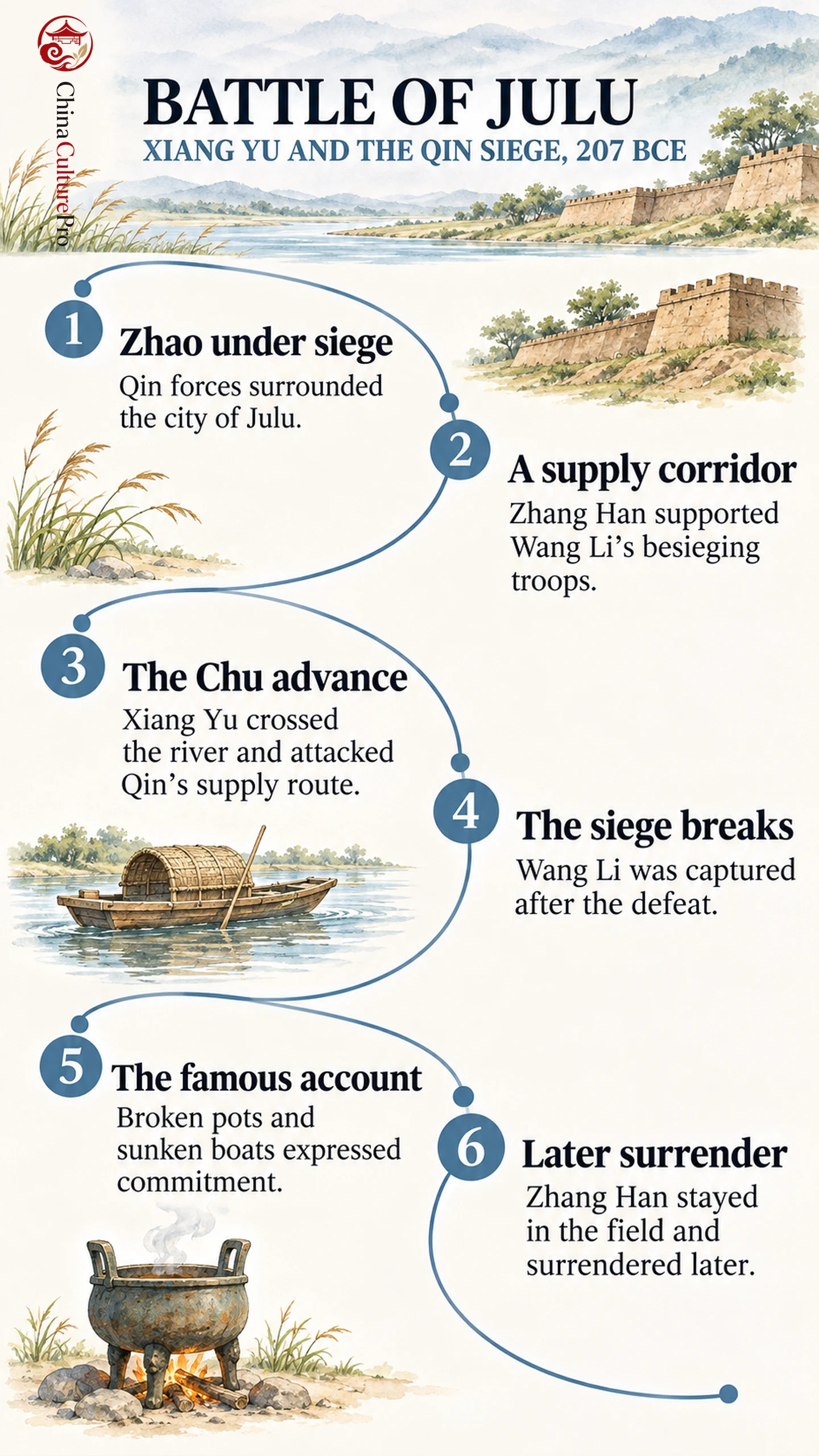
The story of broken cooking pots and sunken boats has come to stand for Julu. It describes the commitment of the army coming to relieve the siege. The outcome also depended on whether the army already surrounding the city could keep receiving food.
How Qin Put Zhao Under Siege
By the time of Julu, a rebellion against the Qin dynasty had produced several regional forces using the names of former states. Qin could still win campaigns. Zhang Han defeated a Chu army at Dingtao and then moved against Zhao. Zhao’s ruler and leading supporters took refuge at Julu, where Qin troops under Wang Li besieged them. [1][3][6]
Wang Li’s troops operated near the city. Zhang Han’s force remained separate and supported the siege from the south. The historical account describes a walled route for delivering grain to the force around the city. That division of labor let the siege continue, but it also gave the relief army a target away from the city walls. [1][3]
How Xiang Yu Broke the Siege
The Chu ruler initially sent Song Yi (宋义, Sòng Yì) as senior commander. The Records of the Grand Historian (史记, Shǐjì) describes a dispute over waiting while Qin and Zhao fought. Xiang Yu killed Song Yi and took command before moving on to relieve Zhao. The intervention was an attack on Qin under a different commander. [1][2]
The account describes an advance detachment crossing first, followed by the main Chu force. In the chapter about the Zhao leaders, attacks disrupted Zhang Han’s route for supplying Wang Li, whose troops ran short of food. The fighting around the city thus involved both the besieging force and the system that kept it in position. [1][3][4]
Relief forces from other regions were already nearby. Xiang Yu’s annals depict some of them waiting while Chu fought, then acknowledging his leadership after his victory. The Zhao narrative gives more space to the defenders and their strained relationship with troops outside the city. In that account, Zhang Er (张耳, Zhāng Ěr) pressed for help from Chen Yu (陈余, Chén Yú), who had troops outside Julu and hesitated to commit them against the stronger Qin force. Reading the two together helps separate the presence of relief armies from their actual entry into combat. [1][2][3]
What “Break the Cauldrons and Sink the Boats” Describes
The phrase “break the cauldrons and sink the boats” (破釜沉舟, pò fǔ chén zhōu) comes from the account of Xiang Yu after the crossing. The annals have him sink the boats, break cooking equipment and send his troops forward with three days of provisions. In later usage, the expression means committing to a course by removing the option of retreat. [1][4]
That detail belongs to a narrative about Xiang Yu’s leadership. A separate monthly table is more useful for distinguishing when the siege was lifted, when Wang Li was captured and when Zhang Han surrendered. The chapter on the Zhao leaders is useful for the pressure on the garrison and the supply route. Each record answers a different question. [1][2][3]
None of these three passages is a contemporary field report. They belong to different parts of the same historical work, assembled later from available traditions and records. Agreement across them is useful, while their different emphases show why the boat episode alone leaves out how the siege was broken. [1][2][3]
What Julu Changed and What Happened Later
With the siege broken, Qin lost the force that had been keeping Zhao trapped. Zhang Han nevertheless stayed in the field. Further fighting and exchanges with the Qin court preceded his surrender to Xiang Yu. The monthly table places that agreement well after the victory at Julu. In between, it records another attack on Zhang Han’s army and an appeal for support at the Qin court. Those intervening entries explain why the siege relief and the surrender belong to different stages. Even without converting the month names to a modern calendar, their order is clear. [1][2]
A separate campaign brought down the Qin court. Liu Bang (刘邦, Liú Bāng) advanced toward the Qin heartland while Xiang Yu fought in the north. The end of Qin then opened a new struggle between the victors, out of which Liu Bang founded the Han dynasty. Julu helps explain how Xiang Yu acquired the military authority to enter that struggle. [1][2][6]
FAQs About the Battle of Julu
Where did the Battle of Julu take place?
It took place around the ancient city of Julu in what is now Hebei. Historical geography identifies the besieged city with the Pingxiang area. The ancient locality and present-day county boundaries should be distinguished. [4][5]
Did Zhang Han surrender during the battle?
No. The siege was broken first and Wang Li was captured. Zhang Han continued to fight before surrendering later in the campaign. [1][2]
Did Liu Bang lead the victory at Julu?
Xiang Yu led the Chu army at Julu. Liu Bang was fighting on a separate line of advance toward the Qin heartland. [1][2][6]
Sources
[1] Sima Qian. Records of the Grand Historian, Chapter 7: Basic Annals of Xiang Yu
[2] Sima Qian. Records of the Grand Historian, Chapter 16: Monthly Table of Qin and Chu
[3] Sima Qian. Records of the Grand Historian, Chapter 89: Zhang Er and Chen Yu
[4] Julu County Government. Battle of Julu
[5] Fudan University, Chinese Historical Gazetteer. Julu Historical Place Record
[6] Michael Puett. The Ambivalence of Creation